Risks surrounding the Iranian situation offset pessimistic EIA forecasts, causing Brent crude oil prices to rise by approximately 4%.
2026-02-19 01:45:36
Recently, international oil prices have shown a trend of "geopolitical support offsetting pessimistic expectations," with Brent crude rising by about 4%. Despite the EIA's (U.S. Energy Information Administration) downward-looking forecasts, oil prices have firmly held above the support level of $69 per barrel. The core logic behind the current oil price movement is that escalating geopolitical risks have become the main driver of the rebound, offsetting pessimistic expectations on the supply and demand front. Brent crude is currently consolidating above $69, and if supply concerns escalate further, there is still a clear upside risk. This article will systematically analyze the current oil price trend and key influencing factors from the perspectives of core drivers, macroeconomic background, fundamentals, technical analysis, position risks, and future conclusions.

The recent intense battle between bulls and bears in the crude oil market, coupled with a concentrated escalation of geopolitical risks, has provided a strong immediate catalyst, effectively maintaining a geopolitical risk premium and becoming the core force driving the oil price rebound and offsetting pessimistic EIA expectations. This can be divided into three main dimensions, all revolving around the core logic of "supply concerns":
(I) Iranian military exercises as a deterrent: Reassessment of the risk premium in the Strait of Hormuz
Iran's brief closure of part of the Strait of Hormuz during a naval exercise was interpreted by the market as a strong signal of pressure on the United States. Although the closure was only for an exercise and did not cause any substantial supply disruption, the Strait of Hormuz is a vital choke point for global oil transportation, with approximately 16.7 million barrels of crude oil passing through it daily. Any disruption to this passage will directly impact oil prices, thus triggering high market vigilance.
From a strategic perspective, Iran's military exercises are a tactical move to counter US military pressure and strengthen its negotiating leverage. With 65% of its fiscal revenue dependent on oil exports, a complete blockade of the Strait would be "economic suicide" for Iran. Therefore, it prefers "controlled pressure" (temporary closure, military exercises as a deterrent), both sending a counter-measure signal and gaining the initiative in negotiations, while preventing the situation from spiraling out of control. Even so, this deterrence has triggered market panic about supply disruptions, pushing up geopolitical risk premiums and becoming a significant driver of the oil price rebound. Analysts warn that if such actions are repeated or escalate, they could trigger a 15%-20% "war premium" in international oil prices, and the current rebound already includes an initial reassessment of this risk.
(II) Escalation of US-Iran Standoff: US Retains Military Strike Option, Exacerbating Market Tensions
US Vice President JD Vance issued a strong statement, clarifying that Iran had not met the US's "red line" demands and that the US would retain the option of military strike. Following this statement, oil prices jumped, with WTI crude rising to $64.32 per barrel and Brent crude rising to $69.46 per barrel, further solidifying the key support level of $69.
This statement stands in stark contrast to the progress of the Geneva nuclear talks: although there has been some progress in the US-Iran nuclear talks, the core differences remain unresolved. While the US is pushing forward with negotiations, it is also sending two carrier strike groups to the Middle East to exert pressure. Iran is responding with military exercises and deterrence in the Strait of Hormuz. The standoff between the two sides continues to escalate, and market sentiment has shifted from cautious to tense, further pushing up the geopolitical risk premium, which, together with Iran's military exercises, forms a "double catalyst".
(III) Breakdown in Russia-Ukraine Talks: Renewed Concerns About Russian Supply
Peace talks between Russia and Ukraine in Geneva collapsed after only two hours, with Ukrainian President Zelenskiy accusing Russia of delaying the process. This breakdown has reignited market concerns about limited Russian oil supplies: Russian oil exports have long been hampered by Western sanctions and pipeline transportation issues. The failure to reach an agreement means there is no hope for de-escalation, and the risk of further sanctions and supply disruptions is increasing.
Historical experience shows that a deterioration in the Russia-Ukraine situation inevitably triggers global oil supply panic. Even without substantial disruption, it injects a short-term risk premium, which has also contributed to the current oil price rebound. It should be noted that the market has partially absorbed the impact of sanctions after the conflict became protracted, and Russia maintains a certain level of exports through its "shadow fleet." Therefore, the strength of this support for oil prices still depends on the subsequent development of the situation.
The current oil price trend is consistent with the typical range-bound pattern in the recent commodity cycle. The core game lies in the balance between "geopolitically driven supply-side support" and "EIA-driven long-term bearish expectations," without any logical break.
From a macro perspective, the interplay of geopolitical risks, inventory changes, and long-term demand expectations is the core driving factor for oil prices. The EIA reiterated its bearish outlook for long-term oil prices, reflecting market concerns about supply-demand balance and demand resilience. However, there is currently no clear demand shock, and the aforementioned triple geopolitical risks have effectively offset this pessimistic sentiment, limiting the downward momentum of oil prices.
This interplay of "structural support (geopolitical) + long-term caution (EIA)" is a typical characteristic of the late stages of a commodity cycle—the market typically narrows its trading range before clarifying its direction. The current concentrated outbreak of geopolitical risks is the key variable that breaks this balance: an escalation of the standoff or a substantial supply disruption could push oil prices above their current range; conversely, as geopolitical risks subside, pessimistic EIA expectations will once again dominate the market, driving oil prices down.
From a fundamental perspective, geopolitical uncertainty is the core source of intermittent support for the oil market, and the three geopolitical dynamics mentioned above further strengthen this support. Among them, the US-Iran standoff in the Middle East, the threat from the Strait of Hormuz, and the vulnerability of Russian supply caused by the breakdown of Russia-Ukraine negotiations have significantly increased market vigilance against supply disruptions, preserving a stability risk premium for oil prices.
Furthermore, stronger tanker freight rates and shipping signals indicate that the current physical crude oil supply is tight, making it difficult for inventories to accumulate rapidly. This environment is generally conducive to stabilizing oil prices (not a trend reversal). The risk of unusual activity in the Strait of Hormuz deserves particular attention: institutions predict that if the strait were effectively blocked, benchmark oil prices could surge to $120-130 per barrel within 24 hours, and in extreme scenarios, exceed $150-200 per barrel. The current brief closure has already released some of the panic.
It should be clarified that the EIA's medium-term bearish forecast still exerts downward pressure on oil prices: if subsequent data confirms this forecast and there are no new supply disruptions (such as Iran continuing to block the Strait of Hormuz, or the escalation of the Russia-Ukraine conflict leading to a sharp reduction in Russian supply), the upward momentum of oil prices will gradually weaken.
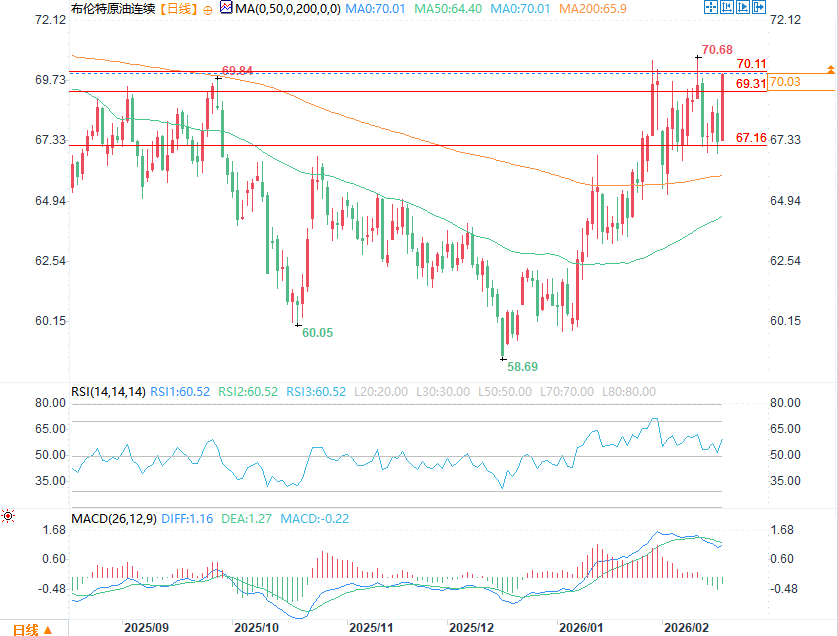
(Brent crude oil daily chart source: FX678)
From a technical perspective, the key focus is on the Brent crude oil price level of $69/barrel—this level is both a recent key breakout point and a crucial support level. Driven by strong statements from the US, Brent crude oil rose to $69.98/barrel in the past four hours, successfully holding above the support level, strengthening the short-term bullish technical structure.
The current technical logic is clear: as long as oil prices hold above the $69 level, the short-term structure remains positive. The continuously rising lows indicate that the bears have not fully taken control of the market, and a geopolitically driven rebound is expected to push oil prices to test higher levels.
The directional judgment is clear: an upward move requires new geopolitical catalysts (escalation of the US-Iran standoff, expansion of the Russia-Ukraine conflict, and the re-closure of the Strait of Hormuz) or improved demand expectations to move towards the $74-76/barrel range; a downward move would break the consolidation logic of the range if the price effectively falls below $69/barrel, and oil prices would face a deeper correction, or even start a new round of decline.
The current short-term trend for crude oil is likely to be "range-bound with a slight upward bias," with geopolitical risks as the core variable further reinforcing the upward trend. Although long-term expectations are bearish, the market has shown strong resilience. This phenomenon usually stems from a reasonable position structure or the intrinsic support provided by geopolitical risk premiums, consistent with the bullish-bearish game logic mentioned earlier.
(a) Baseline Scenario Prediction
In the coming weeks, Brent crude oil is likely to find support above $69/barrel; if geopolitical tensions such as the US-Iran standoff and the Russia-Ukraine conflict continue, oil prices may test the $75/barrel range; if Iran's actions to block the Strait of Hormuz are repeated or escalate, and the US launches a military strike, oil prices may see a 15%-20% "war premium," breaking through the previous trading range.
(II) Key Risk Warnings
Downside risks mainly fall into three categories: first, a clear signal of supply growth exceeding expectations coupled with weak demand; second, a breakthrough in the US-Iran nuclear talks and an easing of the Russia-Ukraine situation, leading to a rapid decline in geopolitical risk premiums; and third, oil prices effectively breaking below the $69/barrel support level (an early signal of a market shift towards a more pessimistic outlook).
Volatility risk warrants close attention: Oil prices are currently in a narrowing range, and any catalyst, such as geopolitical escalation or better-than-expected EIA data, could trigger sharp directional movements. At present, geopolitical risks are escalating, and we are at a critical juncture of rising volatility.
Overall, oil prices are currently maintaining a delicate balance between geopolitical support and bearish long-term expectations. The three geopolitical dynamics of Iran's brief blockade of the Strait of Hormuz, the US retaining the option of military strikes, and the breakdown of Russia-Ukraine negotiations are the core forces driving the oil price rebound and offsetting the pessimistic expectations of the EIA. The fact that oil prices have stabilized above $69 confirms that the market is in a consolidation phase rather than a continuous downward trend.
We maintain a "cautiously bullish" outlook for the short-term trend, with the range-bound trading pattern likely to continue. Geopolitical risks remain the key to breaking the balance—unless there is a major demand shock or a substantial supply disruption driven by geopolitics, the range-bound pattern is unlikely to break decisively.
The key areas to watch in the market going forward are clear: first, the situation in the Middle East (US-Iran standoff, developments in the Strait of Hormuz); second, the latest EIA data and adjustments to long-term forecasts; and third, the subsequent developments in the Russia-Ukraine situation, while also paying attention to changes in US statements and military deployments. These factors will collectively determine the next round of crude oil price movements: whether it will rise to the $75/barrel range or fall below the $69 support level and begin a correction.
I. Core Driver: Triple Geopolitical Risks Erupt Concentrated, Supporting Oil Price Rebound
The recent intense battle between bulls and bears in the crude oil market, coupled with a concentrated escalation of geopolitical risks, has provided a strong immediate catalyst, effectively maintaining a geopolitical risk premium and becoming the core force driving the oil price rebound and offsetting pessimistic EIA expectations. This can be divided into three main dimensions, all revolving around the core logic of "supply concerns":
(I) Iranian military exercises as a deterrent: Reassessment of the risk premium in the Strait of Hormuz
Iran's brief closure of part of the Strait of Hormuz during a naval exercise was interpreted by the market as a strong signal of pressure on the United States. Although the closure was only for an exercise and did not cause any substantial supply disruption, the Strait of Hormuz is a vital choke point for global oil transportation, with approximately 16.7 million barrels of crude oil passing through it daily. Any disruption to this passage will directly impact oil prices, thus triggering high market vigilance.
From a strategic perspective, Iran's military exercises are a tactical move to counter US military pressure and strengthen its negotiating leverage. With 65% of its fiscal revenue dependent on oil exports, a complete blockade of the Strait would be "economic suicide" for Iran. Therefore, it prefers "controlled pressure" (temporary closure, military exercises as a deterrent), both sending a counter-measure signal and gaining the initiative in negotiations, while preventing the situation from spiraling out of control. Even so, this deterrence has triggered market panic about supply disruptions, pushing up geopolitical risk premiums and becoming a significant driver of the oil price rebound. Analysts warn that if such actions are repeated or escalate, they could trigger a 15%-20% "war premium" in international oil prices, and the current rebound already includes an initial reassessment of this risk.
(II) Escalation of US-Iran Standoff: US Retains Military Strike Option, Exacerbating Market Tensions
US Vice President JD Vance issued a strong statement, clarifying that Iran had not met the US's "red line" demands and that the US would retain the option of military strike. Following this statement, oil prices jumped, with WTI crude rising to $64.32 per barrel and Brent crude rising to $69.46 per barrel, further solidifying the key support level of $69.
This statement stands in stark contrast to the progress of the Geneva nuclear talks: although there has been some progress in the US-Iran nuclear talks, the core differences remain unresolved. While the US is pushing forward with negotiations, it is also sending two carrier strike groups to the Middle East to exert pressure. Iran is responding with military exercises and deterrence in the Strait of Hormuz. The standoff between the two sides continues to escalate, and market sentiment has shifted from cautious to tense, further pushing up the geopolitical risk premium, which, together with Iran's military exercises, forms a "double catalyst".
(III) Breakdown in Russia-Ukraine Talks: Renewed Concerns About Russian Supply
Peace talks between Russia and Ukraine in Geneva collapsed after only two hours, with Ukrainian President Zelenskiy accusing Russia of delaying the process. This breakdown has reignited market concerns about limited Russian oil supplies: Russian oil exports have long been hampered by Western sanctions and pipeline transportation issues. The failure to reach an agreement means there is no hope for de-escalation, and the risk of further sanctions and supply disruptions is increasing.
Historical experience shows that a deterioration in the Russia-Ukraine situation inevitably triggers global oil supply panic. Even without substantial disruption, it injects a short-term risk premium, which has also contributed to the current oil price rebound. It should be noted that the market has partially absorbed the impact of sanctions after the conflict became protracted, and Russia maintains a certain level of exports through its "shadow fleet." Therefore, the strength of this support for oil prices still depends on the subsequent development of the situation.
II. Macroeconomic Background: The interplay between bulls and bears is becoming increasingly apparent, with structural support and long-term caution coexisting.
The current oil price trend is consistent with the typical range-bound pattern in the recent commodity cycle. The core game lies in the balance between "geopolitically driven supply-side support" and "EIA-driven long-term bearish expectations," without any logical break.
From a macro perspective, the interplay of geopolitical risks, inventory changes, and long-term demand expectations is the core driving factor for oil prices. The EIA reiterated its bearish outlook for long-term oil prices, reflecting market concerns about supply-demand balance and demand resilience. However, there is currently no clear demand shock, and the aforementioned triple geopolitical risks have effectively offset this pessimistic sentiment, limiting the downward momentum of oil prices.
This interplay of "structural support (geopolitical) + long-term caution (EIA)" is a typical characteristic of the late stages of a commodity cycle—the market typically narrows its trading range before clarifying its direction. The current concentrated outbreak of geopolitical risks is the key variable that breaks this balance: an escalation of the standoff or a substantial supply disruption could push oil prices above their current range; conversely, as geopolitical risks subside, pessimistic EIA expectations will once again dominate the market, driving oil prices down.
III. Supply and Inventory: Geopolitical uncertainty dominates, while tight physical logistics provide support.
From a fundamental perspective, geopolitical uncertainty is the core source of intermittent support for the oil market, and the three geopolitical dynamics mentioned above further strengthen this support. Among them, the US-Iran standoff in the Middle East, the threat from the Strait of Hormuz, and the vulnerability of Russian supply caused by the breakdown of Russia-Ukraine negotiations have significantly increased market vigilance against supply disruptions, preserving a stability risk premium for oil prices.
Furthermore, stronger tanker freight rates and shipping signals indicate that the current physical crude oil supply is tight, making it difficult for inventories to accumulate rapidly. This environment is generally conducive to stabilizing oil prices (not a trend reversal). The risk of unusual activity in the Strait of Hormuz deserves particular attention: institutions predict that if the strait were effectively blocked, benchmark oil prices could surge to $120-130 per barrel within 24 hours, and in extreme scenarios, exceed $150-200 per barrel. The current brief closure has already released some of the panic.
It should be clarified that the EIA's medium-term bearish forecast still exerts downward pressure on oil prices: if subsequent data confirms this forecast and there are no new supply disruptions (such as Iran continuing to block the Strait of Hormuz, or the escalation of the Russia-Ukraine conflict leading to a sharp reduction in Russian supply), the upward momentum of oil prices will gradually weaken.
IV. Technical Structure: $69 becomes a key support/resistance level, with a short-term bullish bias emerging.
(Brent crude oil daily chart source: FX678)
From a technical perspective, the key focus is on the Brent crude oil price level of $69/barrel—this level is both a recent key breakout point and a crucial support level. Driven by strong statements from the US, Brent crude oil rose to $69.98/barrel in the past four hours, successfully holding above the support level, strengthening the short-term bullish technical structure.
The current technical logic is clear: as long as oil prices hold above the $69 level, the short-term structure remains positive. The continuously rising lows indicate that the bears have not fully taken control of the market, and a geopolitically driven rebound is expected to push oil prices to test higher levels.
The directional judgment is clear: an upward move requires new geopolitical catalysts (escalation of the US-Iran standoff, expansion of the Russia-Ukraine conflict, and the re-closure of the Strait of Hormuz) or improved demand expectations to move towards the $74-76/barrel range; a downward move would break the consolidation logic of the range if the price effectively falls below $69/barrel, and oil prices would face a deeper correction, or even start a new round of decline.
V. Positions and Risks: Short-term bias is bullish, but volatility should be monitored; the core variable remains geopolitical.
The current short-term trend for crude oil is likely to be "range-bound with a slight upward bias," with geopolitical risks as the core variable further reinforcing the upward trend. Although long-term expectations are bearish, the market has shown strong resilience. This phenomenon usually stems from a reasonable position structure or the intrinsic support provided by geopolitical risk premiums, consistent with the bullish-bearish game logic mentioned earlier.
(a) Baseline Scenario Prediction
In the coming weeks, Brent crude oil is likely to find support above $69/barrel; if geopolitical tensions such as the US-Iran standoff and the Russia-Ukraine conflict continue, oil prices may test the $75/barrel range; if Iran's actions to block the Strait of Hormuz are repeated or escalate, and the US launches a military strike, oil prices may see a 15%-20% "war premium," breaking through the previous trading range.
(II) Key Risk Warnings
Downside risks mainly fall into three categories: first, a clear signal of supply growth exceeding expectations coupled with weak demand; second, a breakthrough in the US-Iran nuclear talks and an easing of the Russia-Ukraine situation, leading to a rapid decline in geopolitical risk premiums; and third, oil prices effectively breaking below the $69/barrel support level (an early signal of a market shift towards a more pessimistic outlook).
Volatility risk warrants close attention: Oil prices are currently in a narrowing range, and any catalyst, such as geopolitical escalation or better-than-expected EIA data, could trigger sharp directional movements. At present, geopolitical risks are escalating, and we are at a critical juncture of rising volatility.
VI. Conclusion and Market Outlook
Overall, oil prices are currently maintaining a delicate balance between geopolitical support and bearish long-term expectations. The three geopolitical dynamics of Iran's brief blockade of the Strait of Hormuz, the US retaining the option of military strikes, and the breakdown of Russia-Ukraine negotiations are the core forces driving the oil price rebound and offsetting the pessimistic expectations of the EIA. The fact that oil prices have stabilized above $69 confirms that the market is in a consolidation phase rather than a continuous downward trend.
We maintain a "cautiously bullish" outlook for the short-term trend, with the range-bound trading pattern likely to continue. Geopolitical risks remain the key to breaking the balance—unless there is a major demand shock or a substantial supply disruption driven by geopolitics, the range-bound pattern is unlikely to break decisively.
The key areas to watch in the market going forward are clear: first, the situation in the Middle East (US-Iran standoff, developments in the Strait of Hormuz); second, the latest EIA data and adjustments to long-term forecasts; and third, the subsequent developments in the Russia-Ukraine situation, while also paying attention to changes in US statements and military deployments. These factors will collectively determine the next round of crude oil price movements: whether it will rise to the $75/barrel range or fall below the $69 support level and begin a correction.
- Risk Warning and Disclaimer
- The market involves risk, and trading may not be suitable for all investors. This article is for reference only and does not constitute personal investment advice, nor does it take into account certain users’ specific investment objectives, financial situation, or other needs. Any investment decisions made based on this information are at your own risk.