The Federal Reserve stands at a crossroads: Minutes reveal internal divisions, could the dollar usher in a new surge?
2026-02-19 09:57:59
The minutes of the Fed's January meeting revealed a clear division among Fed officials regarding the path of interest rates: most supported holding rates steady for now, while some even considered the possibility of raising rates, with a plan to only resume rate cuts once inflation clearly declines.
The minutes of the Federal Open Market Committee (FOMC) meeting held on January 27-28 were released on Wednesday (February 18). The minutes showed that Fed officials largely reached a consensus on maintaining the benchmark interest rate, but were severely divided on the future policy direction: on one side were hawkish voices advocating for continued efforts to combat inflation, and on the other side were dovish views concerned about the job market and inclined towards further easing .
The meeting decided to maintain the target range for the federal funds rate at 3.5%-3.75%, marking the first pause since three consecutive rate cuts (totaling 75 basis points) in September, October, and December 2025. The vote was 10-2, with two governors—Milan and Waller—voting against the cut, advocating for a further 25 basis point reduction.
The minutes used expressions such as "several," "some," "a number," and even the rare "a vast majority" to highlight the depth of the disagreement.
Some participants believe that if inflation continues to decline as expected, further interest rate cuts would be appropriate.
Some participants argued that policy rates should remain unchanged for a period of time, with a careful assessment of subsequent data; many of them judged that no further easing was necessary unless there was clear evidence that the de-inflation process had stabilized again.
Several participants even suggested that the post-meeting statement should adopt a more balanced "two-way" approach, explicitly acknowledging that raising the target range for the federal funds rate might be appropriate if inflation continues to exceed the target. While this suggestion was not adopted, it reflects that some officials have brought interest rate hikes back into the discussion.
Participants generally expect inflation to gradually decline in 2026, but the speed and pace of this decline remain highly uncertain. Most officials warned that the de-inflation process may be slower and more uneven than anticipated, and the risk of inflation remaining above the 2% target for an extended period "deserves attention." They specifically mentioned the price-pushing effect of tariffs, but believed this impact would gradually diminish within the year.
Recent data presents contradictory signals: January's core CPI (excluding food and energy) hit a near five-year low, but the Fed's preferred PCE price index still hovers around 3%; in the labor market, non-farm payrolls grew faster than expected, and the unemployment rate remained at 4.4%, but private sector job creation slowed significantly and was mainly dependent on the healthcare industry.
This meeting marks the first since the change of presidents in some regions. Dallas Fed President Lorie Logan and Cleveland Fed President Beth Hammack have publicly stated their support for maintaining the status quo in the long term, viewing inflation as the primary threat at present.
Furthermore, the market is closely watching the transition process for the Federal Reserve Chair. Current Chair Jerome Powell's term will end in May, and Trump has nominated former Fed Governor Warsh to succeed him (pending Senate confirmation). Warsh has historically favored a lower interest rate stance and is close to current governors Milan and Waller. If he takes office, the dovish forces within the Fed may further strengthen, but current meeting minutes show a resurgence of hawkish voices, potentially exacerbating divisions.
Theoretical analysis was ultimately reflected in actual market movements. The foreign exchange market reacted extremely quickly after the release of the minutes. After the content regarding "discussions on interest rate hikes" and "cautious interest rate cuts" in the minutes was digested, the US dollar index continued to climb. On Wednesday, the US dollar index rose 0.62%, and during Thursday's Asian session, it fluctuated narrowly around 97.70, briefly touching a two-week high of 97.73.
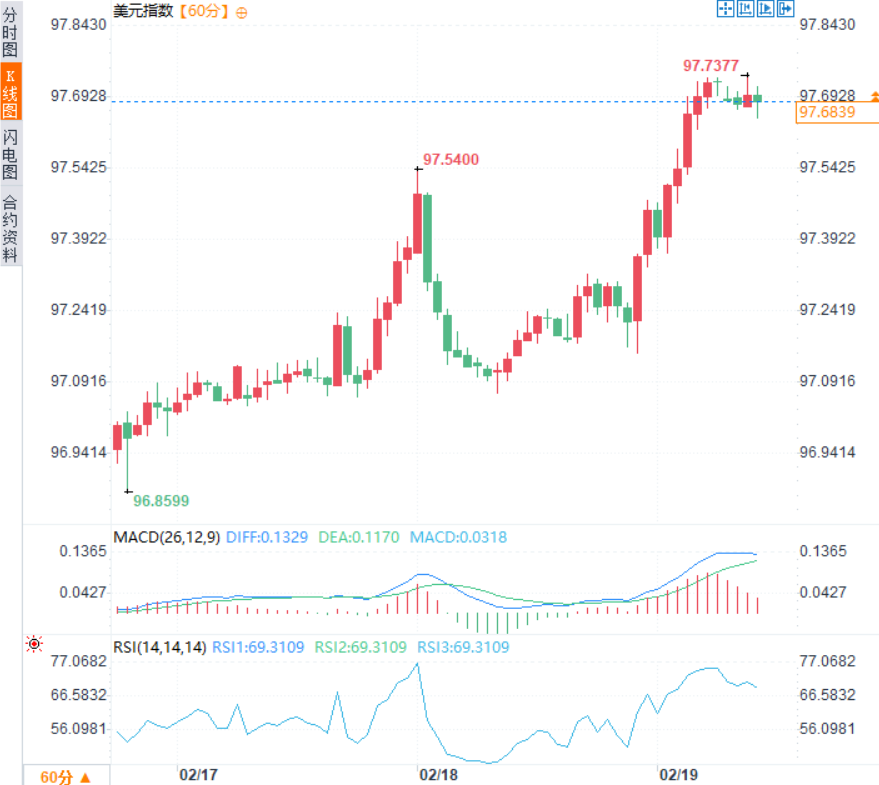
(US Dollar Index hourly chart, source: FX678)
According to the CME FedWatch tool, futures traders are currently most likely betting on a June rate cut, followed by September or October. In the short term, the Federal Reserve is likely to continue its wait-and-see approach, with its data-dependent decision-making becoming more prominent.
Overall, the January meeting minutes reveal that the Federal Reserve is at a critical crossroads: whether the decline in inflation is sustainable, whether the labor market is truly stable, and the impact of external policies (such as tariffs) will all be key variables in determining whether and when to restart interest rate cuts this year. Against this backdrop, the Fed's "cautious wait-and-see" stance is expected to continue at least until mid-year.
At 9:56 AM Beijing time, the US dollar index is currently at 97.67.
The Federal Reserve is increasingly divided on the direction of monetary policy.
The minutes of the Federal Open Market Committee (FOMC) meeting held on January 27-28 were released on Wednesday (February 18). The minutes showed that Fed officials largely reached a consensus on maintaining the benchmark interest rate, but were severely divided on the future policy direction: on one side were hawkish voices advocating for continued efforts to combat inflation, and on the other side were dovish views concerned about the job market and inclined towards further easing .
The meeting decided to maintain the target range for the federal funds rate at 3.5%-3.75%, marking the first pause since three consecutive rate cuts (totaling 75 basis points) in September, October, and December 2025. The vote was 10-2, with two governors—Milan and Waller—voting against the cut, advocating for a further 25 basis point reduction.
Officials' views are becoming increasingly polarized.
The minutes used expressions such as "several," "some," "a number," and even the rare "a vast majority" to highlight the depth of the disagreement.
Some participants believe that if inflation continues to decline as expected, further interest rate cuts would be appropriate.
Some participants argued that policy rates should remain unchanged for a period of time, with a careful assessment of subsequent data; many of them judged that no further easing was necessary unless there was clear evidence that the de-inflation process had stabilized again.
Several participants even suggested that the post-meeting statement should adopt a more balanced "two-way" approach, explicitly acknowledging that raising the target range for the federal funds rate might be appropriate if inflation continues to exceed the target. While this suggestion was not adopted, it reflects that some officials have brought interest rate hikes back into the discussion.
Inflation expectations and risk assessments are becoming more cautious.
Participants generally expect inflation to gradually decline in 2026, but the speed and pace of this decline remain highly uncertain. Most officials warned that the de-inflation process may be slower and more uneven than anticipated, and the risk of inflation remaining above the 2% target for an extended period "deserves attention." They specifically mentioned the price-pushing effect of tariffs, but believed this impact would gradually diminish within the year.
Recent data presents contradictory signals: January's core CPI (excluding food and energy) hit a near five-year low, but the Fed's preferred PCE price index still hovers around 3%; in the labor market, non-farm payrolls grew faster than expected, and the unemployment rate remained at 4.4%, but private sector job creation slowed significantly and was mainly dependent on the healthcare industry.
The change of former presidents of some regional Federal Reserve Banks adds uncertainty.
This meeting marks the first since the change of presidents in some regions. Dallas Fed President Lorie Logan and Cleveland Fed President Beth Hammack have publicly stated their support for maintaining the status quo in the long term, viewing inflation as the primary threat at present.
Furthermore, the market is closely watching the transition process for the Federal Reserve Chair. Current Chair Jerome Powell's term will end in May, and Trump has nominated former Fed Governor Warsh to succeed him (pending Senate confirmation). Warsh has historically favored a lower interest rate stance and is close to current governors Milan and Waller. If he takes office, the dovish forces within the Fed may further strengthen, but current meeting minutes show a resurgence of hawkish voices, potentially exacerbating divisions.
Market reaction
Theoretical analysis was ultimately reflected in actual market movements. The foreign exchange market reacted extremely quickly after the release of the minutes. After the content regarding "discussions on interest rate hikes" and "cautious interest rate cuts" in the minutes was digested, the US dollar index continued to climb. On Wednesday, the US dollar index rose 0.62%, and during Thursday's Asian session, it fluctuated narrowly around 97.70, briefly touching a two-week high of 97.73.
(US Dollar Index hourly chart, source: FX678)
Market Pricing and Outlook
According to the CME FedWatch tool, futures traders are currently most likely betting on a June rate cut, followed by September or October. In the short term, the Federal Reserve is likely to continue its wait-and-see approach, with its data-dependent decision-making becoming more prominent.
Overall, the January meeting minutes reveal that the Federal Reserve is at a critical crossroads: whether the decline in inflation is sustainable, whether the labor market is truly stable, and the impact of external policies (such as tariffs) will all be key variables in determining whether and when to restart interest rate cuts this year. Against this backdrop, the Fed's "cautious wait-and-see" stance is expected to continue at least until mid-year.
At 9:56 AM Beijing time, the US dollar index is currently at 97.67.
- Risk Warning and Disclaimer
- The market involves risk, and trading may not be suitable for all investors. This article is for reference only and does not constitute personal investment advice, nor does it take into account certain users’ specific investment objectives, financial situation, or other needs. Any investment decisions made based on this information are at your own risk.