The US dollar index is nearing the 98 mark, awaiting the release of GDP data.
2026-02-20 11:14:03
The US dollar index remained stable in Asian trading, hovering around 98.00. The minutes of the Federal Reserve's January meeting, released earlier, revealed disagreements among policymakers regarding the interest rate outlook.
Some officials believe that if inflation falls less than expected, raising interest rates should remain an option, and argue that policy statements should provide “more two-way” guidance.
This statement was interpreted by the market as a hawkish signal, providing a temporary boost to the US dollar. US labor market data also strengthened the dollar's support.
Data shows that the number of initial jobless claims for the week ending February 14 fell to 206,000, significantly lower than the market expectation of 225,000 and also lower than the previous value, reflecting the continued resilience of the job market.
In terms of official remarks, Minneapolis Fed President Neel Kashkari said the labor market is “quite resilient” and the Fed is approaching its dual mandate of maximum employment and price stability.
San Francisco Fed President Mary Daly noted that current monetary policy is in a "good position." Overall, officials' rhetoric has not been in a hurry to shift towards easing. The market will now focus on the preliminary US fourth-quarter GDP figures and the core PCE price index.
If economic growth remains robust and inflation remains sticky, the US dollar may continue its strong performance; conversely, if data weakens, it could reduce market expectations for the duration of high interest rates, thus putting pressure on the dollar.
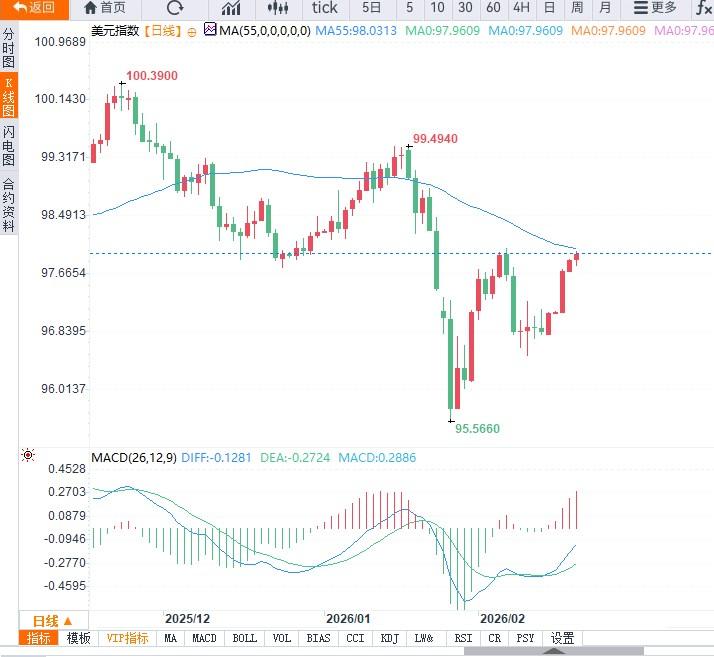
From the daily chart, the US dollar index has recently rebounded from its lows and is approaching the 98.00 level again. Short-term moving averages are starting to turn upwards, and the price is trading above the 20-day moving average, indicating a bullish short-term trend.
If the 98.20 resistance level is broken, the upside potential could target the 99.00 area. The MACD indicator is near the zero line, with the fast and slow lines showing an early golden cross pattern and the momentum bars gradually increasing, suggesting strengthening bullish momentum.
The RSI remains above 55 and has not yet entered overbought territory, indicating that the upward momentum still has room to continue. However, if GDP and PCE data fall short of expectations, the US dollar index may retrace to the support level around 97.30.
If this level is breached, the index may test the 96.80 area further. The overall structure suggests that the index is more likely to maintain a slightly bullish, oscillating pattern before the release of key data.
Editor's Note:
The current rebound in the US dollar index is largely due to the combined effect of resilient data and hawkish policy expectations. In the short term, as long as US economic data remains robust, the downside potential of the dollar will be limited.
However, the true determinants of the trend remain the inflation path and changes in interest rate expectations. If the core PCE figure is higher than expected tonight, the US dollar index is likely to break through the 98 mark and move towards 99.00; if the data is weak, it may trigger profit-taking and return to range-bound trading.
Some officials believe that if inflation falls less than expected, raising interest rates should remain an option, and argue that policy statements should provide “more two-way” guidance.
This statement was interpreted by the market as a hawkish signal, providing a temporary boost to the US dollar. US labor market data also strengthened the dollar's support.
Data shows that the number of initial jobless claims for the week ending February 14 fell to 206,000, significantly lower than the market expectation of 225,000 and also lower than the previous value, reflecting the continued resilience of the job market.
In terms of official remarks, Minneapolis Fed President Neel Kashkari said the labor market is “quite resilient” and the Fed is approaching its dual mandate of maximum employment and price stability.
San Francisco Fed President Mary Daly noted that current monetary policy is in a "good position." Overall, officials' rhetoric has not been in a hurry to shift towards easing. The market will now focus on the preliminary US fourth-quarter GDP figures and the core PCE price index.
If economic growth remains robust and inflation remains sticky, the US dollar may continue its strong performance; conversely, if data weakens, it could reduce market expectations for the duration of high interest rates, thus putting pressure on the dollar.
From the daily chart, the US dollar index has recently rebounded from its lows and is approaching the 98.00 level again. Short-term moving averages are starting to turn upwards, and the price is trading above the 20-day moving average, indicating a bullish short-term trend.
If the 98.20 resistance level is broken, the upside potential could target the 99.00 area. The MACD indicator is near the zero line, with the fast and slow lines showing an early golden cross pattern and the momentum bars gradually increasing, suggesting strengthening bullish momentum.
The RSI remains above 55 and has not yet entered overbought territory, indicating that the upward momentum still has room to continue. However, if GDP and PCE data fall short of expectations, the US dollar index may retrace to the support level around 97.30.
If this level is breached, the index may test the 96.80 area further. The overall structure suggests that the index is more likely to maintain a slightly bullish, oscillating pattern before the release of key data.
Editor's Note:
The current rebound in the US dollar index is largely due to the combined effect of resilient data and hawkish policy expectations. In the short term, as long as US economic data remains robust, the downside potential of the dollar will be limited.
However, the true determinants of the trend remain the inflation path and changes in interest rate expectations. If the core PCE figure is higher than expected tonight, the US dollar index is likely to break through the 98 mark and move towards 99.00; if the data is weak, it may trigger profit-taking and return to range-bound trading.
- Risk Warning and Disclaimer
- The market involves risk, and trading may not be suitable for all investors. This article is for reference only and does not constitute personal investment advice, nor does it take into account certain users’ specific investment objectives, financial situation, or other needs. Any investment decisions made based on this information are at your own risk.