The US tariff ruling boosted demand for the yen as a safe haven, causing GBP/JPY to fall back to 208.80, maintaining its weak structure on the daily chart.
2026-02-23 15:36:45
During Monday's European trading session, the GBP/JPY pair edged lower to around 208.80, a daily decline of approximately 0.11%. This followed the US Supreme Court's ruling that some of President Trump's tariff measures lacked sufficient legal basis, leading to a further shift in the policy path.
Rising trade uncertainty triggered a resurgence of risk aversion in the market, with funds flowing into traditional safe-haven assets and pushing the yen stronger. Meanwhile, market expectations that the Bank of Japan may raise interest rates further in the coming months continue to build, also providing support for the yen.

The pound sterling, however, remained relatively strong. UK retail sales rose 1.8% month-on-month in January, significantly higher than the previous month's 0.4%, indicating continued resilience in consumer spending. The composite PMI rose to 53.9 in February, exceeding expectations, suggesting improved momentum in economic activity.
However, investors are watching Alan Taylor's remarks at a Deutsche Bank event. He previously voted for a 25-basis-point rate cut, so his latest comments could influence market expectations regarding the Bank of England's interest rate path.
Considering previous concerns about rising UK retail spending and employment costs, while current retail sales data are strong, if employment slows and financing costs remain high, [further issues may arise].
The sustainability of the improved consumption remains to be seen, which may limit the pound's upside potential in the medium term.
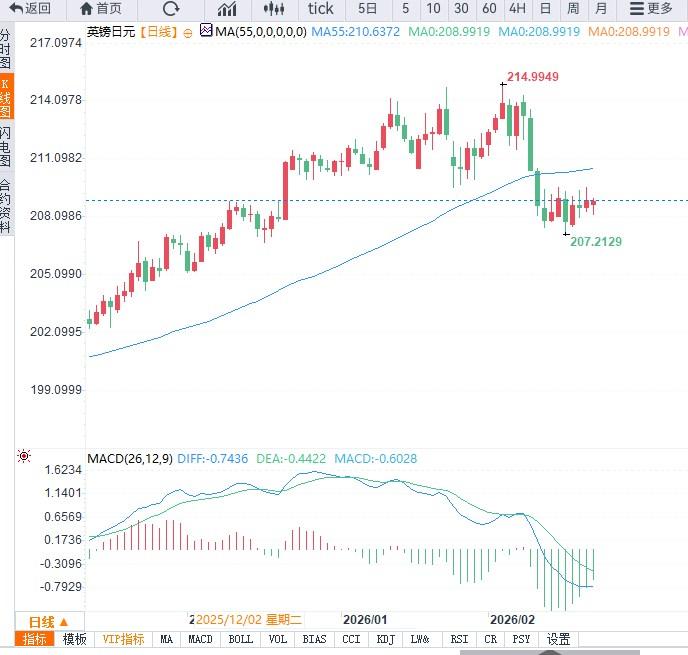
From a daily chart perspective, the GBP/JPY pair continues its overall downward trend. The price is currently trading below the declining 20-day exponential moving average (EMA), which is around 210.18 and continues to slope downwards, indicating significant selling pressure during any rebound.
On the 14th, the RSI rebounded from the 20-40 range to above 40, indicating that the short-term bearish momentum has weakened, but it has not yet broken through the 50 midline, and the overall trend is still bearish.
If the price breaks below the February 17 low of 207.24, it may further test the December 5 low of 206.20 area.
The key resistance levels are at 210.20 (20-day EMA) and the psychological level of 212.00. Only if the price can hold above 210 again will there be a chance for a short-term recovery.
Editor's Note:
The current decline in GBP/JPY is primarily driven by changes in risk sentiment and expectations of yen policy, rather than a significant weakening of UK fundamentals. Although UK retail and PMI data are positive, if market expectations for a tightening policy from the Bank of Japan intensify, [further factors could negatively impact the exchange rate].
Meanwhile, declining global risk appetite may perpetuate the yen's advantage. Until the technical structure improves significantly, the exchange rate is likely to continue its downward trend with fluctuations.
Unless the pound receives stronger economic data or hawkish signals from central banks, the short-term rebound is more likely to be seen as a technical correction.
Rising trade uncertainty triggered a resurgence of risk aversion in the market, with funds flowing into traditional safe-haven assets and pushing the yen stronger. Meanwhile, market expectations that the Bank of Japan may raise interest rates further in the coming months continue to build, also providing support for the yen.
The pound sterling, however, remained relatively strong. UK retail sales rose 1.8% month-on-month in January, significantly higher than the previous month's 0.4%, indicating continued resilience in consumer spending. The composite PMI rose to 53.9 in February, exceeding expectations, suggesting improved momentum in economic activity.
However, investors are watching Alan Taylor's remarks at a Deutsche Bank event. He previously voted for a 25-basis-point rate cut, so his latest comments could influence market expectations regarding the Bank of England's interest rate path.
Considering previous concerns about rising UK retail spending and employment costs, while current retail sales data are strong, if employment slows and financing costs remain high, [further issues may arise].
The sustainability of the improved consumption remains to be seen, which may limit the pound's upside potential in the medium term.
From a daily chart perspective, the GBP/JPY pair continues its overall downward trend. The price is currently trading below the declining 20-day exponential moving average (EMA), which is around 210.18 and continues to slope downwards, indicating significant selling pressure during any rebound.
On the 14th, the RSI rebounded from the 20-40 range to above 40, indicating that the short-term bearish momentum has weakened, but it has not yet broken through the 50 midline, and the overall trend is still bearish.
If the price breaks below the February 17 low of 207.24, it may further test the December 5 low of 206.20 area.
The key resistance levels are at 210.20 (20-day EMA) and the psychological level of 212.00. Only if the price can hold above 210 again will there be a chance for a short-term recovery.
Editor's Note:
The current decline in GBP/JPY is primarily driven by changes in risk sentiment and expectations of yen policy, rather than a significant weakening of UK fundamentals. Although UK retail and PMI data are positive, if market expectations for a tightening policy from the Bank of Japan intensify, [further factors could negatively impact the exchange rate].
Meanwhile, declining global risk appetite may perpetuate the yen's advantage. Until the technical structure improves significantly, the exchange rate is likely to continue its downward trend with fluctuations.
Unless the pound receives stronger economic data or hawkish signals from central banks, the short-term rebound is more likely to be seen as a technical correction.
- Risk Warning and Disclaimer
- The market involves risk, and trading may not be suitable for all investors. This article is for reference only and does not constitute personal investment advice, nor does it take into account certain users’ specific investment objectives, financial situation, or other needs. Any investment decisions made based on this information are at your own risk.