A chart shows that increased shipping capacity has driven the Baltic Dry Index to a three-week high.
2026-02-24 00:12:50
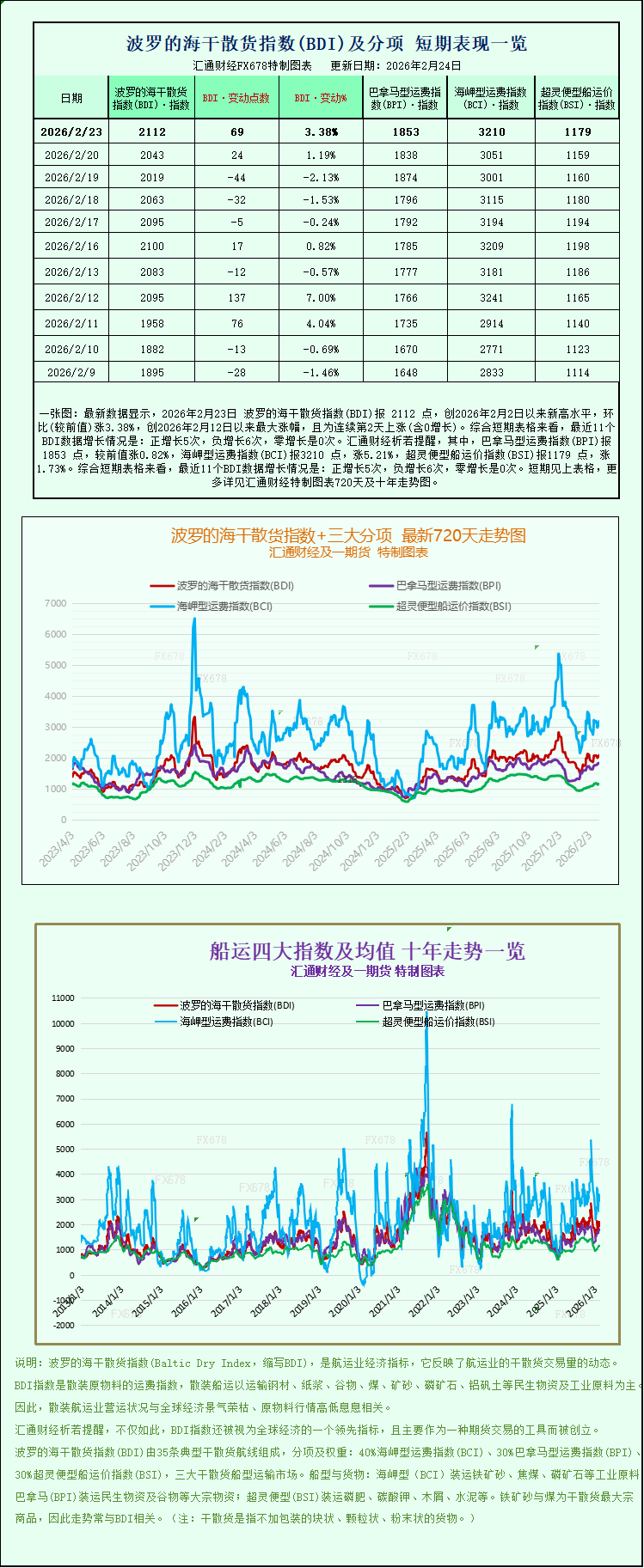
Latest data shows that the Baltic Dry Index (BDI) reached 2112 points on February 23, 2026, a new high since February 2, 2026, up 3.38% month-on-month, the largest increase since February 12, 2026, and the second consecutive day of increase (including zero growth). Looking at the short-term charts, the recent 11 BDI data points show: 5 positive increases, 6 negative increases, and 0 zero increases. Specifically, the Panamax Freight Index (BPI) was 1853 points, up 0.82% from the previous value; the Capesize Freight Index (BCI) was 3210 points, up 5.21%; and the Supramax Freight Index (BSI) was 1179 points, up 1.73%. For detailed 720-day and 10-year trend charts of the Baltic Dry Index and its three main sub-indices, please refer to the specially designed charts.
The Baltic Dry Index (BDI) released by the London Baltic Exchange saw a significant surge on Monday, reaching its highest level in three weeks. This strong performance was primarily driven by the continued increase in global shipping capacity, with all core vessel segments—Capesize, Panamax, and Supramax—rising simultaneously, creating a powerful combined support that propelled the overall index to a comprehensive recovery. This injected strong confidence into the recently volatile dry bulk shipping market. As a core indicator of the global dry bulk shipping market, the Baltic Dry Index is mainly used to comprehensively monitor the fluctuations in ocean freight prices for various dry bulk commodities such as iron ore, coal, and grain worldwide. Its changes directly reflect the activity of global commodity trade and the overall prosperity of the international shipping market. This rise in the index also directly reflects the phased optimization of the supply and demand pattern in the dry bulk shipping market.
Specifically, all sub-sectors of the shipbuilding industry and their corresponding indices showed varying degrees of upward movement, as detailed below:
As a core indicator for measuring the overall trend of the dry bulk shipping market, the Baltic Dry Index, which tracks freight rates for the three main types of vessels—Capesize, Panamax, and Supramax—performed strongly, surging 69 points, or 3.4%, to close at 2112 points. This figure not only represents the highest level since February 2nd but also a significant rebound from recent lows, indicating a continued strengthening of the overall recovery momentum in the dry bulk shipping market. It is understood that the comprehensive rise in the index is attributed to the coordinated performance of the three main vessel types, breaking the previous pattern of individual sectors performing exceptionally well while the overall market remained volatile, demonstrating a comprehensive market recovery.
Among them, the Capesize vessel sector, the "juggernaut" of the dry bulk shipping market, became the core engine driving the overall index upward. Its corresponding index surged 159 points, a significant increase of 5.2%, closing at 3210 points, ranking first among all sub-sectors. Capesize vessels, as one of the largest tonnage types in dry bulk shipping, primarily undertake the transoceanic transportation of core industrial raw materials such as iron ore and coal. A single vessel can carry approximately 150,000 tons of cargo, and their freight rates directly reflect the strength of global demand for industrial raw material shipping. This sharp rise in the index also reflects a moderate recovery in global demand for industrial raw material transportation.
Alongside the rise in the Capesize vessel index, operating revenue also increased. Data shows that Capesize vessels, specializing in transporting bulk commodities such as iron ore and coal, with a single vessel carrying approximately 150,000 tons of cargo, saw a steady increase in average daily revenue, rising by $1,436 on the day of the report, eventually reaching $25,608. This improvement in revenue significantly enhanced the operational efficiency of related shipping companies and further confirmed the high prosperity of the Capesize vessel market. This was mainly due to the increased demand for iron ore transportation resulting from the release of production capacity at the Simandou iron ore project in Guinea, and the rebound in coal transportation demand driven by the resumption of global infrastructure projects after the Spring Festival.
As a mainstay of the dry bulk shipping market, the Panamax sector also showed a steady upward trend. Its corresponding index rose slightly by 15 points, or 0.8%, to close at 1853 points. Although the increase was relatively modest, it continued the recent upward trend with fluctuations, providing stable support for the overall index. Panamax vessels are designed to meet the navigation standards of the Panama Canal, and their capacity falls between Capesize and Supramax vessels, offering strong route flexibility. They are an important reference indicator for the global grain and energy maritime transport market.
Meanwhile, the operating revenue of Panamax vessels also increased. These vessels typically carry 60,000 to 70,000 tons of commodities such as coal or grain. Their average daily revenue rose by $135 to $16,678. This steady increase in revenue was mainly due to expectations of a recovery in South American grain exports. Brazil's soybean planting area continued to expand, with production capacity expected to increase by more than 5%. The Argentine government's temporary suspension of export taxes further boosted South American grain exports, leading to increased demand for seaborne grain shipping. The resilience of global coal shipping demand also provided supplementary support.
Within the small and medium-sized vessel sector, the Supramax market also performed positively, with its corresponding index rising 20 points to close at 1179, achieving a steady recovery. Supramax vessels, as the core force in small and medium-sized dry bulk shipping, typically have a deadweight tonnage between 40,000 and 60,000 tons. They possess strong adaptability to waterways, canals, and ports, and can berth at some smaller ports with less favorable conditions. They mainly carry small batches of dry bulk cargo such as iron ore, grain, fertilizer, and cement, covering a wider geographical area. This index increase was primarily due to a short-term rebound in the activity of small and medium-sized dry bulk trade, as well as improved operational efficiency resulting from optimized vessel capacity. Although the increase was relatively limited, it further improved the pattern of coordinated growth across various sectors.
Industry analysts point out that the Baltic Dry Index's recent three-week high is primarily attributed to the continued increase in shipping capacity, coupled with a moderate recovery in global dry bulk shipping demand, creating a favorable supply-demand dynamic. From an industry perspective, global dry bulk shipping demand is expected to see a moderate recovery in 2026. The Baltic International Maritime Council (BIMCO) projects that deliveries of relevant vessel types will drive fleet capacity growth by 2.6% in 2026, mainly concentrated in Panamax and Supramax vessels, with available capacity expected to see slight growth. Subsequently, with the arrival of the peak season for South American grain exports and the continued release of global iron ore restocking demand, the dry bulk shipping market is expected to maintain its recovery trend, and the Baltic Dry Index is likely to further consolidate its upward momentum.
The Baltic Dry Index (BDI) released by the London Baltic Exchange saw a significant surge on Monday, reaching its highest level in three weeks. This strong performance was primarily driven by the continued increase in global shipping capacity, with all core vessel segments—Capesize, Panamax, and Supramax—rising simultaneously, creating a powerful combined support that propelled the overall index to a comprehensive recovery. This injected strong confidence into the recently volatile dry bulk shipping market. As a core indicator of the global dry bulk shipping market, the Baltic Dry Index is mainly used to comprehensively monitor the fluctuations in ocean freight prices for various dry bulk commodities such as iron ore, coal, and grain worldwide. Its changes directly reflect the activity of global commodity trade and the overall prosperity of the international shipping market. This rise in the index also directly reflects the phased optimization of the supply and demand pattern in the dry bulk shipping market.
Specifically, all sub-sectors of the shipbuilding industry and their corresponding indices showed varying degrees of upward movement, as detailed below:
As a core indicator for measuring the overall trend of the dry bulk shipping market, the Baltic Dry Index, which tracks freight rates for the three main types of vessels—Capesize, Panamax, and Supramax—performed strongly, surging 69 points, or 3.4%, to close at 2112 points. This figure not only represents the highest level since February 2nd but also a significant rebound from recent lows, indicating a continued strengthening of the overall recovery momentum in the dry bulk shipping market. It is understood that the comprehensive rise in the index is attributed to the coordinated performance of the three main vessel types, breaking the previous pattern of individual sectors performing exceptionally well while the overall market remained volatile, demonstrating a comprehensive market recovery.
Among them, the Capesize vessel sector, the "juggernaut" of the dry bulk shipping market, became the core engine driving the overall index upward. Its corresponding index surged 159 points, a significant increase of 5.2%, closing at 3210 points, ranking first among all sub-sectors. Capesize vessels, as one of the largest tonnage types in dry bulk shipping, primarily undertake the transoceanic transportation of core industrial raw materials such as iron ore and coal. A single vessel can carry approximately 150,000 tons of cargo, and their freight rates directly reflect the strength of global demand for industrial raw material shipping. This sharp rise in the index also reflects a moderate recovery in global demand for industrial raw material transportation.
Alongside the rise in the Capesize vessel index, operating revenue also increased. Data shows that Capesize vessels, specializing in transporting bulk commodities such as iron ore and coal, with a single vessel carrying approximately 150,000 tons of cargo, saw a steady increase in average daily revenue, rising by $1,436 on the day of the report, eventually reaching $25,608. This improvement in revenue significantly enhanced the operational efficiency of related shipping companies and further confirmed the high prosperity of the Capesize vessel market. This was mainly due to the increased demand for iron ore transportation resulting from the release of production capacity at the Simandou iron ore project in Guinea, and the rebound in coal transportation demand driven by the resumption of global infrastructure projects after the Spring Festival.
As a mainstay of the dry bulk shipping market, the Panamax sector also showed a steady upward trend. Its corresponding index rose slightly by 15 points, or 0.8%, to close at 1853 points. Although the increase was relatively modest, it continued the recent upward trend with fluctuations, providing stable support for the overall index. Panamax vessels are designed to meet the navigation standards of the Panama Canal, and their capacity falls between Capesize and Supramax vessels, offering strong route flexibility. They are an important reference indicator for the global grain and energy maritime transport market.
Meanwhile, the operating revenue of Panamax vessels also increased. These vessels typically carry 60,000 to 70,000 tons of commodities such as coal or grain. Their average daily revenue rose by $135 to $16,678. This steady increase in revenue was mainly due to expectations of a recovery in South American grain exports. Brazil's soybean planting area continued to expand, with production capacity expected to increase by more than 5%. The Argentine government's temporary suspension of export taxes further boosted South American grain exports, leading to increased demand for seaborne grain shipping. The resilience of global coal shipping demand also provided supplementary support.
Within the small and medium-sized vessel sector, the Supramax market also performed positively, with its corresponding index rising 20 points to close at 1179, achieving a steady recovery. Supramax vessels, as the core force in small and medium-sized dry bulk shipping, typically have a deadweight tonnage between 40,000 and 60,000 tons. They possess strong adaptability to waterways, canals, and ports, and can berth at some smaller ports with less favorable conditions. They mainly carry small batches of dry bulk cargo such as iron ore, grain, fertilizer, and cement, covering a wider geographical area. This index increase was primarily due to a short-term rebound in the activity of small and medium-sized dry bulk trade, as well as improved operational efficiency resulting from optimized vessel capacity. Although the increase was relatively limited, it further improved the pattern of coordinated growth across various sectors.
Industry analysts point out that the Baltic Dry Index's recent three-week high is primarily attributed to the continued increase in shipping capacity, coupled with a moderate recovery in global dry bulk shipping demand, creating a favorable supply-demand dynamic. From an industry perspective, global dry bulk shipping demand is expected to see a moderate recovery in 2026. The Baltic International Maritime Council (BIMCO) projects that deliveries of relevant vessel types will drive fleet capacity growth by 2.6% in 2026, mainly concentrated in Panamax and Supramax vessels, with available capacity expected to see slight growth. Subsequently, with the arrival of the peak season for South American grain exports and the continued release of global iron ore restocking demand, the dry bulk shipping market is expected to maintain its recovery trend, and the Baltic Dry Index is likely to further consolidate its upward momentum.
- Risk Warning and Disclaimer
- The market involves risk, and trading may not be suitable for all investors. This article is for reference only and does not constitute personal investment advice, nor does it take into account certain users’ specific investment objectives, financial situation, or other needs. Any investment decisions made based on this information are at your own risk.