Crude oil trading alert: Geopolitical tensions are supporting stronger oil prices, with a short-term bullish trend expected to continue.
2026-02-24 09:37:59
On Tuesday during Asian trading hours, international oil prices fluctuated near their recent highs. WTI crude oil was almost flat, remaining stable around $66 per barrel. Oil prices had risen nearly 6% in the previous week, mainly driven by escalating tensions in the Middle East.
US President Trump stated that he was considering a military strike against Iran, prompting markets to immediately price in a higher geopolitical risk premium. Meanwhile, reports emerged that the US was amassing military forces in the Middle East.
Lebanese local television, citing unnamed sources, reported that the US embassy in Lebanon has preemptively evacuated dozens of personnel in anticipation of regional developments. US security officials are closely monitoring whether Iran might take retaliatory action against US targets overseas.
Such news further exacerbated market tensions. However, amidst the ongoing tensions, the US and Iran still plan to resume negotiations in Geneva on Thursday. Iranian Foreign Minister Araqchi stated that the standoff surrounding Iran's nuclear program has a "great chance" of being resolved diplomatically, but he also emphasized that Tehran will not make concessions under US military pressure.
The core disagreement in the current negotiations remains focused on uranium enrichment. Although the market widely expects a global supply surplus in the coming months, the potential risk of conflict in the Middle East has brought supply security back into focus.
The Strait of Hormuz, a crucial shipping route, is particularly vulnerable; if the situation spirals out of control, the global oil logistics system could be severely impacted. Meanwhile, the sharp decline in the stock market is also dragging down oil prices.
The overall weakness in risk assets dampened market risk appetite, leaving oil prices lacking further momentum for a breakout from their high levels. In terms of investment bank opinions, Goldman Sachs raised its oil price forecast, citing lower-than-expected inventory increases in developed countries.
However, the bank still believes oil prices will fall from current levels, predicting Brent crude will trade around $60 by the end of the year. Morgan Stanley also stated that Brent crude prices may fall back to the $60 area over time.
On the policy front, the U.S. Supreme Court's rejection of Trump's signature tariff policy has fueled trade concerns, with the government planning new 15% global tariffs. Investors are also watching the ongoing impact of winter storms on energy demand and supply chains.
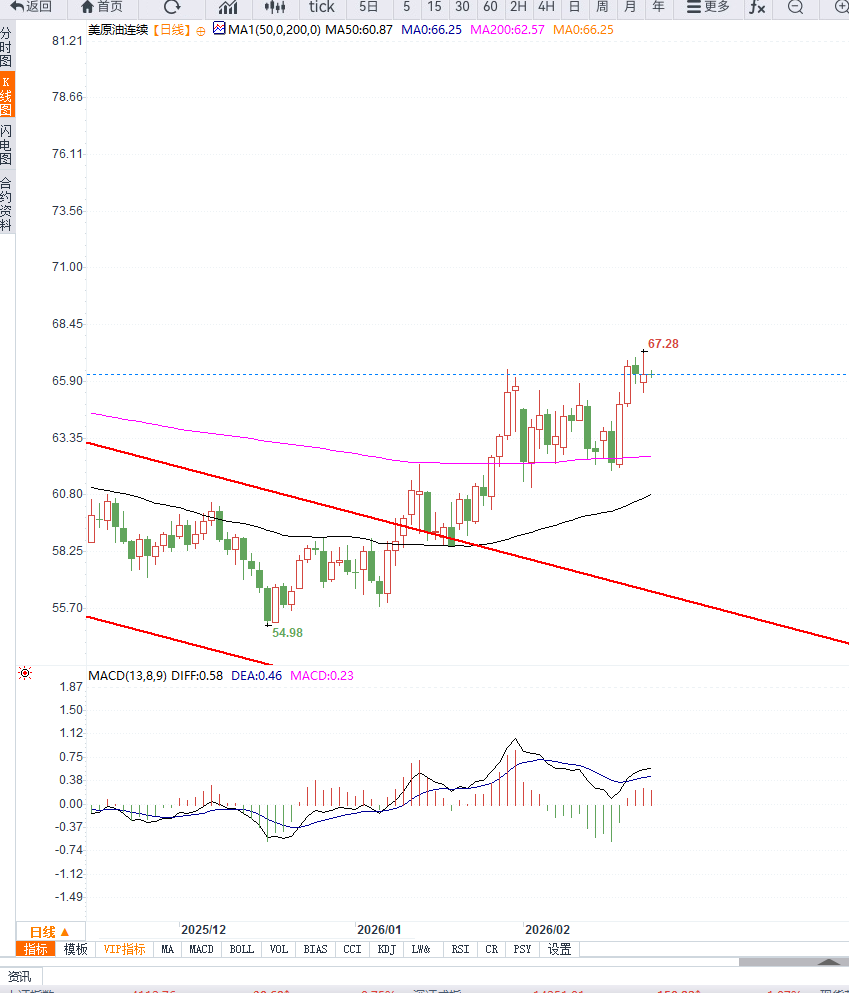
From a daily chart perspective, WTI has steadily rebounded from its previous lows and formed a temporary high above $66. The price is currently trading within a medium-term upward channel, and the overall trend remains bullish. Regarding the moving average system, short-term moving averages are in a bullish alignment, while medium-term moving averages are gradually rising, indicating a relatively healthy trend structure.
The previously formed "golden cross" continues to provide trend support for the market. However, momentum indicators are beginning to show signs of slowing down. The stochastic oscillator has entered overbought territory, indicating that short-term buying momentum is strong but a correction is needed.
If the price fails to break through the resistance zone above $67, a short-term technical pullback may occur. Resistance: $67.00–$68.00; a break above this level would target the psychological level of $70. Support: $65.00; further support lies around $63.50. Overall, the trend remains intact, but the probability of high-level consolidation has increased.
Editor's Note:
The current oil price trend is primarily driven by geopolitical premiums, rather than a significant improvement in demand. While inventory data and supply risks are providing support for prices, the global supply outlook remains relatively loose in the medium to long term.
The market is currently in a typical "risk-driven" phase. Oil prices could quickly give back some of their gains should negotiations progress or military tensions ease. Therefore, short-term price movements depend more on diplomatic and military developments than on fundamental structural changes.
Before the trend reverses, the medium-term outlook remains bullish, but caution is advised regarding the risk of high volatility due to unexpected news. Oil prices are shifting from a "supply and demand driven" to a "geopolitical" driven phase.
US President Trump stated that he was considering a military strike against Iran, prompting markets to immediately price in a higher geopolitical risk premium. Meanwhile, reports emerged that the US was amassing military forces in the Middle East.
Lebanese local television, citing unnamed sources, reported that the US embassy in Lebanon has preemptively evacuated dozens of personnel in anticipation of regional developments. US security officials are closely monitoring whether Iran might take retaliatory action against US targets overseas.
Such news further exacerbated market tensions. However, amidst the ongoing tensions, the US and Iran still plan to resume negotiations in Geneva on Thursday. Iranian Foreign Minister Araqchi stated that the standoff surrounding Iran's nuclear program has a "great chance" of being resolved diplomatically, but he also emphasized that Tehran will not make concessions under US military pressure.
The core disagreement in the current negotiations remains focused on uranium enrichment. Although the market widely expects a global supply surplus in the coming months, the potential risk of conflict in the Middle East has brought supply security back into focus.
The Strait of Hormuz, a crucial shipping route, is particularly vulnerable; if the situation spirals out of control, the global oil logistics system could be severely impacted. Meanwhile, the sharp decline in the stock market is also dragging down oil prices.
The overall weakness in risk assets dampened market risk appetite, leaving oil prices lacking further momentum for a breakout from their high levels. In terms of investment bank opinions, Goldman Sachs raised its oil price forecast, citing lower-than-expected inventory increases in developed countries.
However, the bank still believes oil prices will fall from current levels, predicting Brent crude will trade around $60 by the end of the year. Morgan Stanley also stated that Brent crude prices may fall back to the $60 area over time.
On the policy front, the U.S. Supreme Court's rejection of Trump's signature tariff policy has fueled trade concerns, with the government planning new 15% global tariffs. Investors are also watching the ongoing impact of winter storms on energy demand and supply chains.
From a daily chart perspective, WTI has steadily rebounded from its previous lows and formed a temporary high above $66. The price is currently trading within a medium-term upward channel, and the overall trend remains bullish. Regarding the moving average system, short-term moving averages are in a bullish alignment, while medium-term moving averages are gradually rising, indicating a relatively healthy trend structure.
The previously formed "golden cross" continues to provide trend support for the market. However, momentum indicators are beginning to show signs of slowing down. The stochastic oscillator has entered overbought territory, indicating that short-term buying momentum is strong but a correction is needed.
If the price fails to break through the resistance zone above $67, a short-term technical pullback may occur. Resistance: $67.00–$68.00; a break above this level would target the psychological level of $70. Support: $65.00; further support lies around $63.50. Overall, the trend remains intact, but the probability of high-level consolidation has increased.
Editor's Note:
The current oil price trend is primarily driven by geopolitical premiums, rather than a significant improvement in demand. While inventory data and supply risks are providing support for prices, the global supply outlook remains relatively loose in the medium to long term.
The market is currently in a typical "risk-driven" phase. Oil prices could quickly give back some of their gains should negotiations progress or military tensions ease. Therefore, short-term price movements depend more on diplomatic and military developments than on fundamental structural changes.
Before the trend reverses, the medium-term outlook remains bullish, but caution is advised regarding the risk of high volatility due to unexpected news. Oil prices are shifting from a "supply and demand driven" to a "geopolitical" driven phase.
- Risk Warning and Disclaimer
- The market involves risk, and trading may not be suitable for all investors. This article is for reference only and does not constitute personal investment advice, nor does it take into account certain users’ specific investment objectives, financial situation, or other needs. Any investment decisions made based on this information are at your own risk.