Japanese fiscal concerns and expectations of a Federal Reserve rate cut are intertwined, causing the USD/JPY pair to fluctuate near a resistance level.
2026-02-24 09:51:25
During Tuesday's Asian trading session, USD/JPY rose slightly, continuing its rebound from the 154.00 level, and is currently trading near the 155.00 mark, with a daily gain of approximately 0.15%.
However, given the mixed fundamentals, the upside potential for the exchange rate appears limited. Regarding the yen, Japan's fiscal outlook is a key market focus. Investors are concerned that the government may introduce further stimulus measures to boost the economy.

Japan's weak fourth-quarter GDP growth dampened market expectations for an immediate interest rate hike by the Bank of Japan (BOJ). This waning expectation directly weakened support for the yen's interest rate differential, providing upward momentum for the USD/JPY pair. Meanwhile, the US dollar itself also received some support. The recent robust performance of the US dollar index has helped maintain the USD/JPY's rebound structure.
However, US President Trump's proposed new 15% global tariff plan has sparked market concerns about an economic slowdown, limiting the dollar's potential for further appreciation. More importantly, market bets on further interest rate cuts by the Federal Reserve are rising.
Expectations of further easing mean the dollar's yield advantage may narrow, thus putting downward pressure on USD/JPY. It's worth noting that there's a clear divergence in policy paths. Although expectations of a Japanese interest rate hike have cooled somewhat in the short term, the market generally accepts the view that the BOJ will continue to push forward with the policy normalization process.
This contrasts with the Federal Reserve's likely dovish stance, leaving the long-term interest rate differential outlook uncertain. Furthermore, reports indicate that the US Treasury Secretary personally conducted a so-called "currency assessment" in January when the yen rapidly depreciated to around 158. This occurred during a period of heightened political uncertainty ahead of the Japanese House of Representatives election.
Such news has heightened market vigilance regarding potential coordinated intervention, meaning that policymakers may step in to stabilize the exchange rate should the yen depreciate rapidly again. On the data front, the market will focus on upcoming US economic indicators, including the Conference Board's consumer confidence index and the Richmond Fed's manufacturing index.
Meanwhile, speeches by Federal Reserve officials could also influence the dollar's trajectory. Overall, USD/JPY is currently caught in a tug-of-war between multiple factors. Weak Japanese fundamentals support the exchange rate's upward movement, but expectations of a Fed rate cut and the risk of potential intervention limit gains, making it more likely to fluctuate within the 154-156 range in the short term.
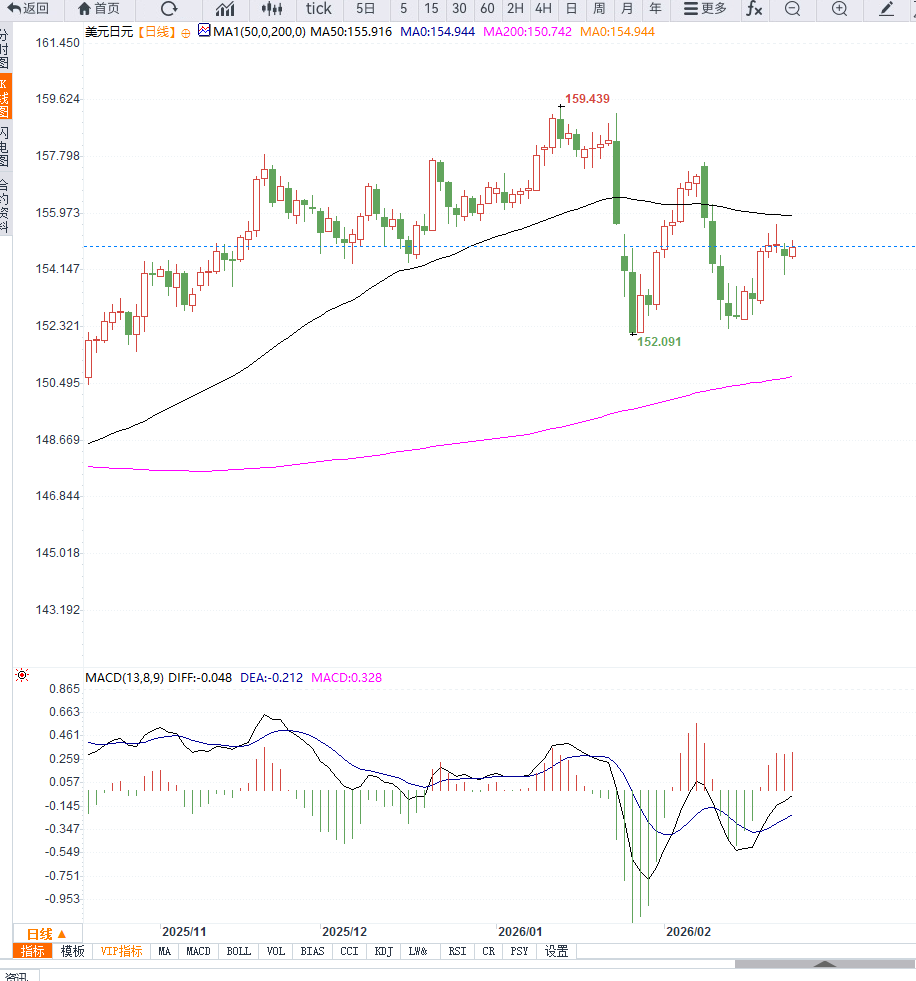
From the daily chart, USD/JPY rebounded after finding support around 154.00 and is currently trading below the psychological resistance level of 155.00. The moving average system shows a high-level consolidation structure, and the price has not yet formed a new trend breakout.
If the price effectively holds above 155.00, the next target is the 156.50 area; if the rebound is resisted and falls below the 154.00 support, it may retest the lows near 152.80. Momentum indicators show that the rebound momentum has not yet been fully established, and the forces of bulls and bears are relatively balanced.
Editor's Note:
The current core logic behind USD/JPY lies in the triple interplay of "fiscal concerns + monetary policy divergence + potential intervention risks." Short-term interest rate differentials support the US dollar, but macroeconomic uncertainties and policy risks limit sustained trend-based price movements.
In the absence of a clear catalyst, the exchange rate is more likely to fluctuate within a range rather than break out in one direction. If the Federal Reserve signals a clearer rate cut, or the Japanese government hints at increased intervention, volatility could rise significantly. In the short term, caution is advised regarding potential technical fluctuations around the 155 level.
However, given the mixed fundamentals, the upside potential for the exchange rate appears limited. Regarding the yen, Japan's fiscal outlook is a key market focus. Investors are concerned that the government may introduce further stimulus measures to boost the economy.
Japan's weak fourth-quarter GDP growth dampened market expectations for an immediate interest rate hike by the Bank of Japan (BOJ). This waning expectation directly weakened support for the yen's interest rate differential, providing upward momentum for the USD/JPY pair. Meanwhile, the US dollar itself also received some support. The recent robust performance of the US dollar index has helped maintain the USD/JPY's rebound structure.
However, US President Trump's proposed new 15% global tariff plan has sparked market concerns about an economic slowdown, limiting the dollar's potential for further appreciation. More importantly, market bets on further interest rate cuts by the Federal Reserve are rising.
Expectations of further easing mean the dollar's yield advantage may narrow, thus putting downward pressure on USD/JPY. It's worth noting that there's a clear divergence in policy paths. Although expectations of a Japanese interest rate hike have cooled somewhat in the short term, the market generally accepts the view that the BOJ will continue to push forward with the policy normalization process.
This contrasts with the Federal Reserve's likely dovish stance, leaving the long-term interest rate differential outlook uncertain. Furthermore, reports indicate that the US Treasury Secretary personally conducted a so-called "currency assessment" in January when the yen rapidly depreciated to around 158. This occurred during a period of heightened political uncertainty ahead of the Japanese House of Representatives election.
Such news has heightened market vigilance regarding potential coordinated intervention, meaning that policymakers may step in to stabilize the exchange rate should the yen depreciate rapidly again. On the data front, the market will focus on upcoming US economic indicators, including the Conference Board's consumer confidence index and the Richmond Fed's manufacturing index.
Meanwhile, speeches by Federal Reserve officials could also influence the dollar's trajectory. Overall, USD/JPY is currently caught in a tug-of-war between multiple factors. Weak Japanese fundamentals support the exchange rate's upward movement, but expectations of a Fed rate cut and the risk of potential intervention limit gains, making it more likely to fluctuate within the 154-156 range in the short term.
From the daily chart, USD/JPY rebounded after finding support around 154.00 and is currently trading below the psychological resistance level of 155.00. The moving average system shows a high-level consolidation structure, and the price has not yet formed a new trend breakout.
If the price effectively holds above 155.00, the next target is the 156.50 area; if the rebound is resisted and falls below the 154.00 support, it may retest the lows near 152.80. Momentum indicators show that the rebound momentum has not yet been fully established, and the forces of bulls and bears are relatively balanced.
Editor's Note:
The current core logic behind USD/JPY lies in the triple interplay of "fiscal concerns + monetary policy divergence + potential intervention risks." Short-term interest rate differentials support the US dollar, but macroeconomic uncertainties and policy risks limit sustained trend-based price movements.
In the absence of a clear catalyst, the exchange rate is more likely to fluctuate within a range rather than break out in one direction. If the Federal Reserve signals a clearer rate cut, or the Japanese government hints at increased intervention, volatility could rise significantly. In the short term, caution is advised regarding potential technical fluctuations around the 155 level.
- Risk Warning and Disclaimer
- The market involves risk, and trading may not be suitable for all investors. This article is for reference only and does not constitute personal investment advice, nor does it take into account certain users’ specific investment objectives, financial situation, or other needs. Any investment decisions made based on this information are at your own risk.