Is the Middle East powder keg about to explode? US-Iran standoff escalates; oil prices closely watched for Trump's next move.
2026-02-24 14:07:30
On Tuesday (February 24) during Asian trading hours, US crude oil prices fluctuated upwards, currently trading around $66.85 per barrel, with a daily increase of approximately 0.8%. The core driver of recent oil price increases is the sharp escalation of geopolitical tensions between the US and Iran. Despite the US's large-scale strikes on Iranian nuclear facilities last June, declaring their "complete destruction," eight months later, the Trump administration is again considering military action against Iran, with an expanded scope of targets.
The tensions were ignited when Trump issued a 10-15 day ultimatum last week demanding that Iran abandon uranium enrichment, a decision Iran refused. His special envoy further warned that Iran might be "only a week away" from obtaining nuclear-grade highly enriched uranium.
Last June, the U.S. military launched a high-intensity strike against Iran's three key nuclear facilities, dropping more than a dozen heavy bunker buster bombs and multiple Tomahawk cruise missiles. President Trump subsequently characterized the operation as a "spectacular military success" in a national address and explicitly declared that "Iran's key nuclear enrichment facilities have been completely and utterly destroyed."
The Pentagon endorsed the strike at the time. Defense Department chief spokesman Sean Parnell said in July that the strike would delay Iran's nuclear program by at least one to two years, "we judge it to be closer to two years."
Eight months later, the Trump administration is once again seriously considering military action against Iran, with a noticeable shift in official statements regarding the objectives. In recent weeks, President Trump has mentioned several goals: stopping Tehran's deadly crackdown on protesters (which he claims has ended at his request), weakening Iran's ballistic missile capabilities, and curbing its nuclear program.
Last week, Trump issued a 15-day ultimatum to Iran, demanding an immediate agreement to ban uranium enrichment. Iranian Foreign Minister Araqchi categorically rejected the demand, emphasizing Iran's legitimate right to develop peaceful nuclear energy.
Last weekend, Trump's special envoy Steve Witkov issued a strong warning: Iran may be just a week away from acquiring enough industrially enriched uranium to build a nuclear bomb . He emphasized, "This is extremely dangerous, and we absolutely cannot allow it."
However, the International Atomic Energy Agency (IAEA) and several analysts have pointed out that the issue of Iran's highly enriched uranium stockpile has persisted for months. Satellite images show that Iran is attempting to rebuild damaged facilities. Due to Iran's ban on inspectors following the bombing, the exact status of its nuclear program remains unclear.
When asked why there was a rush to reach an emergency agreement on a nuclear program that had been "destroyed months ago," White House officials only reiterated: "The president has always made it clear that Iran must not possess nuclear weapons or the ability to manufacture them, nor may it enrich uranium."
A classified assessment by the Defense Intelligence Agency last summer indicated that the three bombed facilities were far from being completely destroyed, and that a large amount of critical material, though buried, was largely intact. IAEA Director General Grossi stated in February that a large quantity of highly enriched uranium "is likely still on site, some of which are difficult to access, but the material is still there." The agency estimates that approximately 441 kilograms (972 pounds) of highly enriched uranium is missing after the bombing.
Analysts believe the most critical issue is not the remaining technological capabilities, but whether the Iranian regime has made the political decision to "rush into developing nuclear weapons." The latest assessment from the Institute for Science and International Security indicates that the probability of Iran deciding to develop nuclear weapons is approximately 40-50%; if it does decide to proceed, the short-term success rate is less than 15%, and the longer-term success rate is approximately 42%.
The report states that although the main gas centrifuge program and most of the weaponization facilities were destroyed, "important knowledge and remaining components are still sufficient to rebuild small-scale enrichment and weaponization capabilities."
According to reports, Trump is weighing options including: first, a limited military strike to force Iran back to the negotiating table; if that fails, he may resort to sustained military action aimed at regime change . Such action is expected to last for several weeks and pose a substantial risk to the 30,000-40,000 US troops stationed in the Middle East.
On Monday, Trump refuted reports of ammunition shortages and insufficient support from allies, saying that his top military advisor, General Kane, believed that "if we decide to confront Iran militarily, it will be an easy battle to win."
U.S. officials revealed that Iran is expected to submit a new nuclear proposal later Tuesday, in preparation for a new round of indirect negotiations in Geneva on Thursday (with Oman and Qatar acting as intermediaries). Meanwhile, Israeli Prime Minister Netanyahu issued a strong warning in parliament on Monday: if Iran attacks Israel, "we will respond with force that they cannot even imagine."
Currently, the escalating confrontation between the US and Iran and the spillover effects of geopolitical risks have put global markets on high alert. Any further escalation of tensions in the Middle East could directly impact energy prices, shipping costs, and global financial stability.
The escalating US-Iran standoff is a strong bullish signal. Although a hawkish stance by the Federal Reserve may lead to a stronger dollar in the short term, limiting upside potential for oil prices, geopolitical factors will soon dominate in the face of substantial supply disruption risks.
Traders need to pay close attention to the outcome of Thursday's Geneva talks and whether the US will take preemptive military action. Any confirmed news of a military strike could be a strong catalyst for oil prices to break out of their recent consolidation range.
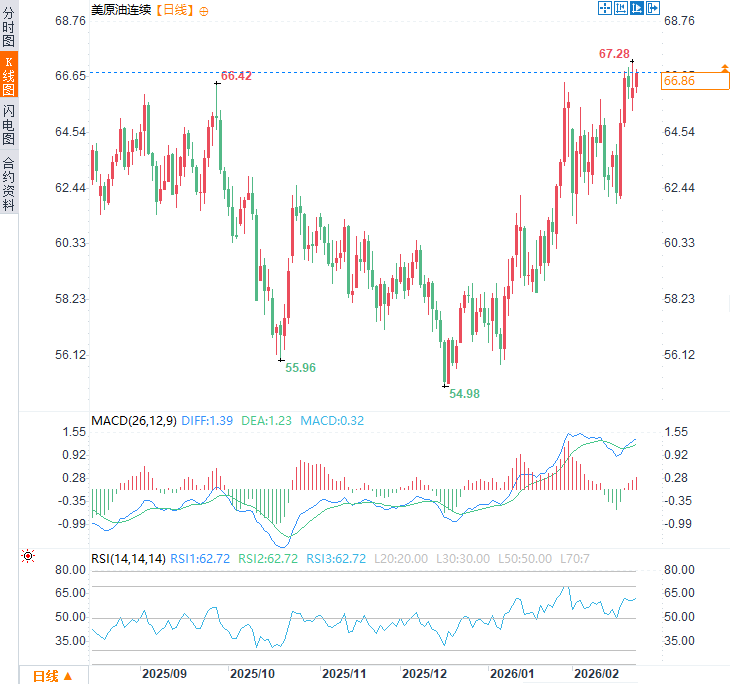
(US crude oil daily chart, source: FX678)
At 14:07 Beijing time, US crude oil futures were trading at $66.85 per barrel.
The tensions were ignited when Trump issued a 10-15 day ultimatum last week demanding that Iran abandon uranium enrichment, a decision Iran refused. His special envoy further warned that Iran might be "only a week away" from obtaining nuclear-grade highly enriched uranium.
The massive airstrikes last June and Trump's claims
Last June, the U.S. military launched a high-intensity strike against Iran's three key nuclear facilities, dropping more than a dozen heavy bunker buster bombs and multiple Tomahawk cruise missiles. President Trump subsequently characterized the operation as a "spectacular military success" in a national address and explicitly declared that "Iran's key nuclear enrichment facilities have been completely and utterly destroyed."
The Pentagon endorsed the strike at the time. Defense Department chief spokesman Sean Parnell said in July that the strike would delay Iran's nuclear program by at least one to two years, "we judge it to be closer to two years."
Eight months later: Goals repeated, wording adjusted
Eight months later, the Trump administration is once again seriously considering military action against Iran, with a noticeable shift in official statements regarding the objectives. In recent weeks, President Trump has mentioned several goals: stopping Tehran's deadly crackdown on protesters (which he claims has ended at his request), weakening Iran's ballistic missile capabilities, and curbing its nuclear program.
Last week, Trump issued a 15-day ultimatum to Iran, demanding an immediate agreement to ban uranium enrichment. Iranian Foreign Minister Araqchi categorically rejected the demand, emphasizing Iran's legitimate right to develop peaceful nuclear energy.
Within a week, a warning of a potential bomb-grade material upgrade is expected.
Last weekend, Trump's special envoy Steve Witkov issued a strong warning: Iran may be just a week away from acquiring enough industrially enriched uranium to build a nuclear bomb . He emphasized, "This is extremely dangerous, and we absolutely cannot allow it."
However, the International Atomic Energy Agency (IAEA) and several analysts have pointed out that the issue of Iran's highly enriched uranium stockpile has persisted for months. Satellite images show that Iran is attempting to rebuild damaged facilities. Due to Iran's ban on inspectors following the bombing, the exact status of its nuclear program remains unclear.
The claim that it has been destroyed contradicts the actual assessment.
When asked why there was a rush to reach an emergency agreement on a nuclear program that had been "destroyed months ago," White House officials only reiterated: "The president has always made it clear that Iran must not possess nuclear weapons or the ability to manufacture them, nor may it enrich uranium."
A classified assessment by the Defense Intelligence Agency last summer indicated that the three bombed facilities were far from being completely destroyed, and that a large amount of critical material, though buried, was largely intact. IAEA Director General Grossi stated in February that a large quantity of highly enriched uranium "is likely still on site, some of which are difficult to access, but the material is still there." The agency estimates that approximately 441 kilograms (972 pounds) of highly enriched uranium is missing after the bombing.
Iran's decision remains the core variable.
Analysts believe the most critical issue is not the remaining technological capabilities, but whether the Iranian regime has made the political decision to "rush into developing nuclear weapons." The latest assessment from the Institute for Science and International Security indicates that the probability of Iran deciding to develop nuclear weapons is approximately 40-50%; if it does decide to proceed, the short-term success rate is less than 15%, and the longer-term success rate is approximately 42%.
The report states that although the main gas centrifuge program and most of the weaponization facilities were destroyed, "important knowledge and remaining components are still sufficient to rebuild small-scale enrichment and weaponization capabilities."
US options: Limited strikes or a protracted campaign
According to reports, Trump is weighing options including: first, a limited military strike to force Iran back to the negotiating table; if that fails, he may resort to sustained military action aimed at regime change . Such action is expected to last for several weeks and pose a substantial risk to the 30,000-40,000 US troops stationed in the Middle East.
On Monday, Trump refuted reports of ammunition shortages and insufficient support from allies, saying that his top military advisor, General Kane, believed that "if we decide to confront Iran militarily, it will be an easy battle to win."
Diplomatic window and regional chain reaction
U.S. officials revealed that Iran is expected to submit a new nuclear proposal later Tuesday, in preparation for a new round of indirect negotiations in Geneva on Thursday (with Oman and Qatar acting as intermediaries). Meanwhile, Israeli Prime Minister Netanyahu issued a strong warning in parliament on Monday: if Iran attacks Israel, "we will respond with force that they cannot even imagine."
Currently, the escalating confrontation between the US and Iran and the spillover effects of geopolitical risks have put global markets on high alert. Any further escalation of tensions in the Middle East could directly impact energy prices, shipping costs, and global financial stability.
Impact analysis on the crude oil market
The escalating US-Iran standoff is a strong bullish signal. Although a hawkish stance by the Federal Reserve may lead to a stronger dollar in the short term, limiting upside potential for oil prices, geopolitical factors will soon dominate in the face of substantial supply disruption risks.
Traders need to pay close attention to the outcome of Thursday's Geneva talks and whether the US will take preemptive military action. Any confirmed news of a military strike could be a strong catalyst for oil prices to break out of their recent consolidation range.
(US crude oil daily chart, source: FX678)
At 14:07 Beijing time, US crude oil futures were trading at $66.85 per barrel.
- Risk Warning and Disclaimer
- The market involves risk, and trading may not be suitable for all investors. This article is for reference only and does not constitute personal investment advice, nor does it take into account certain users’ specific investment objectives, financial situation, or other needs. Any investment decisions made based on this information are at your own risk.