The era of the dollar's "slow deflating" has begun: from "American exceptionalism" to "mediocrity"?
2026-02-24 15:39:39
Since 2025, the US dollar has experienced a significant depreciation, reflecting the fading of the "American exceptionalism" narrative. With slowing economic growth expectations and weakening capital inflows, the valuation bubble that previously relied excessively on the "US outperforms" premium has begun to burst. On Tuesday (February 24th) during the European session, the US dollar index rebounded slightly, currently trading around 97.90, with a daily gain of approximately 0.15%, supported by hawkish comments from the Federal Reserve. However, the long-term problems facing the dollar have become increasingly apparent.
The US dollar is currently facing multiple structural pressures: the market expects the Federal Reserve to continue cutting interest rates, while the fiscal deficit has not narrowed, resulting in an awkward imbalance in the policy mix; trade policy has been erratic, with tariffs failing to support the dollar and instead exacerbating uncertainty; moderate inflation expectations have led to a narrowing of the interest rate advantage, reducing the reliability of traditional valuation anchors. Although there has been no systemic "de-dollarization," reserve managers are accelerating the accumulation of alternative assets such as gold, driving gradual diversification.
In 2025, the US dollar experienced a significant depreciation. This decline was not a sudden event, but rather a concentrated release of long-accumulated pressure. The fading of the "exceptionalism" of the US economy had long been lurking in the market context. Once the narrative began to normalize, various cracks became apparent: economic growth expectations moderated, capital inflows slowed, and the valuation bubble that had previously relied excessively on "US outperforming" burst.
By 2025, dollar holdings will be highly concentrated and heavily reliant on this growth premium; when the premium begins to recede, the dollar’s sensitivity to market sentiment and position changes will increase sharply, with exposure levels far exceeding those of recent years.
At the same time, the policy environment poses a more challenging one for the dollar. Markets expect the Federal Reserve to continue cutting interest rates, while its leadership may face greater political influence, introducing a small but significant risk premium to the Fed's credibility.
At this juncture, fiscal policy remains unanchored, the deficit shows no signs of narrowing, and spending is expected to rise further during the election cycle. The steepening yield curve has failed to provide substantial support for the dollar. Even with a brief rebound in nominal yields, the lack of a credible fiscal path has weakened the traditional support of interest rate differentials for the dollar.
Trade policy has also failed to deliver a clear signal. High tariffs typically reinforce the inflation narrative and support the dollar, but the market has been cautious about recent announcements. The volatility and unpredictability of policy, coupled with the lengthy transmission time of its effects, have resulted in an unusually mild reaction in the foreign exchange market. The tariff rulings, instead of boosting the dollar, have exacerbated the overall atmosphere of uncertainty.
All of these factors combined have contributed to a moderate inflation expectation. Long-term breakeven inflation suggests that the market is comfortable with inflationary pressures being under control (or perhaps even overly optimistic). This is crucial for the dollar: when inflation is perceived as manageable, interest rate differentials narrow, weakening one of the dollar's key supports. A shift in expectations—whether due to tariffs or other factors—could trigger repricing . A more severe scenario is that inflation strengthens again while the Fed continues its accommodative policy; this combination would weigh heavily on real yields and, at a time when confidence is already fragile, raise questions about policy direction and the Fed's independence.
Against this backdrop, it's no surprise that the reliability of traditional valuation anchors has declined. Multiple forces, including policy, capital flows, and politics, are pulling in different directions simultaneously. If the Federal Reserve continues to cut interest rates and interest rate spreads narrow, a weaker dollar is a natural consequence unless other central banks adopt more aggressive or sustained easing policies.
While a structural "de-dollarization" cycle has not yet emerged, multiple driving factors may marginally support gradual diversification. Reserve managers remain subject to clear constraints, and the dollar market remains central to the global system, but the accelerated accumulation of alternative assets such as gold aligns with this broader theme.
Overall, this round of dollar adjustment has both political and structural characteristics. Political factors accelerated the process, but the foundations were already laid: the normalization of American exceptionalism, the awkward imbalance in the policy mix, and the evolving dynamics of inflation and reserve management. How long these forces persist may determine the trajectory of the dollar over the next decade.
This does not yet constitute a dramatic turning point, nor is it a rapid rebound after a brief interruption. A more reasonable path is a slow, uneven adjustment, with the market gradually clarifying the reasonable premium level that US assets should enjoy. In early 2026, the US dollar index will continue to be under pressure amid global uncertainty and the interplay of the Federal Reserve's path, but in the long run, its core status as a reserve currency remains resilient, and the depreciation is more of a cyclical rather than a permanent shift.
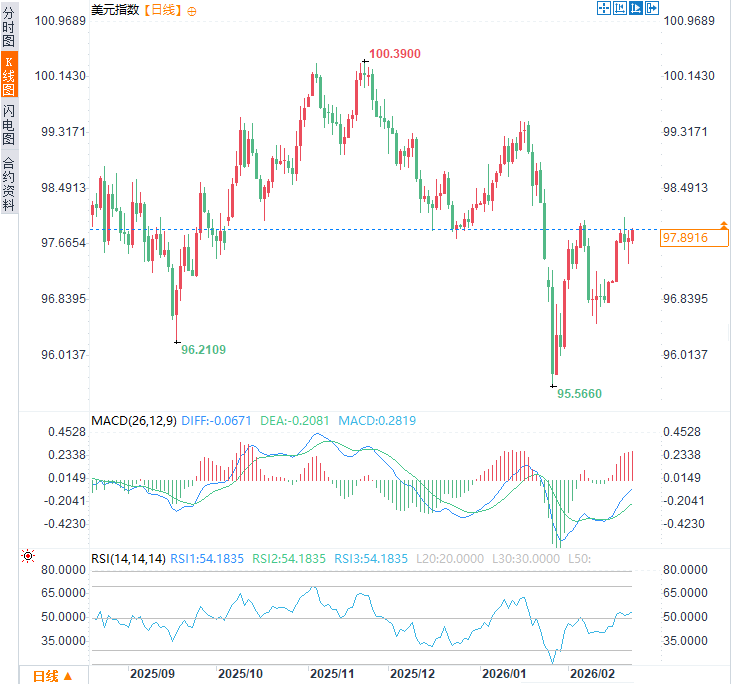
(US Dollar Index Daily Chart, Source: FX678)
At 15:34 Beijing time, the US dollar index is currently at 97.88.
The US dollar is currently facing multiple structural pressures: the market expects the Federal Reserve to continue cutting interest rates, while the fiscal deficit has not narrowed, resulting in an awkward imbalance in the policy mix; trade policy has been erratic, with tariffs failing to support the dollar and instead exacerbating uncertainty; moderate inflation expectations have led to a narrowing of the interest rate advantage, reducing the reliability of traditional valuation anchors. Although there has been no systemic "de-dollarization," reserve managers are accelerating the accumulation of alternative assets such as gold, driving gradual diversification.
The fading of American exceptionalism and the fragility of the dollar at high levels
In 2025, the US dollar experienced a significant depreciation. This decline was not a sudden event, but rather a concentrated release of long-accumulated pressure. The fading of the "exceptionalism" of the US economy had long been lurking in the market context. Once the narrative began to normalize, various cracks became apparent: economic growth expectations moderated, capital inflows slowed, and the valuation bubble that had previously relied excessively on "US outperforming" burst.
By 2025, dollar holdings will be highly concentrated and heavily reliant on this growth premium; when the premium begins to recede, the dollar’s sensitivity to market sentiment and position changes will increase sharply, with exposure levels far exceeding those of recent years.
Multiple challenges in the US policy environment
At the same time, the policy environment poses a more challenging one for the dollar. Markets expect the Federal Reserve to continue cutting interest rates, while its leadership may face greater political influence, introducing a small but significant risk premium to the Fed's credibility.
At this juncture, fiscal policy remains unanchored, the deficit shows no signs of narrowing, and spending is expected to rise further during the election cycle. The steepening yield curve has failed to provide substantial support for the dollar. Even with a brief rebound in nominal yields, the lack of a credible fiscal path has weakened the traditional support of interest rate differentials for the dollar.
The complex interplay between trade policy and inflation expectations
Trade policy has also failed to deliver a clear signal. High tariffs typically reinforce the inflation narrative and support the dollar, but the market has been cautious about recent announcements. The volatility and unpredictability of policy, coupled with the lengthy transmission time of its effects, have resulted in an unusually mild reaction in the foreign exchange market. The tariff rulings, instead of boosting the dollar, have exacerbated the overall atmosphere of uncertainty.
All of these factors combined have contributed to a moderate inflation expectation. Long-term breakeven inflation suggests that the market is comfortable with inflationary pressures being under control (or perhaps even overly optimistic). This is crucial for the dollar: when inflation is perceived as manageable, interest rate differentials narrow, weakening one of the dollar's key supports. A shift in expectations—whether due to tariffs or other factors—could trigger repricing . A more severe scenario is that inflation strengthens again while the Fed continues its accommodative policy; this combination would weigh heavily on real yields and, at a time when confidence is already fragile, raise questions about policy direction and the Fed's independence.
Valuation anchor failure and pressure for gradual diversification
Against this backdrop, it's no surprise that the reliability of traditional valuation anchors has declined. Multiple forces, including policy, capital flows, and politics, are pulling in different directions simultaneously. If the Federal Reserve continues to cut interest rates and interest rate spreads narrow, a weaker dollar is a natural consequence unless other central banks adopt more aggressive or sustained easing policies.
While a structural "de-dollarization" cycle has not yet emerged, multiple driving factors may marginally support gradual diversification. Reserve managers remain subject to clear constraints, and the dollar market remains central to the global system, but the accelerated accumulation of alternative assets such as gold aligns with this broader theme.
The Nature and Long-Term Outlook of the Dollar Adjustment
Overall, this round of dollar adjustment has both political and structural characteristics. Political factors accelerated the process, but the foundations were already laid: the normalization of American exceptionalism, the awkward imbalance in the policy mix, and the evolving dynamics of inflation and reserve management. How long these forces persist may determine the trajectory of the dollar over the next decade.
This does not yet constitute a dramatic turning point, nor is it a rapid rebound after a brief interruption. A more reasonable path is a slow, uneven adjustment, with the market gradually clarifying the reasonable premium level that US assets should enjoy. In early 2026, the US dollar index will continue to be under pressure amid global uncertainty and the interplay of the Federal Reserve's path, but in the long run, its core status as a reserve currency remains resilient, and the depreciation is more of a cyclical rather than a permanent shift.
(US Dollar Index Daily Chart, Source: FX678)
At 15:34 Beijing time, the US dollar index is currently at 97.88.
- Risk Warning and Disclaimer
- The market involves risk, and trading may not be suitable for all investors. This article is for reference only and does not constitute personal investment advice, nor does it take into account certain users’ specific investment objectives, financial situation, or other needs. Any investment decisions made based on this information are at your own risk.