February 26th, the decisive moment: When the by-election is over, will it be the day the pound breaks free from its cage?
2026-02-24 16:34:13
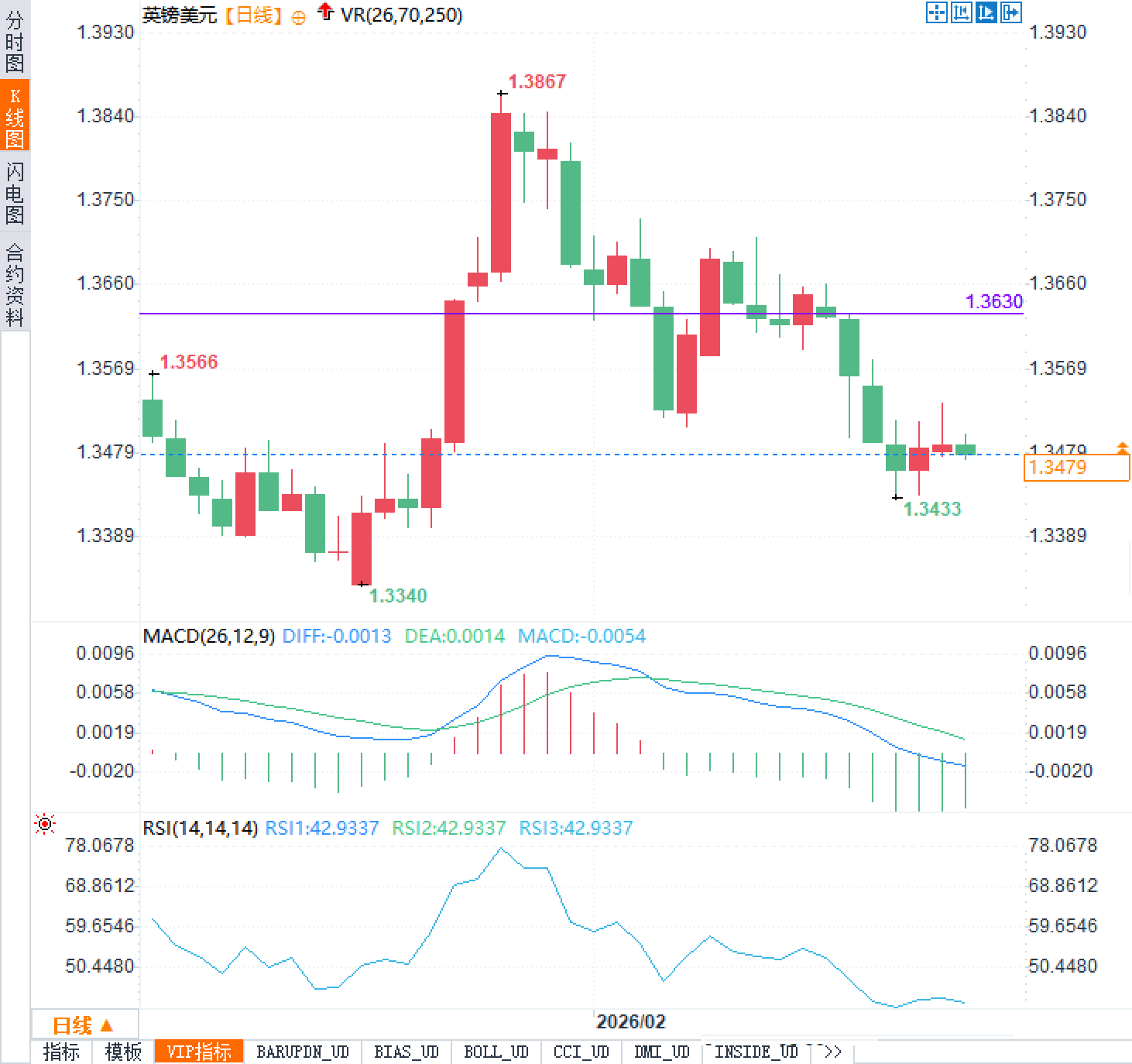
The British pound has recently found itself in a classic "dilemma" against the US dollar, fluctuating around 1.3480 on Tuesday, February 24th, as if held down by an invisible hand. Technically, since the high of 1.3867, the bulls have failed to mount an effective counterattack. The 1.3630 level acts as an insurmountable barrier, while 1.3433 forms the final line of defense.
The MACD indicator shows the fast and slow lines maintaining a death cross near the zero axis, with the histogram expanding to -0.0054, clearly indicating a short-term bearish momentum. The RSI indicator hovers in the neutral-to-weak zone at 42.93, neither reaching the oversold zone nor lacking the strength for a strong rebound. This technical indecisiveness accurately reflects the intense struggle between bullish and bearish forces in the fundamentals: on the one hand, economic data is frequently positive, while on the other hand, political clouds linger, leading to a lack of market direction.
Delving into the UK, the economic fundamentals are unfolding a dramatic tale of two extremes. A previously weak labor market had put pressure on the pound, but subsequent inflation data showed unexpectedly strong performance, with prices sticking much tighter than expected, quickly offsetting the negative impact of the labor market. Even more encouragingly, both the preliminary February PMI and January retail sales figures exceeded expectations, indicating a recovery in economic activity at the beginning of the year, with the boost from the previous budget starting to take effect. Particularly noteworthy is the record-high UK fiscal surplus in January, with improved government borrowing data significantly alleviating market concerns about fiscal sustainability.
However, faced with this seemingly ideal combination of "high inflation + recovering growth," the pound's reaction has been unusually restrained. Analysts point out that this isn't because the market is ignoring the positive news, but rather because traders are waiting for clearer signals. This phenomenon of "good data failing to translate into a surge" suggests that expectations of a dovish shift towards interest rate cuts by the Bank of England have been significantly reduced, thus limiting the pound's potential for a sharp decline. In other words, the solid fundamentals have been laid, awaiting only a favorable wind to dispel the remaining uncertainties shrouding the market.
What's truly suppressing the pound's short-term trend are two impending "storms." First is the Greater Manchester by-election scheduled for February 26th. In the eyes of financial markets, political uncertainty is the biggest enemy, especially given the current mixed fundamental signals. Traders tend to remain on the sidelines until things settle down, unwilling to make hasty bets. Analysts predict that high volatility in the pound will be the norm until the by-election concludes, which is a key reason why recent positive data has failed to drive the exchange rate higher.
Meanwhile, the dramatic shift in US trade policy across the Atlantic cast a shadow over global currency markets. Following the US Supreme Court's ruling that some of the president's tariff measures exceeded his authority, the White House quickly invoked the Trade Act of 1974 to impose global tariffs, raising rates from 10% to 15%. Calculations by the Yale Budget Lab show that this move will cause the average effective US tariff rate to rebound to 13.7%, slightly lower than before the ruling, but a high-tariff environment may become the long-term norm in the US. Rabobank strategists warned that regardless of which party is in power, protectionism will be a means to gain votes and fiscal revenue. This dramatic external volatility has severely suppressed global risk appetite, making it difficult for the pound to rise.
Looking at the big picture, the pound/dollar exchange rate is on the eve of a crucial turning point. Internally, it has strong economic data and limited room for interest rate cuts as a "moat," while externally, it faces the dual pressures of the political election and US tariff policy. The current consolidation is not a sign of deteriorating fundamentals, but rather a rational choice by the market under multiple uncertainties. Once the by-election on February 26th concludes, political risks subside, and the path of US economic policy becomes clearer, pent-up bullish momentum may be released. At that time, if the euro/pound also falls further, the pound could see a genuine window of appreciation.
The MACD indicator shows the fast and slow lines maintaining a death cross near the zero axis, with the histogram expanding to -0.0054, clearly indicating a short-term bearish momentum. The RSI indicator hovers in the neutral-to-weak zone at 42.93, neither reaching the oversold zone nor lacking the strength for a strong rebound. This technical indecisiveness accurately reflects the intense struggle between bullish and bearish forces in the fundamentals: on the one hand, economic data is frequently positive, while on the other hand, political clouds linger, leading to a lack of market direction.
The UK economy is experiencing a stark contrast: sticky inflation and glimmers of growth.
Delving into the UK, the economic fundamentals are unfolding a dramatic tale of two extremes. A previously weak labor market had put pressure on the pound, but subsequent inflation data showed unexpectedly strong performance, with prices sticking much tighter than expected, quickly offsetting the negative impact of the labor market. Even more encouragingly, both the preliminary February PMI and January retail sales figures exceeded expectations, indicating a recovery in economic activity at the beginning of the year, with the boost from the previous budget starting to take effect. Particularly noteworthy is the record-high UK fiscal surplus in January, with improved government borrowing data significantly alleviating market concerns about fiscal sustainability.
However, faced with this seemingly ideal combination of "high inflation + recovering growth," the pound's reaction has been unusually restrained. Analysts point out that this isn't because the market is ignoring the positive news, but rather because traders are waiting for clearer signals. This phenomenon of "good data failing to translate into a surge" suggests that expectations of a dovish shift towards interest rate cuts by the Bank of England have been significantly reduced, thus limiting the pound's potential for a sharp decline. In other words, the solid fundamentals have been laid, awaiting only a favorable wind to dispel the remaining uncertainties shrouding the market.
Political Gamble and Tariff Storm: Two Swords Hanging Over Our Heads
What's truly suppressing the pound's short-term trend are two impending "storms." First is the Greater Manchester by-election scheduled for February 26th. In the eyes of financial markets, political uncertainty is the biggest enemy, especially given the current mixed fundamental signals. Traders tend to remain on the sidelines until things settle down, unwilling to make hasty bets. Analysts predict that high volatility in the pound will be the norm until the by-election concludes, which is a key reason why recent positive data has failed to drive the exchange rate higher.
Meanwhile, the dramatic shift in US trade policy across the Atlantic cast a shadow over global currency markets. Following the US Supreme Court's ruling that some of the president's tariff measures exceeded his authority, the White House quickly invoked the Trade Act of 1974 to impose global tariffs, raising rates from 10% to 15%. Calculations by the Yale Budget Lab show that this move will cause the average effective US tariff rate to rebound to 13.7%, slightly lower than before the ruling, but a high-tariff environment may become the long-term norm in the US. Rabobank strategists warned that regardless of which party is in power, protectionism will be a means to gain votes and fiscal revenue. This dramatic external volatility has severely suppressed global risk appetite, making it difficult for the pound to rise.
A breakthrough is imminent: awaiting the critical point of a shift in the wind direction.
Looking at the big picture, the pound/dollar exchange rate is on the eve of a crucial turning point. Internally, it has strong economic data and limited room for interest rate cuts as a "moat," while externally, it faces the dual pressures of the political election and US tariff policy. The current consolidation is not a sign of deteriorating fundamentals, but rather a rational choice by the market under multiple uncertainties. Once the by-election on February 26th concludes, political risks subside, and the path of US economic policy becomes clearer, pent-up bullish momentum may be released. At that time, if the euro/pound also falls further, the pound could see a genuine window of appreciation.
- Risk Warning and Disclaimer
- The market involves risk, and trading may not be suitable for all investors. This article is for reference only and does not constitute personal investment advice, nor does it take into account certain users’ specific investment objectives, financial situation, or other needs. Any investment decisions made based on this information are at your own risk.