With the US dollar uncertain, the Australian dollar faces another major test: if the 0.7 support level is breached, where does the abyss below end?
2026-02-24 17:54:05
On Tuesday, February 24th, the Australian dollar traded around a delicate 0.7065 against the US dollar during the European session, resembling the calm before the storm. After a recent sharp rise from 0.6662, the exchange rate encountered resistance near 0.7146 and subsequently entered a consolidation phase at higher levels. This movement is not a meaningless stagnation, but rather the market awaiting new pricing clues.

The current market structure shows that bulls and bears are locked in a tug-of-war within a key range, with short-term funds generally adopting a wait-and-see approach. This narrow-range fluctuation is a typical characteristic of a trend continuation, meaning the market is digesting previous gains and accumulating new momentum through turnover. This period of calm often sets the stage for a more dramatic next move, and the key to breaking this balance lies in the upcoming monthly inflation data.
From a micro-level technical perspective, the 0.7000 level has become a crucial psychological and structural defense line that bulls must defend. As long as the price can hold firmly above this area during pullbacks, it indicates that the previous uptrend remains intact, and the current consolidation is merely a pause within the upward movement. Conversely, a decisive break below 0.7000 could be interpreted by short-term traders as a sign of weakening trend momentum, forcibly opening up further downside potential, with the 0.6896 area becoming the next precarious support level. On the upside, 0.7146 represents a significant near-term resistance level; only a break and hold above this level can signal the end of the consolidation and allow the price to potentially resume its previous upward momentum.
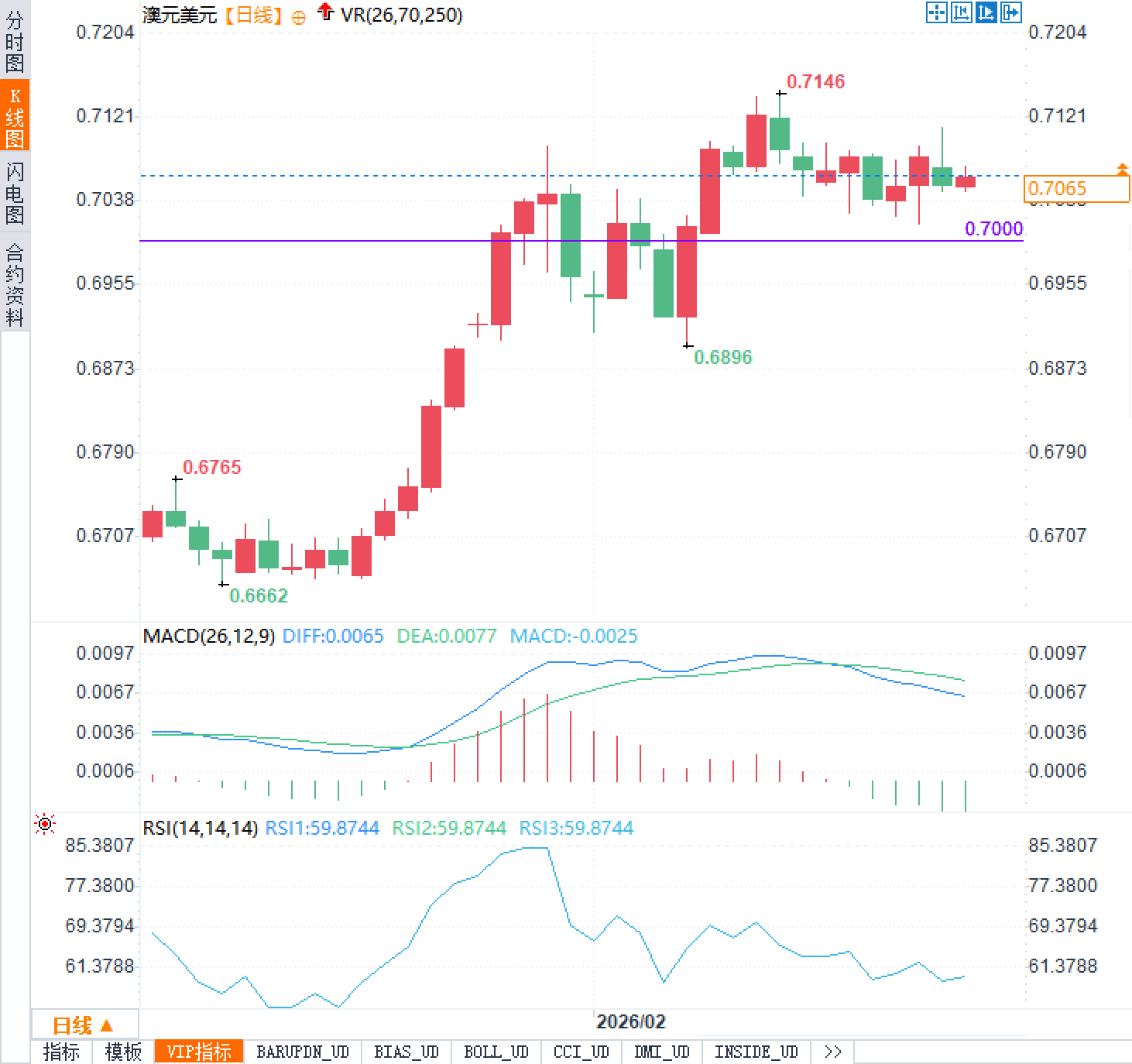
Technical indicators are also signaling caution. The MACD shows the current DIFF at 0.0065, DEA at 0.0077, and the MACD histogram at -0.0025. The red bars have converged and turned weak, reflecting a shift in short-term momentum from strong to moderate. Meanwhile, the RSI reading is approximately 59.8, within the neutral-to-strong range, lacking both significant overbought pressure and insufficient to signal a unilateral acceleration. This combination of technical indicators aligns with the current range-bound trading pattern: prices are no longer solely driven by technical momentum but are highly dependent on news and interest rate expectations to determine direction.
From a fundamental perspective, the volatility of the US dollar is heavily influenced by alternating policy uncertainties and data repricing. Recently, the dollar retreated due to changes in tariff-related laws, as the market tended to reduce its long dollar exposure during periods of heightened uncertainty. However, the dollar subsequently recovered most of its losses, indicating that funds have not formed a unified one-sided view and are more likely waiting for new catalysts. The future direction of the dollar will still depend on shifts in risk sentiment and the repricing of interest rate paths triggered by high-weighted data such as employment and inflation. If strong data pushes up expectations of a Fed rate hike, the dollar will receive strong support; otherwise, it will maintain range-bound trading.
The core logic behind the Australian dollar's performance revolves around interest rate expectations. The Reserve Bank of Australia (RBA) previously raised the cash rate by 25 basis points to 3.85% and released a hawkish signal, suggesting two more rate hikes this year, far exceeding the market's initial expectation of one. This difference provided strong interest rate differential support for the Australian dollar. However, as prices consolidated after their initial rise, the market began demanding stronger evidence to support further rate hikes; existing expectations alone are no longer sufficient to drive a new round of sustained upward movement. The failure of previously strong employment data to sustain the exchange rate's rise also indicates that the market's sensitivity to positive news is declining, and a new, strong stimulus is urgently needed in the short term to restart the upward engine.
In summary, the narrow consolidation of the Australian dollar against the US dollar around 0.7065 is essentially a natural manifestation of the shift in interest rate expectations from rapid upward revision to cautious verification. Monthly inflation data will be the ultimate variable determining the short-term direction. If inflation is significantly overheated, the market may anticipate the next rate hike in advance, thus pushing up the Australian dollar and significantly increasing the probability of breaking through 0.7146. However, given the already hawkish expectations, the data must be strong enough to provide additional impetus; otherwise, the positive impact could easily be seen as already priced in. Conversely, if inflation is weak, it is most likely to trigger a resonance of expectation pullback and profit-taking, weakening the rationale for further rate hikes and causing the price to test 0.7000 or even 0.6896.
The current market structure shows that bulls and bears are locked in a tug-of-war within a key range, with short-term funds generally adopting a wait-and-see approach. This narrow-range fluctuation is a typical characteristic of a trend continuation, meaning the market is digesting previous gains and accumulating new momentum through turnover. This period of calm often sets the stage for a more dramatic next move, and the key to breaking this balance lies in the upcoming monthly inflation data.
Technical Game: The Extreme Tug-of-War Between Support and Resistance
From a micro-level technical perspective, the 0.7000 level has become a crucial psychological and structural defense line that bulls must defend. As long as the price can hold firmly above this area during pullbacks, it indicates that the previous uptrend remains intact, and the current consolidation is merely a pause within the upward movement. Conversely, a decisive break below 0.7000 could be interpreted by short-term traders as a sign of weakening trend momentum, forcibly opening up further downside potential, with the 0.6896 area becoming the next precarious support level. On the upside, 0.7146 represents a significant near-term resistance level; only a break and hold above this level can signal the end of the consolidation and allow the price to potentially resume its previous upward momentum.
Technical indicators are also signaling caution. The MACD shows the current DIFF at 0.0065, DEA at 0.0077, and the MACD histogram at -0.0025. The red bars have converged and turned weak, reflecting a shift in short-term momentum from strong to moderate. Meanwhile, the RSI reading is approximately 59.8, within the neutral-to-strong range, lacking both significant overbought pressure and insufficient to signal a unilateral acceleration. This combination of technical indicators aligns with the current range-bound trading pattern: prices are no longer solely driven by technical momentum but are highly dependent on news and interest rate expectations to determine direction.
Macroeconomic Battle: The Dollar Mystery and the RBA's Hawkish Stance
From a fundamental perspective, the volatility of the US dollar is heavily influenced by alternating policy uncertainties and data repricing. Recently, the dollar retreated due to changes in tariff-related laws, as the market tended to reduce its long dollar exposure during periods of heightened uncertainty. However, the dollar subsequently recovered most of its losses, indicating that funds have not formed a unified one-sided view and are more likely waiting for new catalysts. The future direction of the dollar will still depend on shifts in risk sentiment and the repricing of interest rate paths triggered by high-weighted data such as employment and inflation. If strong data pushes up expectations of a Fed rate hike, the dollar will receive strong support; otherwise, it will maintain range-bound trading.
The core logic behind the Australian dollar's performance revolves around interest rate expectations. The Reserve Bank of Australia (RBA) previously raised the cash rate by 25 basis points to 3.85% and released a hawkish signal, suggesting two more rate hikes this year, far exceeding the market's initial expectation of one. This difference provided strong interest rate differential support for the Australian dollar. However, as prices consolidated after their initial rise, the market began demanding stronger evidence to support further rate hikes; existing expectations alone are no longer sufficient to drive a new round of sustained upward movement. The failure of previously strong employment data to sustain the exchange rate's rise also indicates that the market's sensitivity to positive news is declining, and a new, strong stimulus is urgently needed in the short term to restart the upward engine.
Decisive Moment: Inflation Data Triggers Directional Choice
In summary, the narrow consolidation of the Australian dollar against the US dollar around 0.7065 is essentially a natural manifestation of the shift in interest rate expectations from rapid upward revision to cautious verification. Monthly inflation data will be the ultimate variable determining the short-term direction. If inflation is significantly overheated, the market may anticipate the next rate hike in advance, thus pushing up the Australian dollar and significantly increasing the probability of breaking through 0.7146. However, given the already hawkish expectations, the data must be strong enough to provide additional impetus; otherwise, the positive impact could easily be seen as already priced in. Conversely, if inflation is weak, it is most likely to trigger a resonance of expectation pullback and profit-taking, weakening the rationale for further rate hikes and causing the price to test 0.7000 or even 0.6896.
- Risk Warning and Disclaimer
- The market involves risk, and trading may not be suitable for all investors. This article is for reference only and does not constitute personal investment advice, nor does it take into account certain users’ specific investment objectives, financial situation, or other needs. Any investment decisions made based on this information are at your own risk.