With UK inflation easing and trade uncertainty rising, GBP/USD is fluctuating around 1.3500, awaiting a directional breakout.
2026-02-24 14:38:58
GBP/USD edged lower in Asian trading on Tuesday, consolidating around 1.3480. The pair had risen for two consecutive days, but a rebound in the US dollar from its lows dampened the pound's upward momentum.
Regarding the US dollar, the market is focused on the US ADP employment data and speeches by Federal Reserve officials. The Federal Reserve is currently maintaining a cautious stance. Federal Reserve Governor Christopher Waller stated that whether or not to support a March rate cut will depend on the performance of the February employment market data.
The market currently prices only a very low probability of a rate cut in March, but it is still pricing in a gradual easing over the next year. Meanwhile, the Trump administration is considering imposing national security tariffs on certain industries under Section 232 of the Trade Expansion Act of 1962.
This move is independent of the previously announced 15% global tariff policy. Trade uncertainty may weaken foreign investors' confidence in dollar assets, thus limiting the dollar's potential for further appreciation. Regarding the pound, expectations for a Bank of England rate cut continue to rise. A weakening UK labor market and declining inflation have reinforced expectations of further easing.
Alan Taylor, a member of the Bank of England's Monetary Policy Committee, indicated a cautious outlook on the UK economy and supported further interest rate cuts in the near term. Such dovish statements continued to weigh on the pound.
Overall, the current volatility of the pound against the dollar reflects a complex situation involving the intertwining of differences in policy paths between the UK and the US and trade uncertainties.
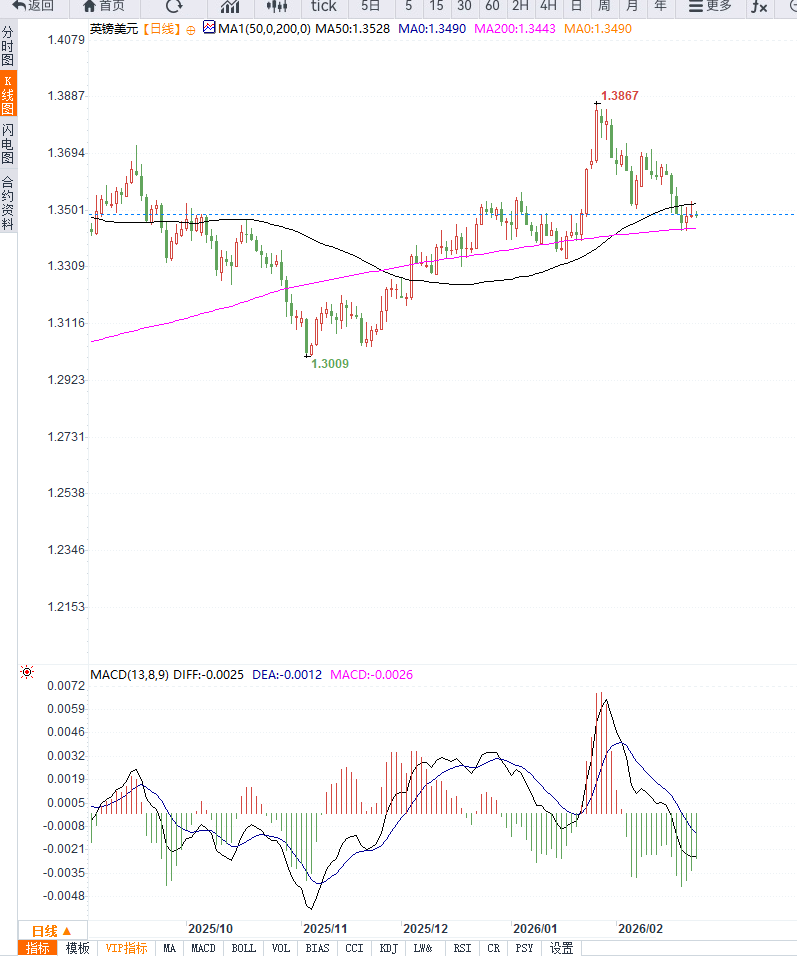
From a daily chart perspective, the GBP/USD pair remains in a technical correction phase following its pullback from the previous high of 1.3869. The current price is trading below the 50-day exponential moving average (approximately 1.3520) but still above the 200-day exponential moving average (approximately 1.3370), indicating that the overall trend has not yet fully turned bearish, but rather is in a consolidation phase following a medium-term uptrend.
Since rebounding from the low of 1.3287, the exchange rate has given back about half of its gains; such a 50% retracement is generally considered a healthy corrective structure. The stochastic oscillator has entered oversold territory, indicating that the previous downward pressure may be gradually releasing, but the RSI remains in the neutral-to-weak range, suggesting that the market has not yet formed a strong rebound signal.
Recent candlestick patterns show small bodies and significant overlap in price ranges, reflecting market uncertainty. The current key price range is between 1.3370 and 1.3600, with 1.3475 and 1.3370 forming a support zone below, and 1.3520 and 1.3600 forming a resistance zone above.
If the price breaks through and holds above the 50-day moving average, a short-term technical rebound may continue. However, if it falls below the 200-day moving average, the medium-term structure may turn bearish.
Editor's Note:
The current trend of the pound reflects a typical phase of policy expectation game. Slowing inflation and increasing economic growth pressure in the UK have led the market to anticipate a rate cut; while the US remains on the sidelines, the uncertainty brought about by trade policy makes it difficult for the dollar to form a unilateral appreciation trend.
The future direction of the exchange rate will depend on US employment data, Federal Reserve policy signals, and changes in UK economic data. In the absence of a clear catalyst, the pound/dollar exchange rate is more likely to maintain a range-bound trading pattern.
Regarding the US dollar, the market is focused on the US ADP employment data and speeches by Federal Reserve officials. The Federal Reserve is currently maintaining a cautious stance. Federal Reserve Governor Christopher Waller stated that whether or not to support a March rate cut will depend on the performance of the February employment market data.
The market currently prices only a very low probability of a rate cut in March, but it is still pricing in a gradual easing over the next year. Meanwhile, the Trump administration is considering imposing national security tariffs on certain industries under Section 232 of the Trade Expansion Act of 1962.
This move is independent of the previously announced 15% global tariff policy. Trade uncertainty may weaken foreign investors' confidence in dollar assets, thus limiting the dollar's potential for further appreciation. Regarding the pound, expectations for a Bank of England rate cut continue to rise. A weakening UK labor market and declining inflation have reinforced expectations of further easing.
Alan Taylor, a member of the Bank of England's Monetary Policy Committee, indicated a cautious outlook on the UK economy and supported further interest rate cuts in the near term. Such dovish statements continued to weigh on the pound.
Overall, the current volatility of the pound against the dollar reflects a complex situation involving the intertwining of differences in policy paths between the UK and the US and trade uncertainties.
From a daily chart perspective, the GBP/USD pair remains in a technical correction phase following its pullback from the previous high of 1.3869. The current price is trading below the 50-day exponential moving average (approximately 1.3520) but still above the 200-day exponential moving average (approximately 1.3370), indicating that the overall trend has not yet fully turned bearish, but rather is in a consolidation phase following a medium-term uptrend.
Since rebounding from the low of 1.3287, the exchange rate has given back about half of its gains; such a 50% retracement is generally considered a healthy corrective structure. The stochastic oscillator has entered oversold territory, indicating that the previous downward pressure may be gradually releasing, but the RSI remains in the neutral-to-weak range, suggesting that the market has not yet formed a strong rebound signal.
Recent candlestick patterns show small bodies and significant overlap in price ranges, reflecting market uncertainty. The current key price range is between 1.3370 and 1.3600, with 1.3475 and 1.3370 forming a support zone below, and 1.3520 and 1.3600 forming a resistance zone above.
If the price breaks through and holds above the 50-day moving average, a short-term technical rebound may continue. However, if it falls below the 200-day moving average, the medium-term structure may turn bearish.
Editor's Note:
The current trend of the pound reflects a typical phase of policy expectation game. Slowing inflation and increasing economic growth pressure in the UK have led the market to anticipate a rate cut; while the US remains on the sidelines, the uncertainty brought about by trade policy makes it difficult for the dollar to form a unilateral appreciation trend.
The future direction of the exchange rate will depend on US employment data, Federal Reserve policy signals, and changes in UK economic data. In the absence of a clear catalyst, the pound/dollar exchange rate is more likely to maintain a range-bound trading pattern.
- Risk Warning and Disclaimer
- The market involves risk, and trading may not be suitable for all investors. This article is for reference only and does not constitute personal investment advice, nor does it take into account certain users’ specific investment objectives, financial situation, or other needs. Any investment decisions made based on this information are at your own risk.