Trade uncertainty and policy divergence coexist, leading to a slight rebound in the US dollar index.
2026-02-24 15:14:27
The US dollar index rose slightly to around 97.80 in Asian trading on Tuesday, ending a two-day losing streak. The dollar saw a temporary rebound after a technical correction, but overall upward momentum remains cautious.
Market focus is on the US ADP employment data and speeches by Federal Reserve officials. The Fed's policy stance remains cautiously inactive. Fed Governor Waller stated that whether to support a rate cut at the March meeting will depend on the February labor market data.

The interest rate market currently only estimates a 5% probability of a rate cut in March, but still anticipates gradual easing over the next few years. Meanwhile, the Trump administration is considering imposing national security tariffs on multiple industries under Section 232 of the Trade Expansion Act of 1962.
This move is independent of the previously announced 15% global tariff policy. Adjustments to trade policy increase uncertainty regarding the path of global economic growth and inflation, potentially affecting international capital's willingness to allocate to dollar-denominated assets.
At the international level, the EU indicated it might suspend its ratification process for the trade agreement with the US. Meanwhile, the US and India postponed their scheduled trade negotiations, suggesting Washington is reassessing its overall tariff strategy.
Congress is also unlikely to extend the new tariffs for more than 150 days, casting doubt on the policy's sustainability. From a global policy divergence perspective, the market expects the Federal Reserve to cut interest rates by a cumulative total of about 50 basis points by 2026, while the Bank of Japan is likely to raise rates by another 25 basis points, and the European Central Bank is expected to maintain policy stability.
Policy differences among major economies will have a profound impact on the medium- to long-term trend of the US dollar index. Overall, the US dollar is currently in a state of both short-term rebound and medium-term pressure.
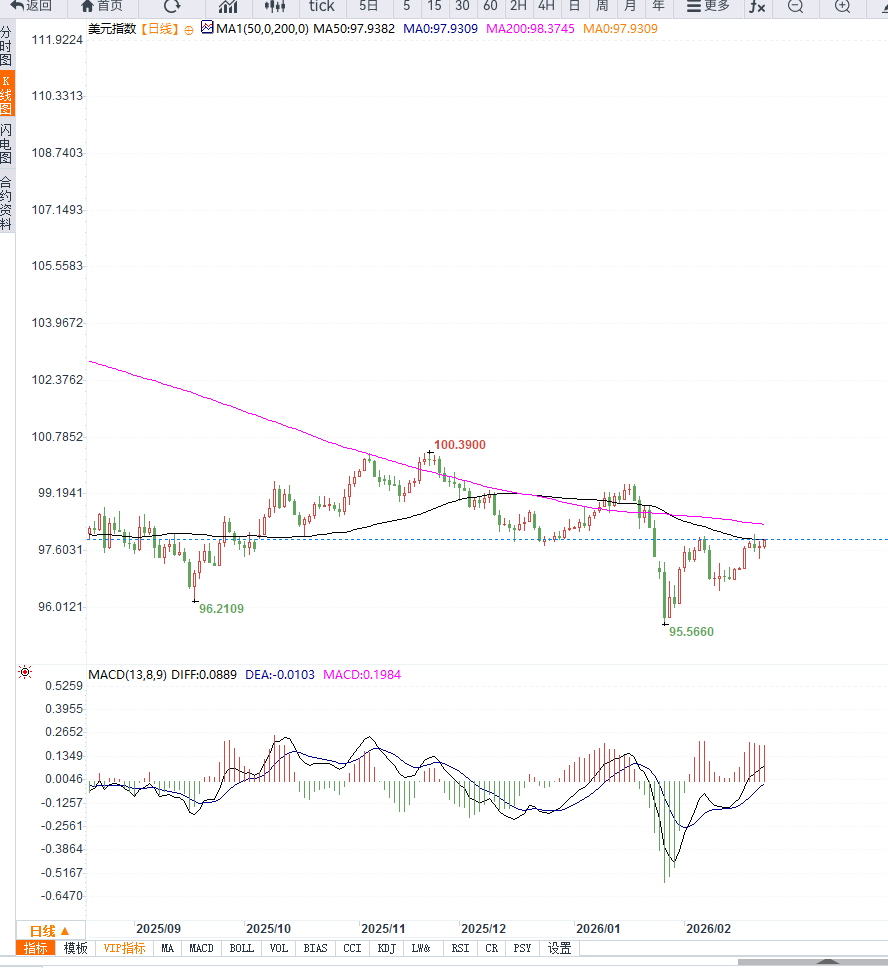
From a daily chart perspective, the US dollar index has seen a technical rebound after falling from its previous highs and is currently trading around 97.80. Prices have stabilized in the short term, but the overall trend remains range-bound. The previous pullback released some upward momentum, causing the market to re-enter a phase of directional choice.
Regarding the moving average system, the price is still fluctuating around the medium-term moving average, without forming a clear one-sided trend. If the price can regain its footing above the short-term moving average, the rebound may continue; if it falls below the recent low again, a deeper correction may follow.
In terms of momentum indicators, the RSI is in the neutral zone, with no extreme overbought or oversold signals; the MACD histogram is gradually contracting, indicating that bullish momentum has not yet formed a trend of expansion. Recent candlestick bodies have been relatively small, suggesting a strong wait-and-see attitude in the market.
The current key price range is between 97.20 and 98.50, with 97.20 forming a short-term support area and 98.50 being the main resistance area above.
A break above 98.50 could open up further upside potential, while a drop below 97.20 could lead to a retest of lower support levels. Overall, the US dollar index's technical structure suggests that the rebound and correction are incomplete, but the trend has not yet been established.
Editor's Note:
The current trend of the US dollar index essentially reflects the complex environment of intertwined policy expectations and trade uncertainties. In the short term, US employment data will determine whether the Federal Reserve continues its wait-and-see stance; in the medium term, the divergence in policy paths among major central banks globally will be a key variable.
The US dollar is unlikely to establish a sustained one-sided trend until trade policies become clearer. Employment data, details of tariff policy implementation, and changes in global central bank policy communication will determine the next direction of the US dollar index.
Market focus is on the US ADP employment data and speeches by Federal Reserve officials. The Fed's policy stance remains cautiously inactive. Fed Governor Waller stated that whether to support a rate cut at the March meeting will depend on the February labor market data.
The interest rate market currently only estimates a 5% probability of a rate cut in March, but still anticipates gradual easing over the next few years. Meanwhile, the Trump administration is considering imposing national security tariffs on multiple industries under Section 232 of the Trade Expansion Act of 1962.
This move is independent of the previously announced 15% global tariff policy. Adjustments to trade policy increase uncertainty regarding the path of global economic growth and inflation, potentially affecting international capital's willingness to allocate to dollar-denominated assets.
At the international level, the EU indicated it might suspend its ratification process for the trade agreement with the US. Meanwhile, the US and India postponed their scheduled trade negotiations, suggesting Washington is reassessing its overall tariff strategy.
Congress is also unlikely to extend the new tariffs for more than 150 days, casting doubt on the policy's sustainability. From a global policy divergence perspective, the market expects the Federal Reserve to cut interest rates by a cumulative total of about 50 basis points by 2026, while the Bank of Japan is likely to raise rates by another 25 basis points, and the European Central Bank is expected to maintain policy stability.
Policy differences among major economies will have a profound impact on the medium- to long-term trend of the US dollar index. Overall, the US dollar is currently in a state of both short-term rebound and medium-term pressure.
From a daily chart perspective, the US dollar index has seen a technical rebound after falling from its previous highs and is currently trading around 97.80. Prices have stabilized in the short term, but the overall trend remains range-bound. The previous pullback released some upward momentum, causing the market to re-enter a phase of directional choice.
Regarding the moving average system, the price is still fluctuating around the medium-term moving average, without forming a clear one-sided trend. If the price can regain its footing above the short-term moving average, the rebound may continue; if it falls below the recent low again, a deeper correction may follow.
In terms of momentum indicators, the RSI is in the neutral zone, with no extreme overbought or oversold signals; the MACD histogram is gradually contracting, indicating that bullish momentum has not yet formed a trend of expansion. Recent candlestick bodies have been relatively small, suggesting a strong wait-and-see attitude in the market.
The current key price range is between 97.20 and 98.50, with 97.20 forming a short-term support area and 98.50 being the main resistance area above.
A break above 98.50 could open up further upside potential, while a drop below 97.20 could lead to a retest of lower support levels. Overall, the US dollar index's technical structure suggests that the rebound and correction are incomplete, but the trend has not yet been established.
Editor's Note:
The current trend of the US dollar index essentially reflects the complex environment of intertwined policy expectations and trade uncertainties. In the short term, US employment data will determine whether the Federal Reserve continues its wait-and-see stance; in the medium term, the divergence in policy paths among major central banks globally will be a key variable.
The US dollar is unlikely to establish a sustained one-sided trend until trade policies become clearer. Employment data, details of tariff policy implementation, and changes in global central bank policy communication will determine the next direction of the US dollar index.
- Risk Warning and Disclaimer
- The market involves risk, and trading may not be suitable for all investors. This article is for reference only and does not constitute personal investment advice, nor does it take into account certain users’ specific investment objectives, financial situation, or other needs. Any investment decisions made based on this information are at your own risk.