A chart: The Baltic Dry Index (BDI) is at 2129 points, with both supply and demand driving the continued upward trend.
2026-02-25 01:56:34
Latest data shows that the Baltic Dry Index (BDI) reached 2129 points on February 24, 2026, a new high since January 30, 2026, up 0.80% month-on-month, marking the third consecutive day of increase (including zero growth). Looking at the short-term charts, the recent 11 BDI data points show: 6 positive increases, 5 negative increases, and 0 zero increases. Specifically, the Panamax Freight Index (BPI) was 1866 points, up 0.70% from the previous value; the Capesize Freight Index (BCI) was 3207 points, down 0.09%; and the Supramax Freight Index (BSI) was 1217 points, up 3.22%. For detailed 720-day and 10-year trend charts of the Baltic Dry Index and its three main sub-indices, please refer to the specially designed charts.
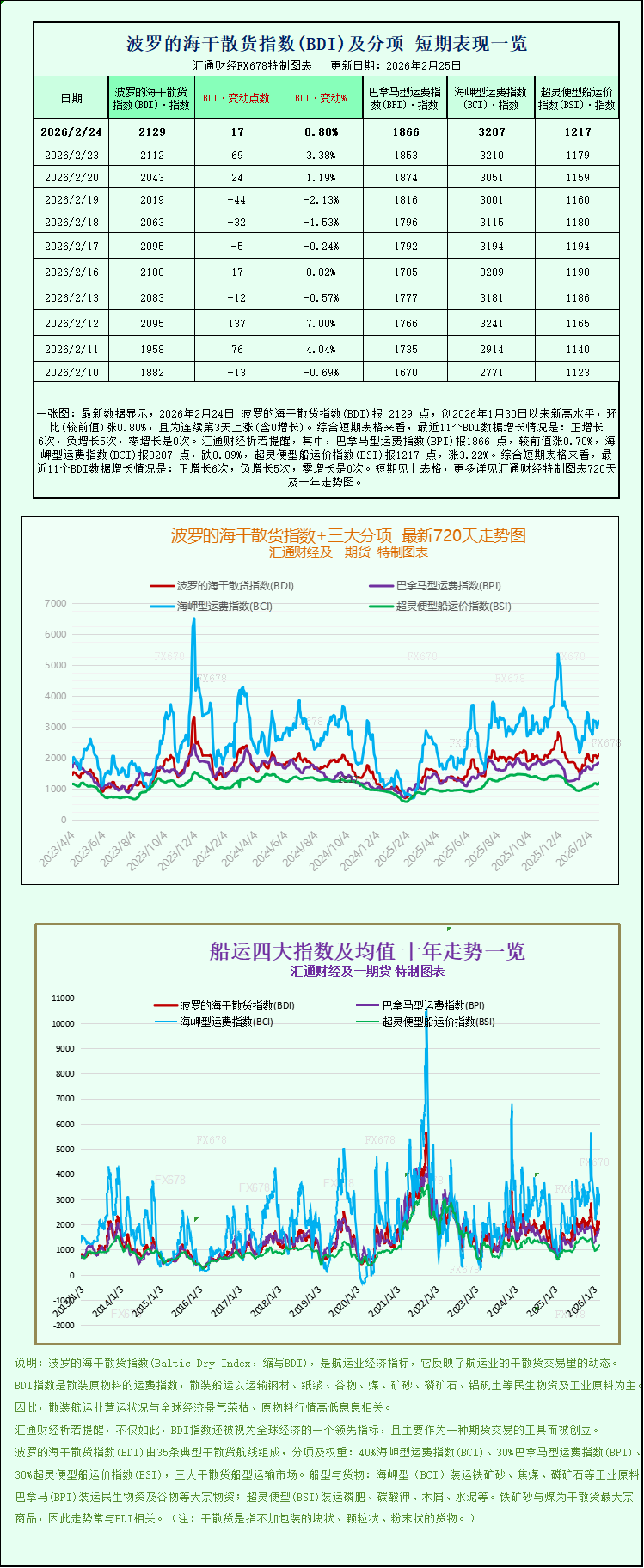
The Baltic Dry Index (BDI) continued its climb on Tuesday, closing at 2,129 points, demonstrating strong intrinsic momentum in the shipping market. Following a remarkable 3.4% gain on Monday, reaching a three-week high, the index rose again modestly by 17 points, or approximately 0.8%. Reuters and senior market analysts pointed out that the current broad-based rise in freight rates is not an isolated surge in a single vessel type, but rather stems from the overall recovery in global industrial raw material trade. In particular, the robust demand for Capesize vessels in the iron ore transportation sector has become the core engine supporting the continued upward movement of the overall index. This "multi-pronged" approach provides a solid defensive foundation for freight rates at their bottom.
The Capesize Index (BCI) performed the best, continuing to lead the overall index. At the beginning of the week, the Capesize index surged 159 points to 3,210 points, and today it maintained a strong consolidation at high levels. Benefiting from the concentrated release of iron ore shipments on major routes between Brazil and Western Australia, the average daily charter rate for Capesize vessels has steadily climbed above the US$25,000 mark, far exceeding their operating break-even point. Although the upward momentum subsided slightly during the day compared to the earlier session, the overall slope remains upward, clearly reflecting a significant demand recovery in the dry bulk shipping market in the medium term, with commodity traders showing a marked increase in their willingness to charter vessels.
Panamax and Supramax vessels maintained steady growth, with demand across different shipping segments showing a rare balanced distribution. The Panamax freight index (BPI) is currently holding steady above 1,850 points, with daily profitability remaining at a high level of around US$16,000. This is mainly due to the approaching peak season for South American grain exports and a temporary rebound in coal demand in the Northern Hemisphere during the spring. Meanwhile, the Supramax bulk carrier index (BSI) has also completely shaken off its previous slump, rising slightly to around 1,179 points. This across-the-board growth across medium and large vessel types confirms the accelerated global flow of primary raw materials and reflects the urgency of the manufacturing supply chain to replenish raw material inventories.
Technical analysis and market outlook are optimistic, with the Baltic Dry Index (BDI) poised to challenge higher levels within an upward channel. Over the past month, the BDI has recorded a cumulative increase of nearly 20%, with a year-on-year increase exceeding a staggering 100%, indicating a qualitative leap in the shipping cycle. Analysts generally believe that with the continued improvement in demand expectations from major raw material importing countries (especially China), coupled with the seasonal boost from the concentrated commencement of global infrastructure projects, if the BDI can effectively hold above the key psychological level of 2,100 points, it has a very high probability of challenging the peak reached at the beginning of the year. This upward momentum not only boosts shipowner confidence but also injects a strong dose of confidence into the global economic recovery.
The Baltic Dry Index (BDI) continued its climb on Tuesday, closing at 2,129 points, demonstrating strong intrinsic momentum in the shipping market. Following a remarkable 3.4% gain on Monday, reaching a three-week high, the index rose again modestly by 17 points, or approximately 0.8%. Reuters and senior market analysts pointed out that the current broad-based rise in freight rates is not an isolated surge in a single vessel type, but rather stems from the overall recovery in global industrial raw material trade. In particular, the robust demand for Capesize vessels in the iron ore transportation sector has become the core engine supporting the continued upward movement of the overall index. This "multi-pronged" approach provides a solid defensive foundation for freight rates at their bottom.
The Capesize Index (BCI) performed the best, continuing to lead the overall index. At the beginning of the week, the Capesize index surged 159 points to 3,210 points, and today it maintained a strong consolidation at high levels. Benefiting from the concentrated release of iron ore shipments on major routes between Brazil and Western Australia, the average daily charter rate for Capesize vessels has steadily climbed above the US$25,000 mark, far exceeding their operating break-even point. Although the upward momentum subsided slightly during the day compared to the earlier session, the overall slope remains upward, clearly reflecting a significant demand recovery in the dry bulk shipping market in the medium term, with commodity traders showing a marked increase in their willingness to charter vessels.
Panamax and Supramax vessels maintained steady growth, with demand across different shipping segments showing a rare balanced distribution. The Panamax freight index (BPI) is currently holding steady above 1,850 points, with daily profitability remaining at a high level of around US$16,000. This is mainly due to the approaching peak season for South American grain exports and a temporary rebound in coal demand in the Northern Hemisphere during the spring. Meanwhile, the Supramax bulk carrier index (BSI) has also completely shaken off its previous slump, rising slightly to around 1,179 points. This across-the-board growth across medium and large vessel types confirms the accelerated global flow of primary raw materials and reflects the urgency of the manufacturing supply chain to replenish raw material inventories.
Technical analysis and market outlook are optimistic, with the Baltic Dry Index (BDI) poised to challenge higher levels within an upward channel. Over the past month, the BDI has recorded a cumulative increase of nearly 20%, with a year-on-year increase exceeding a staggering 100%, indicating a qualitative leap in the shipping cycle. Analysts generally believe that with the continued improvement in demand expectations from major raw material importing countries (especially China), coupled with the seasonal boost from the concentrated commencement of global infrastructure projects, if the BDI can effectively hold above the key psychological level of 2,100 points, it has a very high probability of challenging the peak reached at the beginning of the year. This upward momentum not only boosts shipowner confidence but also injects a strong dose of confidence into the global economic recovery.
- Risk Warning and Disclaimer
- The market involves risk, and trading may not be suitable for all investors. This article is for reference only and does not constitute personal investment advice, nor does it take into account certain users’ specific investment objectives, financial situation, or other needs. Any investment decisions made based on this information are at your own risk.