The US wants to cut off Russia-India energy lines? The Supreme Court says no! Is Russia's oil supply secure?
2026-02-25 10:58:46
On February 20, the U.S. Supreme Court ruled that the president does not have the authority to unilaterally impose broad tariffs under the International Emergency Economic Powers Act (IEEPA), effectively repealing previous punitive tariffs imposed on countries such as India. This ruling significantly reduces the U.S. government's flexibility in using tariffs to pressure other countries' energy policies, providing India with greater room to maintain its energy trade with Russia.
The US Supreme Court ruling weakens the US's ability to intervene in India's purchases of Russian oil through tariffs. This helps maintain a stable supply of Russian crude oil to Asia and, in the long term, helps stabilize oil prices. However, this is a slow-moving variable, and the short-term market focus remains on the US-Iran geopolitical situation. On Wednesday (February 25), US crude oil prices fluctuated upwards and are currently trading around $66.20 per barrel, with a daily increase of approximately 0.85%.
As one of Russia's largest buyers of crude oil, India's purchases of Russian oil have long been a thorny issue in US-India relations. In August 2025, the Trump administration imposed an additional 25% tariff on Indian goods, which, combined with the existing 25% tariff, brought India's total tariffs on US exports to as high as 50%, the highest among all of the US's trading partners.
Earlier this month, the US and India reached a provisional trade agreement, with the US reducing tariffs on Indian goods from 50% to 18% and, on February 6, removing the punitive 25% tariff on Indian goods by executive order. Trump claimed that India pledged to "directly or indirectly cease importing Russian oil" and switch to purchasing US energy products. However, the joint US-India statement did not explicitly mention India's commitment to reduce Russian oil imports, only stating that India plans to purchase $500 billion worth of goods from the US over the next five years, including energy.
According to energy data provider Kpler, India's average daily imports of Russian crude oil are projected to reach 1.71 million barrels in 2025, but have fallen to 1.16 million barrels per day so far in February 2026. Kpler senior crude oil analyst Muyu Xu pointed out that due to the temporary US-India agreement, Indian refineries have postponed bookings for Russian crude oil arriving in April this month. However, following the Supreme Court ruling, Xu believes India has room to maintain Russian oil imports at a level of 800,000 to 1 million barrels per day.
“I expect India to maintain a healthy relationship with Russia, including in the energy sector,” said Sarang Shidore, director of the Global South program at the Quincy Institute for Responsible Statecraft. He added that India might moderately reduce its Russian oil purchases, but a complete halt is highly unlikely. The court ruling limits Trump’s ability to adjust tariffs based on non-trade or non-economic factors such as Russian oil purchases.
Oxford Economics chief economist Alexandra Hermann points out that India's commitment to Russian oil "has never been formally codified into law and has consistently proven difficult to enforce in practice." India's energy strategy is primarily price-driven and aims to avoid over-reliance on a single supplier. US crude oil is unlikely to replace Russian crude oil on a significant scale.
Pankaj Srivastava, Senior Vice President of Commodity Markets at Rystad Energy, stated that despite repeated pressure from the United States using tariffs, India continues to import Russian oil. The Supreme Court ruling, coupled with Trump's subsequent imposition of a 10% global import tariff under Section 122 of the Trade Act of 1974 (later adjusted to 15%, but a customs memorandum confirmed the effective rate as 10%), has diminished the potential advantage of the interim trade agreement for Indian exporters.
Analysts believe the US is unlikely to exert excessive pressure on India over Russian oil, lest it jeopardize energy exports to India. Currently, India imports 200,000-300,000 barrels of crude oil daily from the US, ranking as its sixth-largest supplier, while Russia remained India's largest crude oil supplier as of the end of January.
The Indian trade delegation has rescheduled its visit to the United States to finalize details of a provisional trade agreement. A source familiar with the matter revealed that the visit will take place after both sides assess the latest developments and their impact.
The US Supreme Court ruling has reduced the extent to which geopolitics distorts oil trade flows. It reinforces market logic: as long as Russian oil maintains a price advantage and India needs to ensure energy security, Russian oil will continue to flow to Asia. This acts as a stabilizer and buffer for global oil prices—reducing the risk of a sharp drop in supply due to escalating sanctions—but also means that Russia can maintain its oil production and export capacity for a longer period.
Overall, the Supreme Court's rejection of the IEEPA tariffs grants India greater autonomy in its decisions regarding Russian oil imports. Despite lingering geopolitical pressures, price advantages and supply security considerations will continue to dominate India's energy import strategy. The Indian Ministry of Petroleum and Natural Gas did not respond to requests for comment.
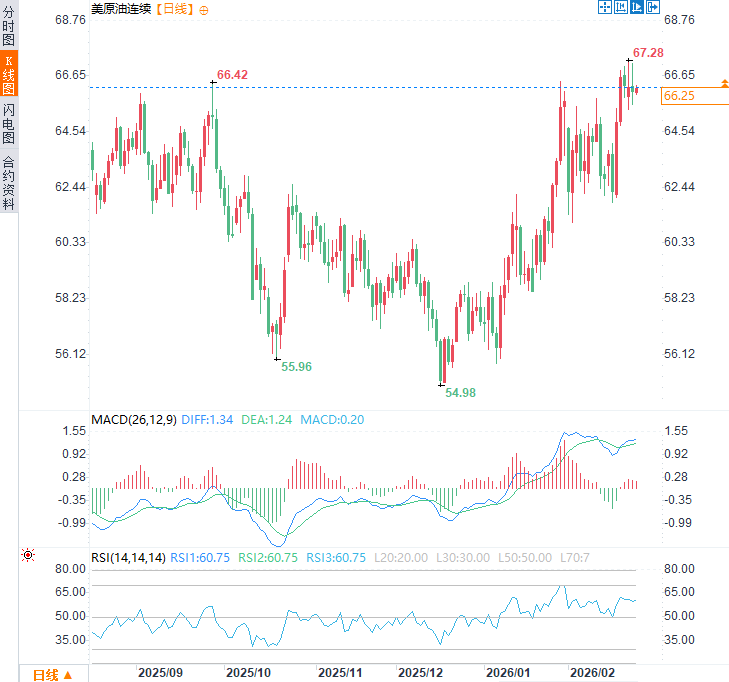
(US crude oil daily chart, source: FX678)
At 10:58 Beijing time, US crude oil futures were trading at $66.27 per barrel.
The US Supreme Court ruling weakens the US's ability to intervene in India's purchases of Russian oil through tariffs. This helps maintain a stable supply of Russian crude oil to Asia and, in the long term, helps stabilize oil prices. However, this is a slow-moving variable, and the short-term market focus remains on the US-Iran geopolitical situation. On Wednesday (February 25), US crude oil prices fluctuated upwards and are currently trading around $66.20 per barrel, with a daily increase of approximately 0.85%.
India's Russian oil imports are affected by tariffs, but the outlook is turning positive.
As one of Russia's largest buyers of crude oil, India's purchases of Russian oil have long been a thorny issue in US-India relations. In August 2025, the Trump administration imposed an additional 25% tariff on Indian goods, which, combined with the existing 25% tariff, brought India's total tariffs on US exports to as high as 50%, the highest among all of the US's trading partners.
Earlier this month, the US and India reached a provisional trade agreement, with the US reducing tariffs on Indian goods from 50% to 18% and, on February 6, removing the punitive 25% tariff on Indian goods by executive order. Trump claimed that India pledged to "directly or indirectly cease importing Russian oil" and switch to purchasing US energy products. However, the joint US-India statement did not explicitly mention India's commitment to reduce Russian oil imports, only stating that India plans to purchase $500 billion worth of goods from the US over the next five years, including energy.
According to energy data provider Kpler, India's average daily imports of Russian crude oil are projected to reach 1.71 million barrels in 2025, but have fallen to 1.16 million barrels per day so far in February 2026. Kpler senior crude oil analyst Muyu Xu pointed out that due to the temporary US-India agreement, Indian refineries have postponed bookings for Russian crude oil arriving in April this month. However, following the Supreme Court ruling, Xu believes India has room to maintain Russian oil imports at a level of 800,000 to 1 million barrels per day.
“I expect India to maintain a healthy relationship with Russia, including in the energy sector,” said Sarang Shidore, director of the Global South program at the Quincy Institute for Responsible Statecraft. He added that India might moderately reduce its Russian oil purchases, but a complete halt is highly unlikely. The court ruling limits Trump’s ability to adjust tariffs based on non-trade or non-economic factors such as Russian oil purchases.
The core of India's energy strategy: price and diversification
Oxford Economics chief economist Alexandra Hermann points out that India's commitment to Russian oil "has never been formally codified into law and has consistently proven difficult to enforce in practice." India's energy strategy is primarily price-driven and aims to avoid over-reliance on a single supplier. US crude oil is unlikely to replace Russian crude oil on a significant scale.
Pankaj Srivastava, Senior Vice President of Commodity Markets at Rystad Energy, stated that despite repeated pressure from the United States using tariffs, India continues to import Russian oil. The Supreme Court ruling, coupled with Trump's subsequent imposition of a 10% global import tariff under Section 122 of the Trade Act of 1974 (later adjusted to 15%, but a customs memorandum confirmed the effective rate as 10%), has diminished the potential advantage of the interim trade agreement for Indian exporters.
Analysts believe the US is unlikely to exert excessive pressure on India over Russian oil, lest it jeopardize energy exports to India. Currently, India imports 200,000-300,000 barrels of crude oil daily from the US, ranking as its sixth-largest supplier, while Russia remained India's largest crude oil supplier as of the end of January.
Prospects for US-India Trade Negotiations
The Indian trade delegation has rescheduled its visit to the United States to finalize details of a provisional trade agreement. A source familiar with the matter revealed that the visit will take place after both sides assess the latest developments and their impact.
The US Supreme Court ruling has reduced the extent to which geopolitics distorts oil trade flows. It reinforces market logic: as long as Russian oil maintains a price advantage and India needs to ensure energy security, Russian oil will continue to flow to Asia. This acts as a stabilizer and buffer for global oil prices—reducing the risk of a sharp drop in supply due to escalating sanctions—but also means that Russia can maintain its oil production and export capacity for a longer period.
Overall, the Supreme Court's rejection of the IEEPA tariffs grants India greater autonomy in its decisions regarding Russian oil imports. Despite lingering geopolitical pressures, price advantages and supply security considerations will continue to dominate India's energy import strategy. The Indian Ministry of Petroleum and Natural Gas did not respond to requests for comment.
(US crude oil daily chart, source: FX678)
At 10:58 Beijing time, US crude oil futures were trading at $66.27 per barrel.
- Risk Warning and Disclaimer
- The market involves risk, and trading may not be suitable for all investors. This article is for reference only and does not constitute personal investment advice, nor does it take into account certain users’ specific investment objectives, financial situation, or other needs. Any investment decisions made based on this information are at your own risk.