WTI crude oil retreated after hitting a 7-month high, indicating a short-term consolidation pattern.
2026-02-25 22:00:48
On Wednesday (February 25), WTI crude oil futures rose slightly during the European session, reversing the earlier pullback. Earlier this week, it had reached a seven-month high of $67.28 per barrel (the highest since September 2025). Since February, WTI crude oil has been trending upwards, consolidating between $62 and $64 per barrel at the beginning of the month before climbing to around $66 per barrel in the latter half, a monthly increase of over 8%, mainly driven by tightening supply, geopolitical risks, and resilient demand.

At 21:50 Beijing time, April WTI crude oil futures were trading at $66.03 per barrel (+$0.40, +0.61%), while Brent crude oil was trading at $71.06 per barrel (-$0.17, -0.24%). Current oil prices are facing a "two-way constraint": geopolitical factors and OPEC+ production cuts are supporting upward movement, while surging inventories and weaker-than-expected demand recovery are limiting gains, making a one-sided market trend unlikely in the short term. Goldman Sachs recently raised its Q4 2026 WTI oil price forecast to $56 per barrel, confirming a positive shift in the supply and demand dynamics.
The market is focused on the EIA inventory report, while a surge in API inventories has raised concerns about a bearish outlook.
At 23:30 Beijing time today, the EIA will release official crude oil inventory data. The market expects an increase of 1.3 million barrels, contrasting with last week's decrease of 2.3 million barrels, highlighting concerns about inventory accumulation. The average increase in inventories over the past five years for the same period is 3.1 million barrels. If this data is close to or exceeds the average, it will strengthen bearish sentiment and push oil prices to test the trendline support at $64.98 per barrel; if it is lower than expected, it may drive oil prices to test the resistance above $67 per barrel.
Prior to the EIA data release, news of a staggering 11.43 million barrel increase in API private inventories (compared to an expected increase of 1 million barrels) had already put the market on the bearish side. The main reason behind this was that the decline in US crude oil imports was less than the increase in production, and refinery utilization (91%) had not fully absorbed the increased output. Last week, the EIA reported a 9 million barrel decrease in inventories, which boosted oil prices. However, this API data overturned the optimistic expectation of a decline in inventories, highlighting the current loose global supply and demand situation and creating a game of "geopolitical support for prices and inventory pressure on prices."
The situation in Iran keeps risk premiums in place, and US-Iran negotiations become a key short-term variable.
The Middle East accounts for over 35% of global crude oil production, and the Strait of Hormuz transports over 17 million barrels of crude oil daily (nearly 20% of global production). Escalating conflict between the US and Iran will directly disrupt supply, making geopolitical risk premiums a core "safety net" for oil prices. The US-Iran nuclear negotiations have been fraught with difficulties. Relations deteriorated after the US withdrew from the Iran nuclear deal in 2018. Five rounds of indirect negotiations were interrupted by an Israeli attack in 2025, and the two rounds in early 2026 yielded no substantial progress.
The US and Iran will hold their third round of talks in Geneva on February 26. The US demands that Iran halt its nuclear activities and ballistic missile program, while Iran insists on its right to nuclear facilities and refuses to negotiate on the missile issue. President Trump has recently made several strong statements, saying he will never allow Iran to possess nuclear weapons, stabilizing risk premiums but failing to stimulate new buying. The Israeli Prime Minister's additional demands further increase the uncertainty of the negotiations.
Technical Analysis: The upward trend remains intact, but it faces multiple challenges.
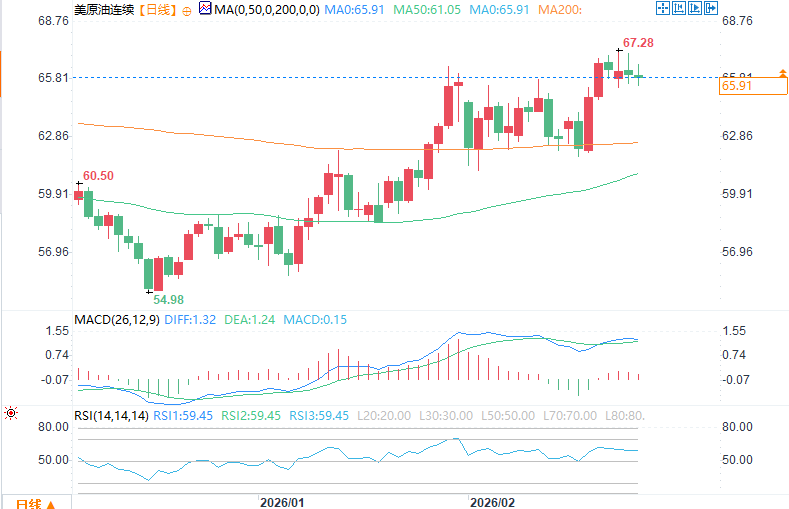
(WTI crude oil daily chart source: FX678)
From the perspective of moving averages, trend lines, and oscillating charts, the WTI crude oil futures contract remains in an upward trend, but faces short-term downward pressure. Support is found at the 200-day moving average at $62.59/barrel and the 50-day moving average at $61.05/barrel; the latter is about to cross above the former, forming a "golden cross," indicating a clear bullish signal in the medium to long term. In the short term, profit-taking has occurred after oil prices reached their highs, and the 5-day and 10-day moving averages have slightly turned downwards, increasing the risk of a pullback.
Today's trendline support is at $64.98/barrel; a break below this level could lead to a pullback to the $63-$64/barrel range. A break above the $67.28/barrel high would resume the upward trend, potentially reaching $68-$70/barrel. Short-term hourly charts show a slightly weak bias, while the daily chart shows range-bound trading. Key support levels to watch are $65.5-$65.8/barrel, and key resistance levels are $66.8-$67.4/barrel.
Thursday's negotiations: The next key focus for the market, determining the short-term direction of oil prices.
Thursday's US-Iran talks are the key short-term variable for the oil market, likely resulting in one of two outcomes: a breakdown in negotiations or continued consultations. If negotiations break down and the conflict escalates, geopolitical risk premiums will surge, potentially pushing WTI crude oil above $70 per barrel. If negotiations continue and geopolitical premiums cool, the market will return to supply and demand fundamentals. Coupled with bearish API inventory data and the IEA's forecast of a 2.96 million barrel daily global inventory accumulation in 2026, oil prices may retreat to the $64-65 per barrel range.
OPEC+ production cuts provide medium- to long-term support for oil prices. In March 2026, the eight core oil-producing countries continued their voluntary production cuts of 3.24 million barrels per day. In January, OPEC+ daily production decreased by 439,000 barrels month-on-month, further widening the supply gap. Even if there is a short-term correction, the downside potential is limited.
At 21:50 Beijing time, April WTI crude oil futures were trading at $66.03 per barrel (+$0.40, +0.61%), while Brent crude oil was trading at $71.06 per barrel (-$0.17, -0.24%). Current oil prices are facing a "two-way constraint": geopolitical factors and OPEC+ production cuts are supporting upward movement, while surging inventories and weaker-than-expected demand recovery are limiting gains, making a one-sided market trend unlikely in the short term. Goldman Sachs recently raised its Q4 2026 WTI oil price forecast to $56 per barrel, confirming a positive shift in the supply and demand dynamics.
The market is focused on the EIA inventory report, while a surge in API inventories has raised concerns about a bearish outlook.
At 23:30 Beijing time today, the EIA will release official crude oil inventory data. The market expects an increase of 1.3 million barrels, contrasting with last week's decrease of 2.3 million barrels, highlighting concerns about inventory accumulation. The average increase in inventories over the past five years for the same period is 3.1 million barrels. If this data is close to or exceeds the average, it will strengthen bearish sentiment and push oil prices to test the trendline support at $64.98 per barrel; if it is lower than expected, it may drive oil prices to test the resistance above $67 per barrel.
Prior to the EIA data release, news of a staggering 11.43 million barrel increase in API private inventories (compared to an expected increase of 1 million barrels) had already put the market on the bearish side. The main reason behind this was that the decline in US crude oil imports was less than the increase in production, and refinery utilization (91%) had not fully absorbed the increased output. Last week, the EIA reported a 9 million barrel decrease in inventories, which boosted oil prices. However, this API data overturned the optimistic expectation of a decline in inventories, highlighting the current loose global supply and demand situation and creating a game of "geopolitical support for prices and inventory pressure on prices."
The situation in Iran keeps risk premiums in place, and US-Iran negotiations become a key short-term variable.
The Middle East accounts for over 35% of global crude oil production, and the Strait of Hormuz transports over 17 million barrels of crude oil daily (nearly 20% of global production). Escalating conflict between the US and Iran will directly disrupt supply, making geopolitical risk premiums a core "safety net" for oil prices. The US-Iran nuclear negotiations have been fraught with difficulties. Relations deteriorated after the US withdrew from the Iran nuclear deal in 2018. Five rounds of indirect negotiations were interrupted by an Israeli attack in 2025, and the two rounds in early 2026 yielded no substantial progress.
The US and Iran will hold their third round of talks in Geneva on February 26. The US demands that Iran halt its nuclear activities and ballistic missile program, while Iran insists on its right to nuclear facilities and refuses to negotiate on the missile issue. President Trump has recently made several strong statements, saying he will never allow Iran to possess nuclear weapons, stabilizing risk premiums but failing to stimulate new buying. The Israeli Prime Minister's additional demands further increase the uncertainty of the negotiations.
Technical Analysis: The upward trend remains intact, but it faces multiple challenges.
(WTI crude oil daily chart source: FX678)
From the perspective of moving averages, trend lines, and oscillating charts, the WTI crude oil futures contract remains in an upward trend, but faces short-term downward pressure. Support is found at the 200-day moving average at $62.59/barrel and the 50-day moving average at $61.05/barrel; the latter is about to cross above the former, forming a "golden cross," indicating a clear bullish signal in the medium to long term. In the short term, profit-taking has occurred after oil prices reached their highs, and the 5-day and 10-day moving averages have slightly turned downwards, increasing the risk of a pullback.
Today's trendline support is at $64.98/barrel; a break below this level could lead to a pullback to the $63-$64/barrel range. A break above the $67.28/barrel high would resume the upward trend, potentially reaching $68-$70/barrel. Short-term hourly charts show a slightly weak bias, while the daily chart shows range-bound trading. Key support levels to watch are $65.5-$65.8/barrel, and key resistance levels are $66.8-$67.4/barrel.
Thursday's negotiations: The next key focus for the market, determining the short-term direction of oil prices.
Thursday's US-Iran talks are the key short-term variable for the oil market, likely resulting in one of two outcomes: a breakdown in negotiations or continued consultations. If negotiations break down and the conflict escalates, geopolitical risk premiums will surge, potentially pushing WTI crude oil above $70 per barrel. If negotiations continue and geopolitical premiums cool, the market will return to supply and demand fundamentals. Coupled with bearish API inventory data and the IEA's forecast of a 2.96 million barrel daily global inventory accumulation in 2026, oil prices may retreat to the $64-65 per barrel range.
OPEC+ production cuts provide medium- to long-term support for oil prices. In March 2026, the eight core oil-producing countries continued their voluntary production cuts of 3.24 million barrels per day. In January, OPEC+ daily production decreased by 439,000 barrels month-on-month, further widening the supply gap. Even if there is a short-term correction, the downside potential is limited.
- Risk Warning and Disclaimer
- The market involves risk, and trading may not be suitable for all investors. This article is for reference only and does not constitute personal investment advice, nor does it take into account certain users’ specific investment objectives, financial situation, or other needs. Any investment decisions made based on this information are at your own risk.