When the US dollar is "protected," what can the Swiss franc use to withstand this wave of interest rate differentials?
2026-02-25 21:34:57
On Wednesday, February 25th, the USD/CHF pair showed a slightly stronger stance amid fluctuations, hovering around 0.7750 during the North American session. The exchange rate stabilized and rebounded after hitting an intraday low of 0.7718. This was not merely random market noise, but a direct reflection of a subtle shift in trading logic. Previously, the market had been fervently betting on a swift rate cut by the Federal Reserve, but Chicago Fed President Goolsby issued a cautious signal on Tuesday, emphasizing that premature action was not advisable until inflation clearly returned to the 2% target. This statement poured cold water on overheated expectations, causing traders to adjust their positions and postpone the timetable for rate cuts.
This shift in expectations has directly reshaped the short-term fate of the US dollar. The current market consensus has shifted to the view that the Federal Reserve is highly likely to hold rates steady at its March and April meetings, although a further 50 basis point rate cut is still priced in for the year, but at a significantly delayed pace. Even more intriguing is the change in probability between June and July: June, once considered the prime window for a rate cut, has seen its probability drop from about 50% a week ago to about 40%; while July has risen to about 65%. For the foreign exchange market, this shift from an "early cut" to a "late cut" narrative means that the dollar's high interest rate advantage will last longer, and this marginal increase in the attractiveness of the interest rate differential has become the core engine driving the dollar's appreciation against the Swiss franc.
Just as the US dollar strengthened, the Swiss franc's fundamentals failed to provide sufficient ammunition for a counterattack. Although economic sentiment in Switzerland improved somewhat in February, with the expectations index jumping sharply from -4.7 to 9.8, this improvement failed to translate into a strong rise in the franc. The key reason lies in the overly "calm" remarks made by Swiss National Bank President Schlegel on Tuesday. He explicitly stated that even if negative inflation occurs for several consecutive months, there is no need to sound the alarm in the medium term, and predicted that inflation will rebound in subsequent quarters. This tolerance for short-term deflation has actually weakened market expectations that the Swiss National Bank will be forced to implement aggressive easing due to low inflation, but it has also dispelled the one-sided illusion held by some investors that "low inflation inevitably leads to a tough policy."
Schlegel also reiterated that the central bank is prepared to intervene if exchange rate fluctuations jeopardize price stability and financial conditions. This statement sends a complex signal: on the one hand, it shows the central bank has a policy toolbox and is unwilling to see excessive volatility in the Swiss franc; on the other hand, it also suggests that, as long as the bottom line is not crossed, the Swiss franc's movements will be more constrained by changes in external interest rate differentials than by internal data. In this context, the Swiss franc is unlikely to move independently and is more likely to become a "shadow" of changes in dollar interest rate differentials and risk sentiment fluctuations. When the dollar strengthens due to delayed expectations of interest rate cuts, the Swiss franc often only passively faces pressure, and unless there is extreme demand for safe-haven assets, it is difficult to see any momentum for a significant independent appreciation.
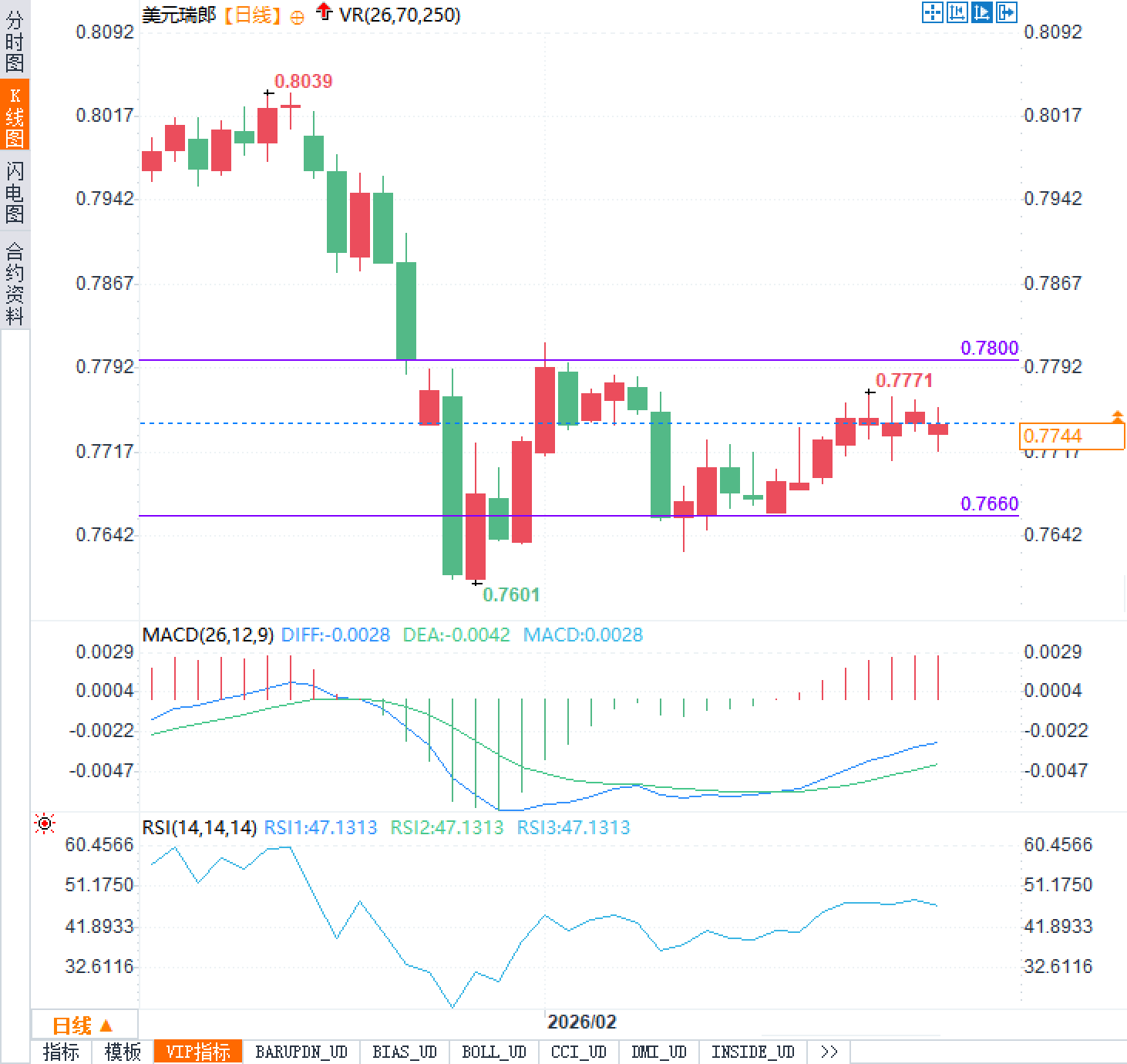
From a technical chart perspective, the USD/CHF pair is currently in a typical phase of correction and consolidation. The daily chart shows that after falling from a high of 0.8039, the pair bottomed out around 0.7601 and is currently trading in the upper part of a range between 0.7660 and 0.7800. 0.7800 forms a formidable resistance level; failure to break through this resistance zone could easily lead to a pullback. Conversely, 0.7660 is a key support level; a breach of this level could see the market retest the previous low support at 0.7601. While the MACD momentum indicator shows the histogram turning positive, with the DIFF and DEA at -0.0028 and -0.0042 respectively, indicating weakening downward momentum and a reversal in the market, the two lines remain deeply below the zero line, meaning a trend reversal has not yet been confirmed. The RSI indicator is in the neutral-to-weak zone at 47, further confirming the current market's characteristic of "hesitant to rise and trapped in consolidation."
Analysts believe the core logic of short-term trading lies in the combined effect of two variables: first, the delayed expectation of a Fed rate cut provides marginal support for the dollar; second, the Swiss National Bank's relaxed stance on negative inflation limits the upside potential of the Swiss franc. Under this combined pressure, the exchange rate is more likely to fluctuate between 0.7660 and 0.7800. The real turning point may not arrive until Friday, when the US Producer Price Index and Swiss Q4 GDP data will be released. The former relates to upstream inflationary pressures, while the latter reflects Swiss growth momentum. Any unexpected deviation in either data could be the trigger to break the current stalemate and cause the exchange rate to break through or fall below key price levels.
This shift in expectations has directly reshaped the short-term fate of the US dollar. The current market consensus has shifted to the view that the Federal Reserve is highly likely to hold rates steady at its March and April meetings, although a further 50 basis point rate cut is still priced in for the year, but at a significantly delayed pace. Even more intriguing is the change in probability between June and July: June, once considered the prime window for a rate cut, has seen its probability drop from about 50% a week ago to about 40%; while July has risen to about 65%. For the foreign exchange market, this shift from an "early cut" to a "late cut" narrative means that the dollar's high interest rate advantage will last longer, and this marginal increase in the attractiveness of the interest rate differential has become the core engine driving the dollar's appreciation against the Swiss franc.
The Swiss Franc Dilemma: "Calmness" and Hidden Worries Amid Negative Inflation
Just as the US dollar strengthened, the Swiss franc's fundamentals failed to provide sufficient ammunition for a counterattack. Although economic sentiment in Switzerland improved somewhat in February, with the expectations index jumping sharply from -4.7 to 9.8, this improvement failed to translate into a strong rise in the franc. The key reason lies in the overly "calm" remarks made by Swiss National Bank President Schlegel on Tuesday. He explicitly stated that even if negative inflation occurs for several consecutive months, there is no need to sound the alarm in the medium term, and predicted that inflation will rebound in subsequent quarters. This tolerance for short-term deflation has actually weakened market expectations that the Swiss National Bank will be forced to implement aggressive easing due to low inflation, but it has also dispelled the one-sided illusion held by some investors that "low inflation inevitably leads to a tough policy."
Schlegel also reiterated that the central bank is prepared to intervene if exchange rate fluctuations jeopardize price stability and financial conditions. This statement sends a complex signal: on the one hand, it shows the central bank has a policy toolbox and is unwilling to see excessive volatility in the Swiss franc; on the other hand, it also suggests that, as long as the bottom line is not crossed, the Swiss franc's movements will be more constrained by changes in external interest rate differentials than by internal data. In this context, the Swiss franc is unlikely to move independently and is more likely to become a "shadow" of changes in dollar interest rate differentials and risk sentiment fluctuations. When the dollar strengthens due to delayed expectations of interest rate cuts, the Swiss franc often only passively faces pressure, and unless there is extreme demand for safe-haven assets, it is difficult to see any momentum for a significant independent appreciation.
Technical Siege: Awaiting a Breakout from Range-Bound Trading
From a technical chart perspective, the USD/CHF pair is currently in a typical phase of correction and consolidation. The daily chart shows that after falling from a high of 0.8039, the pair bottomed out around 0.7601 and is currently trading in the upper part of a range between 0.7660 and 0.7800. 0.7800 forms a formidable resistance level; failure to break through this resistance zone could easily lead to a pullback. Conversely, 0.7660 is a key support level; a breach of this level could see the market retest the previous low support at 0.7601. While the MACD momentum indicator shows the histogram turning positive, with the DIFF and DEA at -0.0028 and -0.0042 respectively, indicating weakening downward momentum and a reversal in the market, the two lines remain deeply below the zero line, meaning a trend reversal has not yet been confirmed. The RSI indicator is in the neutral-to-weak zone at 47, further confirming the current market's characteristic of "hesitant to rise and trapped in consolidation."
Analysts believe the core logic of short-term trading lies in the combined effect of two variables: first, the delayed expectation of a Fed rate cut provides marginal support for the dollar; second, the Swiss National Bank's relaxed stance on negative inflation limits the upside potential of the Swiss franc. Under this combined pressure, the exchange rate is more likely to fluctuate between 0.7660 and 0.7800. The real turning point may not arrive until Friday, when the US Producer Price Index and Swiss Q4 GDP data will be released. The former relates to upstream inflationary pressures, while the latter reflects Swiss growth momentum. Any unexpected deviation in either data could be the trigger to break the current stalemate and cause the exchange rate to break through or fall below key price levels.
- Risk Warning and Disclaimer
- The market involves risk, and trading may not be suitable for all investors. This article is for reference only and does not constitute personal investment advice, nor does it take into account certain users’ specific investment objectives, financial situation, or other needs. Any investment decisions made based on this information are at your own risk.