Silver Forecast: Tight COMEX Inventories Support Bullish Outlook and Price Forecast for Silver
2026-02-25 23:26:15
On Wednesday (February 25, 2026), spot silver prices surged, continuing the strong rebound that began last Friday. Last Friday, silver successfully broke through the important technical support level of the 50-day moving average and firmly established itself above the 50% retracement level of $83.61, laying a solid foundation for further gains. This effective technical breakout, coupled with the recent release of consistently positive fundamental news, has attracted a large influx of speculative funds back into the silver market, further fueling the bullish momentum.
However, it should be noted that even with the current strong silver price trend, the bulls still need to break through key resistance levels to continue the upward trend: First, they need to overcome the previous high of $92.20 set on February 4. After breaking through this level, they will face further important pullback resistance in the range of $92.87 to $99.66. This range is a key consolidation area during the previous rise in silver prices, and is expected to face strong profit-taking pressure.
COMEX Silver Supply Shortage: Key Driving Factors
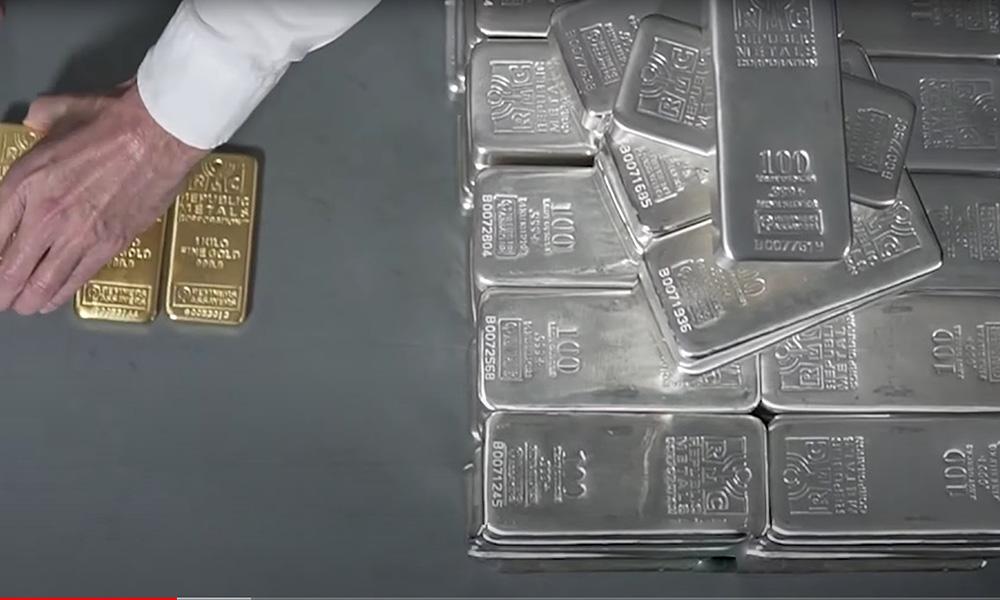
The core logic driving silver prices is the significant tightening of physical silver supply on the COMEX exchange. This phenomenon has become the focus of global silver market attention and is the core driving force behind the continued rise in silver prices.
Specifically, COMEX silver total inventories have shown a continuous downward trend: from 532 million ounces in October 2025 to 366.25 million ounces on February 20, 2026, a decrease of 31% in just over four months, exceeding market expectations for the rate of inventory reduction. More importantly, not all inventories are available for physical delivery of futures contracts—the decline in "registered inventories" (i.e., silver certified by the exchange and directly usable for futures delivery) is even more severe.
As of late February 2026, COMEX silver registered inventories had fallen below the psychologically important 90 million ounces mark, remaining at only around 88 million ounces. The reason this change has attracted significant market attention is the increasingly prominent imbalance between "paper contracts" and "physical contracts" in the silver futures market: the current open interest in silver futures contracts exceeds four times the deliverable registered inventory, meaning there are a large number of "paper contracts" in the market, but a severe shortage of corresponding physical silver. Once the futures contracts expire, a large number of holders will demand physical delivery, and the exchange will face the risk of being unable to deliver in full, potentially triggering a liquidity crisis. This is the core reason for the current high level of market tension.
March may become a critical turning point.
Industry analysts generally believe that March 2026 is likely to be a critical juncture when the current pressure on the silver market intensifies. Looking at market trends, several large global financial services institutions, including JPMorgan Chase, have recently begun issuing a large number of precious metal delivery certificates. This action sends a clear signal: market participants are gradually shifting from a speculative model of "simply rolling paper futures contracts" to a hedging model of "locking in physical precious metals," reflecting the growing concern among institutions about future physical supply shortages.
Besides the actions of financial institutions, industrial demand could also be a significant factor disrupting the supply-demand balance. Currently, global industrial silver consumption remains robust, while industrial enterprises generally have low silver inventories. If these enterprises, in order to ensure production needs, begin to demand physical delivery from exchanges, it will further exacerbate the supply-demand imbalance and trigger an explosive growth in demand.
Furthermore, regional market price differences directly reflect the tightness of the global physical silver market: currently, the spot price of silver in Shanghai is more than $10 higher than the spot price in Western markets. This price difference is far beyond the normal level, which fully demonstrates that the global distribution of physical silver is uneven and the overall supply is tight.
It is important to emphasize that the previous short-term pullback in silver prices was not due to a decline in actual demand, but rather mainly influenced by technical factors and adjustments in market rules: the Chicago Mercantile Exchange (CME Group) recently raised the margin requirements for silver futures trading, forcing some over-leveraged long investors to liquidate their positions, which in turn triggered a brief pullback in silver prices.
From the demand side, actual demand for silver has not shrunk substantially: global industrial consumption of silver continues to grow rapidly, especially in sectors such as new energy and electronics manufacturing. On the supply side, existing mines are seeing limited increases in silver production, and new mines have long commissioning cycles, making it difficult to quickly fill the demand gap. Meanwhile, the market generally believes that several large US banks still hold substantial short positions in silver, and these institutions may be using the paper market to suppress prices, creating conditions for them to hoard physical silver.
Technical Analysis
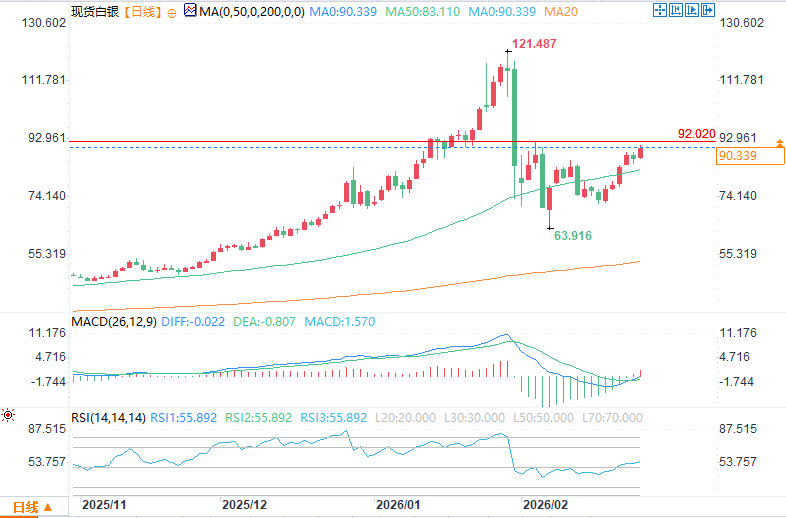
(Spot silver daily chart source: EasyTrade)
From a technical perspective, after successfully breaking through the 50-day moving average, the technical pattern of silver prices has improved further, opening up short-term upside potential. Currently, the primary target for silver prices is to retest the high of $92.02 reached in early February. If this resistance level is successfully broken, it will further challenge the key retracement range of $92.87-$99.66.
Market analysts point out that the $90 mark is a crucial psychological support level for silver's short-term price movement. If it can effectively hold this level and break through previous highs, it will signify the start of a new round of upward movement. In the long term, the structural supply-demand gap in the silver market will persist—demand growth is clear, while supply growth is weak. This pattern will continue to provide long-term support for silver prices, laying the fundamental foundation for a long-term bullish outlook for silver.
However, it should be noted that even with the current strong silver price trend, the bulls still need to break through key resistance levels to continue the upward trend: First, they need to overcome the previous high of $92.20 set on February 4. After breaking through this level, they will face further important pullback resistance in the range of $92.87 to $99.66. This range is a key consolidation area during the previous rise in silver prices, and is expected to face strong profit-taking pressure.
COMEX Silver Supply Shortage: Key Driving Factors
The core logic driving silver prices is the significant tightening of physical silver supply on the COMEX exchange. This phenomenon has become the focus of global silver market attention and is the core driving force behind the continued rise in silver prices.
Specifically, COMEX silver total inventories have shown a continuous downward trend: from 532 million ounces in October 2025 to 366.25 million ounces on February 20, 2026, a decrease of 31% in just over four months, exceeding market expectations for the rate of inventory reduction. More importantly, not all inventories are available for physical delivery of futures contracts—the decline in "registered inventories" (i.e., silver certified by the exchange and directly usable for futures delivery) is even more severe.
As of late February 2026, COMEX silver registered inventories had fallen below the psychologically important 90 million ounces mark, remaining at only around 88 million ounces. The reason this change has attracted significant market attention is the increasingly prominent imbalance between "paper contracts" and "physical contracts" in the silver futures market: the current open interest in silver futures contracts exceeds four times the deliverable registered inventory, meaning there are a large number of "paper contracts" in the market, but a severe shortage of corresponding physical silver. Once the futures contracts expire, a large number of holders will demand physical delivery, and the exchange will face the risk of being unable to deliver in full, potentially triggering a liquidity crisis. This is the core reason for the current high level of market tension.
March may become a critical turning point.
Industry analysts generally believe that March 2026 is likely to be a critical juncture when the current pressure on the silver market intensifies. Looking at market trends, several large global financial services institutions, including JPMorgan Chase, have recently begun issuing a large number of precious metal delivery certificates. This action sends a clear signal: market participants are gradually shifting from a speculative model of "simply rolling paper futures contracts" to a hedging model of "locking in physical precious metals," reflecting the growing concern among institutions about future physical supply shortages.
Besides the actions of financial institutions, industrial demand could also be a significant factor disrupting the supply-demand balance. Currently, global industrial silver consumption remains robust, while industrial enterprises generally have low silver inventories. If these enterprises, in order to ensure production needs, begin to demand physical delivery from exchanges, it will further exacerbate the supply-demand imbalance and trigger an explosive growth in demand.
Furthermore, regional market price differences directly reflect the tightness of the global physical silver market: currently, the spot price of silver in Shanghai is more than $10 higher than the spot price in Western markets. This price difference is far beyond the normal level, which fully demonstrates that the global distribution of physical silver is uneven and the overall supply is tight.
It is important to emphasize that the previous short-term pullback in silver prices was not due to a decline in actual demand, but rather mainly influenced by technical factors and adjustments in market rules: the Chicago Mercantile Exchange (CME Group) recently raised the margin requirements for silver futures trading, forcing some over-leveraged long investors to liquidate their positions, which in turn triggered a brief pullback in silver prices.
From the demand side, actual demand for silver has not shrunk substantially: global industrial consumption of silver continues to grow rapidly, especially in sectors such as new energy and electronics manufacturing. On the supply side, existing mines are seeing limited increases in silver production, and new mines have long commissioning cycles, making it difficult to quickly fill the demand gap. Meanwhile, the market generally believes that several large US banks still hold substantial short positions in silver, and these institutions may be using the paper market to suppress prices, creating conditions for them to hoard physical silver.
Technical Analysis
(Spot silver daily chart source: EasyTrade)
From a technical perspective, after successfully breaking through the 50-day moving average, the technical pattern of silver prices has improved further, opening up short-term upside potential. Currently, the primary target for silver prices is to retest the high of $92.02 reached in early February. If this resistance level is successfully broken, it will further challenge the key retracement range of $92.87-$99.66.
Market analysts point out that the $90 mark is a crucial psychological support level for silver's short-term price movement. If it can effectively hold this level and break through previous highs, it will signify the start of a new round of upward movement. In the long term, the structural supply-demand gap in the silver market will persist—demand growth is clear, while supply growth is weak. This pattern will continue to provide long-term support for silver prices, laying the fundamental foundation for a long-term bullish outlook for silver.
- Risk Warning and Disclaimer
- The market involves risk, and trading may not be suitable for all investors. This article is for reference only and does not constitute personal investment advice, nor does it take into account certain users’ specific investment objectives, financial situation, or other needs. Any investment decisions made based on this information are at your own risk.