The USD/JPY pair fluctuated and declined amid a combination of uncertainty surrounding Japanese inflation and policy prospects, coupled with a weakening dollar.
2026-02-26 10:06:16
The US dollar weakened against the Japanese yen to around 156.15 during Thursday's Asian trading session, with the dollar index showing slight weakness amid policy uncertainty. This followed the US Supreme Court's ruling to overturn President Donald Trump's broad global tariffs, prompting a reassessment of the direction of US trade policy.
However, Trump's subsequent announcement of a 15% uniform tariff on imported goods indicates that the policy direction remains uncertain. U.S. Trade Representative Jamison Greer further stated that the tariff rate may be expanded in the coming days, but the executive authorization is only valid for 150 days unless extended by Congress.
Policy uncertainty has increased the risk of short-term volatility in the US dollar. Investors are concerned that frequently adjusted tariff policies may affect business confidence and capital flows, thereby putting temporary selling pressure on the dollar.
Meanwhile, Japan is about to release its Tokyo Consumer Price Index (CPI), while the United States will release its Producer Price Index (PPI). Both data are considered important leading indicators for judging inflation trends.
If Japanese inflation continues to rise, it could strengthen market expectations that the Bank of Japan will gradually exit its ultra-loose monetary policy. Regarding monetary policy, the Bank of Japan governor stated that if the economic outlook meets expectations, the interest rate hike process will continue, but further confirmation from the data at the March and April meetings is needed.
This statement indicates that the Bank of Japan remains cautious. Meanwhile, Japanese Prime Minister Sanae Takaichi expressed reservations about further interest rate hikes, believing that tightening too quickly could put pressure on the economy.
Most economists expect Japan's policy rate to rise to 1.0% by the end of June 2026. Amid a confluence of policy signals, the USD/JPY exchange rate has shown a volatile but slightly weak trend, as the market weighs the relative impact of US policy uncertainty on the pace of Japan's interest rate hikes.
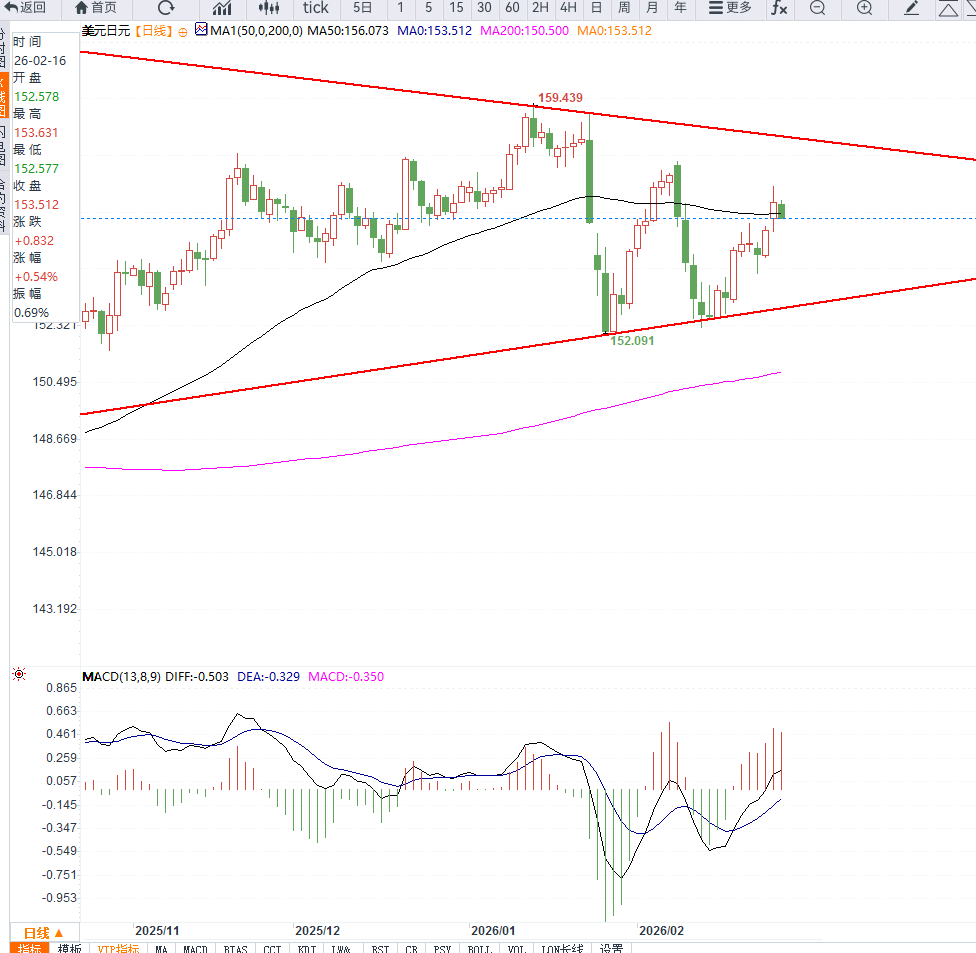
From a daily chart perspective, the USD/JPY pair remains within its medium-term upward trend channel, but short-term momentum has slowed. The price is consolidating technically above 156, indicating a temporary cooling of bullish momentum. The 20-day moving average, still trending upwards and located around 154.80, serves as the first dynamic support; the 50-day moving average, located in the 152.60 area, provides medium-term trend support.
The RSI indicator has fallen from the overbought zone to around 55, indicating that the upward momentum is recovering but has not yet turned into a bearish trend. If the exchange rate breaks below the 155 level, it may further test the 154.80 support in the short term; if it holds and breaks through the 157.00 resistance again, it is expected to challenge the previous high of 158.50 again. The overall structure is still bullish, but it has entered a high-level consolidation phase.
Editor's Note:
The current volatility in the USD/JPY exchange rate is primarily driven by the repricing of policy expectation gaps. While the fluctuating US tariff policies are putting short-term pressure on the dollar, this uncertainty is more of a sentiment-driven factor and has not yet altered the structural advantage of the US's relatively high interest rate environment.
On the other hand, although the Bank of Japan has signaled its intention to continue raising interest rates, its decision-making pace is clearly cautious, and there are concerns at the government level about the pressure on the economy, which limits the potential for continued appreciation of the yen.
From a macroeconomic perspective, the interest rate differential between the US and Japan remains high, and the medium-term trend of the USD/JPY exchange rate has not yet reversed. However, there is significant technical resistance in the 156-158 range in the short term. Coupled with the wait-and-see sentiment before the data release, the exchange rate is more likely to enter a high-level consolidation phase.
Only if Japanese inflation significantly exceeds expectations and forces the market to pre-price interest rate hikes, or if US inflation noticeably declines, weakening expectations of interest rate hikes, will the exchange rate likely experience a directional breakout. Until then, range-bound trading is likely to be the dominant trend.
However, Trump's subsequent announcement of a 15% uniform tariff on imported goods indicates that the policy direction remains uncertain. U.S. Trade Representative Jamison Greer further stated that the tariff rate may be expanded in the coming days, but the executive authorization is only valid for 150 days unless extended by Congress.
Policy uncertainty has increased the risk of short-term volatility in the US dollar. Investors are concerned that frequently adjusted tariff policies may affect business confidence and capital flows, thereby putting temporary selling pressure on the dollar.
Meanwhile, Japan is about to release its Tokyo Consumer Price Index (CPI), while the United States will release its Producer Price Index (PPI). Both data are considered important leading indicators for judging inflation trends.
If Japanese inflation continues to rise, it could strengthen market expectations that the Bank of Japan will gradually exit its ultra-loose monetary policy. Regarding monetary policy, the Bank of Japan governor stated that if the economic outlook meets expectations, the interest rate hike process will continue, but further confirmation from the data at the March and April meetings is needed.
This statement indicates that the Bank of Japan remains cautious. Meanwhile, Japanese Prime Minister Sanae Takaichi expressed reservations about further interest rate hikes, believing that tightening too quickly could put pressure on the economy.
Most economists expect Japan's policy rate to rise to 1.0% by the end of June 2026. Amid a confluence of policy signals, the USD/JPY exchange rate has shown a volatile but slightly weak trend, as the market weighs the relative impact of US policy uncertainty on the pace of Japan's interest rate hikes.
From a daily chart perspective, the USD/JPY pair remains within its medium-term upward trend channel, but short-term momentum has slowed. The price is consolidating technically above 156, indicating a temporary cooling of bullish momentum. The 20-day moving average, still trending upwards and located around 154.80, serves as the first dynamic support; the 50-day moving average, located in the 152.60 area, provides medium-term trend support.
The RSI indicator has fallen from the overbought zone to around 55, indicating that the upward momentum is recovering but has not yet turned into a bearish trend. If the exchange rate breaks below the 155 level, it may further test the 154.80 support in the short term; if it holds and breaks through the 157.00 resistance again, it is expected to challenge the previous high of 158.50 again. The overall structure is still bullish, but it has entered a high-level consolidation phase.
Editor's Note:
The current volatility in the USD/JPY exchange rate is primarily driven by the repricing of policy expectation gaps. While the fluctuating US tariff policies are putting short-term pressure on the dollar, this uncertainty is more of a sentiment-driven factor and has not yet altered the structural advantage of the US's relatively high interest rate environment.
On the other hand, although the Bank of Japan has signaled its intention to continue raising interest rates, its decision-making pace is clearly cautious, and there are concerns at the government level about the pressure on the economy, which limits the potential for continued appreciation of the yen.
From a macroeconomic perspective, the interest rate differential between the US and Japan remains high, and the medium-term trend of the USD/JPY exchange rate has not yet reversed. However, there is significant technical resistance in the 156-158 range in the short term. Coupled with the wait-and-see sentiment before the data release, the exchange rate is more likely to enter a high-level consolidation phase.
Only if Japanese inflation significantly exceeds expectations and forces the market to pre-price interest rate hikes, or if US inflation noticeably declines, weakening expectations of interest rate hikes, will the exchange rate likely experience a directional breakout. Until then, range-bound trading is likely to be the dominant trend.
- Risk Warning and Disclaimer
- The market involves risk, and trading may not be suitable for all investors. This article is for reference only and does not constitute personal investment advice, nor does it take into account certain users’ specific investment objectives, financial situation, or other needs. Any investment decisions made based on this information are at your own risk.