Seven experts warn that Trump is dragging the United States into a "no-exit" war with Iran.
2026-02-26 15:30:04
The United States is once again on the brink of war with Iran, but this time the situation may be very different. Eight months have passed since the Trump administration's airstrikes on Iranian nuclear facilities last June. The world order has changed significantly, and President Trump seems more confident than ever.
Previous strikes against Iran have yielded little to no serious backlash, and Trump is now intensifying pressure on Tehran, demanding that it completely abandon its nuclear program. To this end, the United States has deployed its largest fighter jet and naval fleet to the Middle East since the Iraq War. If negotiations fail, Trump has threatened a large-scale strike, and has not ruled out the possibility of regime change.
The large-scale deployment of US troops has fueled expectations of disruption in the Strait of Hormuz, and oil prices have already factored in this risk premium. Oil prices fluctuated upwards during the European session on Thursday (February 26), currently trading around $65.60 per barrel, a daily increase of approximately 0.25%.
Experts generally agree that the risks Trump may be taking this time are far more unpredictable and potentially more deadly than in the past . The lack of clear strategic objectives, an exit strategy, and an underestimation of Iran's retaliatory capabilities are the biggest threats.
Ryan Crocker (former U.S. ambassador to Afghanistan, Iraq, and other countries, and current Distinguished Chairman of Foreign Affairs and Security at the RAND Corporation) points out that Iran is highly unlikely to accept the U.S. demands for "zero uranium enrichment, abandonment of ballistic missiles, and severing of support for proxy forces." These elements are considered core pillars of the legitimacy of the Islamic Republic regime, and complete concessions would be tantamount to self-destruction.
The current large-scale military deployment of the United States cannot be sustained indefinitely. This time, there won't be a "TACO" (Trump Always Chickens Out) scenario—if negotiations break down, Trump will likely take limited action first, attempting to coerce Iran into submission. But this won't work, and he may then escalate the operation, carrying out "decapitations" against high-ranking officials, including religious and military leaders. This requires extremely high-precision intelligence, which is now more difficult to obtain than it was last June .
The initial strike must completely destroy Iran's missile capabilities; otherwise, Iran will launch a barrage of retaliation against US allies, Israel, and regional assets. Trump will not intervene with ground troops. If a regime-wide decapitation is achieved, the US will be completely unable to control the subsequent situation. It is certain that a secular democracy led by the son of the Shah of Iran will not emerge; more likely, an unknown military force will seize power, accompanied by widespread internal strife and violence.
Jonathan Panikov (Director of the Middle East Security Initiative at the Atlantic Council and former Deputy National Intelligence Officer for the Near East on the National Intelligence Council) points out that Trump has drawn conclusions from the killing of Soleimani (2020), the June airstrike last year, and the recent "capture" of Maduro in Venezuela that "military operations are effective and costly," and may be overstating this perception. However, it is unlikely that Iran's Supreme Leader Khamenei could be "kidnapped" like Maduro.
The lack of clear objectives and an overall strategy is the biggest hidden danger . If Tehran determines that its regime's survival is threatened, its retaliation will be extremely broad: not limited to ballistic missile attacks on Israel or US military bases, but potentially including global terrorism, cyberattacks, and proxy operations.
Trump's statements have backed him into a corner: inaction will severely weaken America's deterrent power and cause Arab countries, Beijing, and Moscow to further question the reliability of US commitments. History has shown that airstrikes or street protests alone are insufficient to end the Iranian regime; the key lies in whether the security forces defect or split.
Dennis Ross (Distinguished Fellow at the Washington Institute for Near East Policy and former U.S. Middle East Envoy) points out that Iran's limited retaliation after last year's strikes on the three major nuclear facilities in Fordow, Natanz, and Isfahan indicates its unwillingness to escalate. Trump seems to have concluded from this that limited force can be used to coerce negotiations, and if that fails, escalate to regime collapse.
But Iran now believes Trump fears escalating the conflict and is therefore increasing its threats in an attempt to force the US to back down. Ironically, neither side actually wants a full-blown war: Trump is worried about soaring oil prices impacting his domestic economy, while Iran is well aware of its fragile air defenses and the fact that public discontent is at a breaking point, with escalation potentially shaking the foundations of its regime .
This is a classic "cockfighting game": both sides see the other as the more likely to blink. The core issue is whether Trump will still strictly limit his goal to "Iran's permanent abandonment of its nuclear weapons pursuit," and whether Khamenei will ultimately prioritize "regime survival" over "revolutionary dignity," as he did in 1988 when the Iran-Iraq War ended.
Ray Taki (a senior fellow at the Council on Foreign Relations) points out : The reality is that after last year's bombing, Iran's nuclear facilities are now in ruins and are effectively at "zero enrichment." Trump, however, is still demanding that the regime publicly declare "never enriching," while he himself has long distrusted any commitment from Iran. This is essentially "bombing for a statement."
Once war begins, the dynamics are extremely difficult to predict. The United States may have the upper hand in the short term, but if Iran retaliates by killing US troops, it will trigger a new round of bombing, trapping the US in a vicious cycle of retaliation. The strategic objectives of this operation are vague and poorly explained; in previous eras, Congress would have already demanded explanations and accountability from the White House.
Arash Aziz (a contributor to The Atlantic and author of *What the Iranians Want*) points out that Trump may have concluded from the 12-Day War that decisive military action can quickly end a conflict, and that Iran is powerless against overwhelming American power. However, overconfidence is dangerous: under certain conditions, Iran might deliberately escalate the conflict, attacking Israeli and Dubai infrastructure or US military bases, creating instability. Although Iran would pay a heavy price, some military leaders might use this opportunity to elevate their own positions.
This analyst believes that, under the right conditions, the Iranian leadership would prefer negotiations to a full-scale war. They might seize the opportunity to reach a new agreement with the United States, or even push for a regime change similar to that in Venezuela. However, the risk of escalating the conflict remains, even if neither side truly wants it.
Robin Wright (a senior Middle East analyst and author of several books on the Middle East) points out that Trump seems to have failed to fully grasp the growing domestic and international opposition to war with Iran, or to hold overly simplistic assumptions about the post-war situation. Before the 12-Day War last year, he demanded "unconditional surrender," and now he claims regime change is "best for Iran." Theocratic rule is unsustainable in the long run, but he has never clearly stated who or what will replace it. The miscalculations of the previous four administrations in Afghanistan and Iraq have been costly—thousands of American soldiers killed and trillions of dollars spent. If Trump only seeks a new nuclear agreement, the current regime will continue to exist, but then what?
A majority of Americans oppose military action against Iran under the current circumstances, as polls showed last month. Dozens of lawmakers from both parties warned that the White House has no right to wage a new war without congressional authorization. Many countries, including the UK, are wary, prohibiting US military aircraft from using their bases. The lessons of the 2011 Arab Spring are profound: after the fall of dictators in many countries, Tunisia's democratic leader was imprisoned, Egypt became more brutal, Libya split, and Yemen fell into poverty. Iranian protesters' violence inspires the world, but the Middle East remains the most volatile region in 78 years. Washington needs to be cautious to avoid the next misstep.
Ian Bremer (founder and president of the Eurasia Group) points out that Trump's increased confidence in a military strike against Iran stems from the killing of Soleimani at the end of his first term, the "12-Day War" last year, and the success of the operation in Venezuela.
Limited actions carry relatively low risks: Israel has already established escalation dominance over Iranian proxies in the region, and there is currently no imminent threat to the Iranian regime. However, a broader "decapitation" operation is different; it could trigger attacks on US military targets, critical energy infrastructure, or even disrupt the Strait of Hormuz, leading to sharp fluctuations in global oil prices .
Therefore, the most likely path remains to first implement limited strikes to further weaken Iran's nuclear and missile capabilities, while simultaneously testing its bottom line in negotiations. Iran has made virtually no concessions in negotiations so far, but after the US further weakened its capabilities, there is no reason not to continue testing.
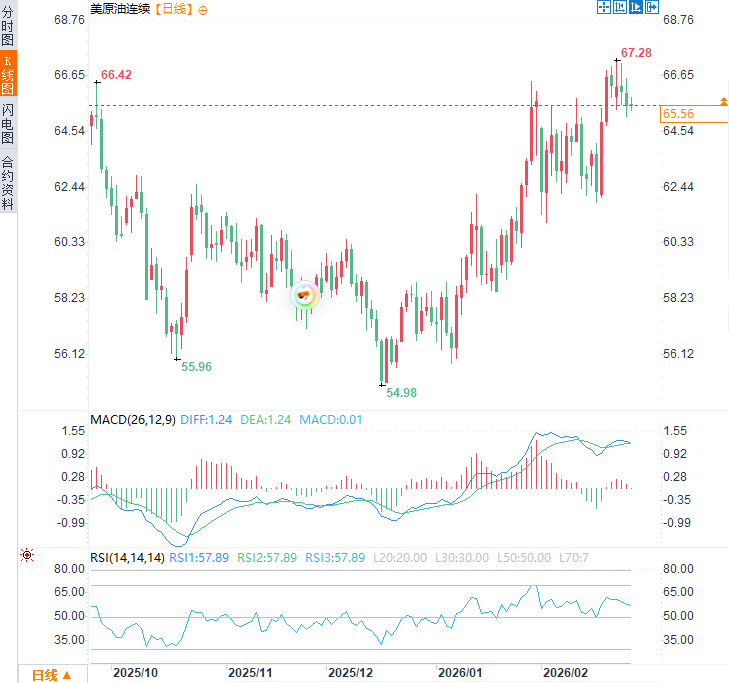
(US crude oil daily chart, source: FX678)
Overall, experts agree that Trump is pushing the United States into a game with highly uncertain consequences. With the current military buildup being unprecedented and the diplomatic window closing, any miscalculation could trigger a chain reaction that exceeds expectations.
At 15:29 Beijing time, US crude oil futures were trading at $65.50 per barrel.
Previous strikes against Iran have yielded little to no serious backlash, and Trump is now intensifying pressure on Tehran, demanding that it completely abandon its nuclear program. To this end, the United States has deployed its largest fighter jet and naval fleet to the Middle East since the Iraq War. If negotiations fail, Trump has threatened a large-scale strike, and has not ruled out the possibility of regime change.
The large-scale deployment of US troops has fueled expectations of disruption in the Strait of Hormuz, and oil prices have already factored in this risk premium. Oil prices fluctuated upwards during the European session on Thursday (February 26), currently trading around $65.60 per barrel, a daily increase of approximately 0.25%.
Experts generally agree that the risks Trump may be taking this time are far more unpredictable and potentially more deadly than in the past . The lack of clear strategic objectives, an exit strategy, and an underestimation of Iran's retaliatory capabilities are the biggest threats.
Iran cannot accept zero enrichment, and the legitimacy of its regime is in grave danger.
Ryan Crocker (former U.S. ambassador to Afghanistan, Iraq, and other countries, and current Distinguished Chairman of Foreign Affairs and Security at the RAND Corporation) points out that Iran is highly unlikely to accept the U.S. demands for "zero uranium enrichment, abandonment of ballistic missiles, and severing of support for proxy forces." These elements are considered core pillars of the legitimacy of the Islamic Republic regime, and complete concessions would be tantamount to self-destruction.
The current large-scale military deployment of the United States cannot be sustained indefinitely. This time, there won't be a "TACO" (Trump Always Chickens Out) scenario—if negotiations break down, Trump will likely take limited action first, attempting to coerce Iran into submission. But this won't work, and he may then escalate the operation, carrying out "decapitations" against high-ranking officials, including religious and military leaders. This requires extremely high-precision intelligence, which is now more difficult to obtain than it was last June .
The initial strike must completely destroy Iran's missile capabilities; otherwise, Iran will launch a barrage of retaliation against US allies, Israel, and regional assets. Trump will not intervene with ground troops. If a regime-wide decapitation is achieved, the US will be completely unable to control the subsequent situation. It is certain that a secular democracy led by the son of the Shah of Iran will not emerge; more likely, an unknown military force will seize power, accompanied by widespread internal strife and violence.
Trump overemphasizes the lessons of military success, yet his strategic goals remain unclear.
Jonathan Panikov (Director of the Middle East Security Initiative at the Atlantic Council and former Deputy National Intelligence Officer for the Near East on the National Intelligence Council) points out that Trump has drawn conclusions from the killing of Soleimani (2020), the June airstrike last year, and the recent "capture" of Maduro in Venezuela that "military operations are effective and costly," and may be overstating this perception. However, it is unlikely that Iran's Supreme Leader Khamenei could be "kidnapped" like Maduro.
The lack of clear objectives and an overall strategy is the biggest hidden danger . If Tehran determines that its regime's survival is threatened, its retaliation will be extremely broad: not limited to ballistic missile attacks on Israel or US military bases, but potentially including global terrorism, cyberattacks, and proxy operations.
Trump's statements have backed him into a corner: inaction will severely weaken America's deterrent power and cause Arab countries, Beijing, and Moscow to further question the reliability of US commitments. History has shown that airstrikes or street protests alone are insufficient to end the Iranian regime; the key lies in whether the security forces defect or split.
Both sides are caught in a game of chicken: neither wants a full-scale war, yet both believe the other will back down first.
Dennis Ross (Distinguished Fellow at the Washington Institute for Near East Policy and former U.S. Middle East Envoy) points out that Iran's limited retaliation after last year's strikes on the three major nuclear facilities in Fordow, Natanz, and Isfahan indicates its unwillingness to escalate. Trump seems to have concluded from this that limited force can be used to coerce negotiations, and if that fails, escalate to regime collapse.
But Iran now believes Trump fears escalating the conflict and is therefore increasing its threats in an attempt to force the US to back down. Ironically, neither side actually wants a full-blown war: Trump is worried about soaring oil prices impacting his domestic economy, while Iran is well aware of its fragile air defenses and the fact that public discontent is at a breaking point, with escalation potentially shaking the foundations of its regime .
This is a classic "cockfighting game": both sides see the other as the more likely to blink. The core issue is whether Trump will still strictly limit his goal to "Iran's permanent abandonment of its nuclear weapons pursuit," and whether Khamenei will ultimately prioritize "regime survival" over "revolutionary dignity," as he did in 1988 when the Iran-Iraq War ended.
Military adventures lacking strategic objectives could lead to a cycle of retaliation.
Ray Taki (a senior fellow at the Council on Foreign Relations) points out : The reality is that after last year's bombing, Iran's nuclear facilities are now in ruins and are effectively at "zero enrichment." Trump, however, is still demanding that the regime publicly declare "never enriching," while he himself has long distrusted any commitment from Iran. This is essentially "bombing for a statement."
Once war begins, the dynamics are extremely difficult to predict. The United States may have the upper hand in the short term, but if Iran retaliates by killing US troops, it will trigger a new round of bombing, trapping the US in a vicious cycle of retaliation. The strategic objectives of this operation are vague and poorly explained; in previous eras, Congress would have already demanded explanations and accountability from the White House.
The Iranian leadership prefers negotiations to a full-scale war, but the risk of escalating the conflict remains.
Arash Aziz (a contributor to The Atlantic and author of *What the Iranians Want*) points out that Trump may have concluded from the 12-Day War that decisive military action can quickly end a conflict, and that Iran is powerless against overwhelming American power. However, overconfidence is dangerous: under certain conditions, Iran might deliberately escalate the conflict, attacking Israeli and Dubai infrastructure or US military bases, creating instability. Although Iran would pay a heavy price, some military leaders might use this opportunity to elevate their own positions.
This analyst believes that, under the right conditions, the Iranian leadership would prefer negotiations to a full-scale war. They might seize the opportunity to reach a new agreement with the United States, or even push for a regime change similar to that in Venezuela. However, the risk of escalating the conflict remains, even if neither side truly wants it.
Opposition is growing both domestically and internationally; Trump's assumptions about the postwar situation are too simplistic.
Robin Wright (a senior Middle East analyst and author of several books on the Middle East) points out that Trump seems to have failed to fully grasp the growing domestic and international opposition to war with Iran, or to hold overly simplistic assumptions about the post-war situation. Before the 12-Day War last year, he demanded "unconditional surrender," and now he claims regime change is "best for Iran." Theocratic rule is unsustainable in the long run, but he has never clearly stated who or what will replace it. The miscalculations of the previous four administrations in Afghanistan and Iraq have been costly—thousands of American soldiers killed and trillions of dollars spent. If Trump only seeks a new nuclear agreement, the current regime will continue to exist, but then what?
A majority of Americans oppose military action against Iran under the current circumstances, as polls showed last month. Dozens of lawmakers from both parties warned that the White House has no right to wage a new war without congressional authorization. Many countries, including the UK, are wary, prohibiting US military aircraft from using their bases. The lessons of the 2011 Arab Spring are profound: after the fall of dictators in many countries, Tunisia's democratic leader was imprisoned, Egypt became more brutal, Libya split, and Yemen fell into poverty. Iranian protesters' violence inspires the world, but the Middle East remains the most volatile region in 78 years. Washington needs to be cautious to avoid the next misstep.
Limited actions carry relatively manageable risks, but an escalation of decapitation strikes would trigger regional instability.
Ian Bremer (founder and president of the Eurasia Group) points out that Trump's increased confidence in a military strike against Iran stems from the killing of Soleimani at the end of his first term, the "12-Day War" last year, and the success of the operation in Venezuela.
Limited actions carry relatively low risks: Israel has already established escalation dominance over Iranian proxies in the region, and there is currently no imminent threat to the Iranian regime. However, a broader "decapitation" operation is different; it could trigger attacks on US military targets, critical energy infrastructure, or even disrupt the Strait of Hormuz, leading to sharp fluctuations in global oil prices .
Therefore, the most likely path remains to first implement limited strikes to further weaken Iran's nuclear and missile capabilities, while simultaneously testing its bottom line in negotiations. Iran has made virtually no concessions in negotiations so far, but after the US further weakened its capabilities, there is no reason not to continue testing.
(US crude oil daily chart, source: FX678)
Overall, experts agree that Trump is pushing the United States into a game with highly uncertain consequences. With the current military buildup being unprecedented and the diplomatic window closing, any miscalculation could trigger a chain reaction that exceeds expectations.
At 15:29 Beijing time, US crude oil futures were trading at $65.50 per barrel.
- Risk Warning and Disclaimer
- The market involves risk, and trading may not be suitable for all investors. This article is for reference only and does not constitute personal investment advice, nor does it take into account certain users’ specific investment objectives, financial situation, or other needs. Any investment decisions made based on this information are at your own risk.