The Bank of Japan's suspected window guidance to Sanae Takashi, subtly orchestrating a dovish strategy.
2026-02-26 15:22:06
Bank of Japan policy board member Hajime Takada recently signaled a hawkish policy stance, stating that Japan's inflation is "close" to the 2% target and that the 2% inflation target has been "mission accomplished," with the economic normalcy brought about by the long-term deflationary era essentially broken.
Its clear stance that the inflation target has been "nearly achieved" sends a hawkish signal at the margin, providing a key basis for the Bank of Japan to further tighten its policy and continue to reduce its bond holdings. It also directly injects potential upward momentum into the yen exchange rate, outlining the deep linkage between the Bank of Japan's policy normalization and the yen's trend.

As a member of the Central Bank's policy council for more than three years, Hajime Takada supports the central bank continuing its gradual interest rate hike path, advocates for a further "tightening" of monetary policy, and revealed that at the January 2026 monetary policy meeting, he has proposed raising the policy rate from 0.75% in December 2025 to 1.0%.
He pointed out that Japan's real interest rate is still in deep negative territory, and the overall monetary policy remains loose, leaving ample room for tightening.
From the perspective of exchange rate logic, if the market gradually prices higher terminal interest rates, it will directly narrow the interest rate differential between Japan and the United States, providing substantial upward support for the yen exchange rate.
Takata defines 2026 as a "switching cycle" for the global economy, predicting that global monetary and fiscal policies will move towards easing in tandem, coupled with the AI investment boom, which will jointly drive the global economy upward. The IMF has also revised its global growth forecast for 2026 upward.
Regarding the domestic situation in Japan, the retaliatory tariffs introduced by the United States in April 2025 will have a far lower actual drag on Japan than the market previously expected; the four transmission paths of capital expenditure, exports, profits and exchange rates have not been substantially impacted, and the risk of Japan returning to deflation has been greatly reduced, laying a solid economic foundation for policy normalization.
Regarding the contraction of the balance sheet, Takata emphasized that the Japanese bond market needs to return to normal, and clarified that the Bank of Japan will continue to reduce the scale of bond purchases.
As the Bank of Japan gradually exits quantitative easing, the central level of Japanese government bond yields is expected to rise further, which will enhance the attractiveness of yen-denominated assets.
He also proposed contingency plans, stating that if the term premium rises abnormally, the Bank of Japan should intervene at any time through market operations and other tools to stabilize the pace of bond market and exchange rate fluctuations.
According to Takada, it is currently impossible to determine a reasonable pace of interest rate hikes and the final interest rate. There is no fixed path for interest rate hikes, and adjustments will be made flexibly based on the future economic environment, prices, market trends, and overseas macroeconomic conditions.
He believes that the Bank of Japan is not currently in a policy lag, but it needs to be wary of the risk of missing out on policy opportunities due to the global resumption of interest rate hikes.
At the same time, it was acknowledged that a weak yen has both advantages and disadvantages, and the central bank's policy adjustments will fully consider the exchange rate transmission effect.
Meanwhile, the two newly nominated policy committee members by the Japanese government recently—Toichiro Asada, professor emeritus at Chuo University, and Ayano Sato, professor at Aoyama Gakuin University—have positions that are significantly biased towards "reflation."
Asada, an expert in macroeconomic dynamics, has long advocated for a combination of proactive fiscal expansion and loose monetary policy; while Sato, in his academic research, has demonstrated an emphasis on "high-pressure economy" and full employment.
The addition of these two scholars with strong "dovish" leanings is seen by the market as a clear signal that the Sanae Takaichi cabinet is trying to "put the brakes" on the Bank of Japan's aggressive pace of interest rate hikes, indicating that the Bank of Japan will face more intense internal competition regarding the pace of policy tightening in the future.
Overall, Takada Hajime's statement establishes the core logic of the yen's strengthening: "inflation target achieved → continued policy tightening → interest rate differential advantage restored → asset attractiveness enhanced."
However, it was also mentioned that a weaker yen may not necessarily be a bad thing, implying that as an export-oriented country, a weaker yen is beneficial for Japan to maintain its competitiveness in foreign trade.
The future trend of the Japanese yen needs to focus on three key factors: first, the final market pricing of terminal interest rates; second, the pace of global policy coordination and changes in the Japan-US interest rate differential; and third, the coordination effect of fiscal and monetary policies.
The short-term window of opportunity provides clear upward support for the yen, but we must remain wary of potential intervention by the central bank by Sanae Koshino and changes in policymakers. The medium-term trend still depends on the verification of economic fundamentals data and the dynamic balance of market risk appetite. If Japan's export data continues to exceed expectations, or if geopolitical risks continue to emerge in a weak dollar environment, it could support a strong rebound in the yen.
Technically, the USD/JPY pair rebounded to the middle channel line but encountered resistance. However, given the recent strong rebound, if the USD/JPY can maintain its position around 156.90, it has the potential for further gains, meaning the yen will continue to depreciate.
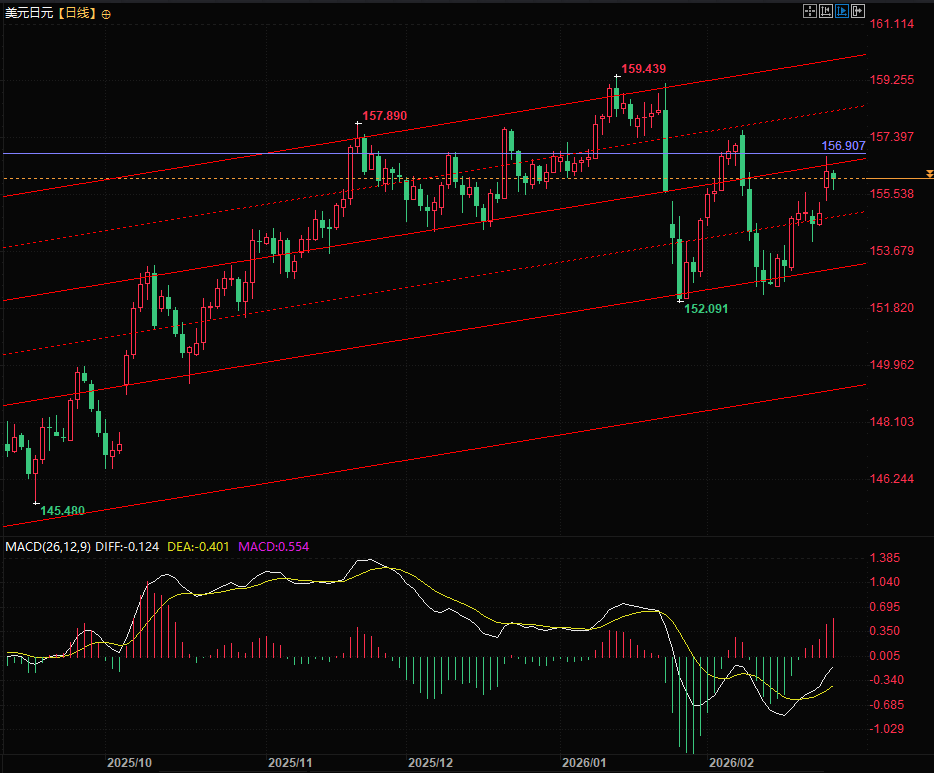
(USD/JPY daily chart, source: FX678)
At 15:20 Beijing time, the USD/JPY exchange rate is currently at 156.10 and 11.
Its clear stance that the inflation target has been "nearly achieved" sends a hawkish signal at the margin, providing a key basis for the Bank of Japan to further tighten its policy and continue to reduce its bond holdings. It also directly injects potential upward momentum into the yen exchange rate, outlining the deep linkage between the Bank of Japan's policy normalization and the yen's trend.
Suspected window guidance, Hajime Takada advocates for a shift in interest rates, having previously proposed raising rates to 1.0%.
As a member of the Central Bank's policy council for more than three years, Hajime Takada supports the central bank continuing its gradual interest rate hike path, advocates for a further "tightening" of monetary policy, and revealed that at the January 2026 monetary policy meeting, he has proposed raising the policy rate from 0.75% in December 2025 to 1.0%.
He pointed out that Japan's real interest rate is still in deep negative territory, and the overall monetary policy remains loose, leaving ample room for tightening.
From the perspective of exchange rate logic, if the market gradually prices higher terminal interest rates, it will directly narrow the interest rate differential between Japan and the United States, providing substantial upward support for the yen exchange rate.
The macroeconomic fundamentals are solid: the impact of tariffs is less than expected, and the risk of deflation has subsided.
Takata defines 2026 as a "switching cycle" for the global economy, predicting that global monetary and fiscal policies will move towards easing in tandem, coupled with the AI investment boom, which will jointly drive the global economy upward. The IMF has also revised its global growth forecast for 2026 upward.
Regarding the domestic situation in Japan, the retaliatory tariffs introduced by the United States in April 2025 will have a far lower actual drag on Japan than the market previously expected; the four transmission paths of capital expenditure, exports, profits and exchange rates have not been substantially impacted, and the risk of Japan returning to deflation has been greatly reduced, laying a solid economic foundation for policy normalization.
Bond market normalization progresses: reduced bond purchases benefit yen assets.
Regarding the contraction of the balance sheet, Takata emphasized that the Japanese bond market needs to return to normal, and clarified that the Bank of Japan will continue to reduce the scale of bond purchases.
As the Bank of Japan gradually exits quantitative easing, the central level of Japanese government bond yields is expected to rise further, which will enhance the attractiveness of yen-denominated assets.
He also proposed contingency plans, stating that if the term premium rises abnormally, the Bank of Japan should intervene at any time through market operations and other tools to stabilize the pace of bond market and exchange rate fluctuations.
With the central bank's new nominee and no predetermined interest rate hike path, the yen should not be viewed with excessive optimism.
According to Takada, it is currently impossible to determine a reasonable pace of interest rate hikes and the final interest rate. There is no fixed path for interest rate hikes, and adjustments will be made flexibly based on the future economic environment, prices, market trends, and overseas macroeconomic conditions.
He believes that the Bank of Japan is not currently in a policy lag, but it needs to be wary of the risk of missing out on policy opportunities due to the global resumption of interest rate hikes.
At the same time, it was acknowledged that a weak yen has both advantages and disadvantages, and the central bank's policy adjustments will fully consider the exchange rate transmission effect.
Meanwhile, the two newly nominated policy committee members by the Japanese government recently—Toichiro Asada, professor emeritus at Chuo University, and Ayano Sato, professor at Aoyama Gakuin University—have positions that are significantly biased towards "reflation."
Asada, an expert in macroeconomic dynamics, has long advocated for a combination of proactive fiscal expansion and loose monetary policy; while Sato, in his academic research, has demonstrated an emphasis on "high-pressure economy" and full employment.
The addition of these two scholars with strong "dovish" leanings is seen by the market as a clear signal that the Sanae Takaichi cabinet is trying to "put the brakes" on the Bank of Japan's aggressive pace of interest rate hikes, indicating that the Bank of Japan will face more intense internal competition regarding the pace of policy tightening in the future.
Summary and Technical Analysis:
Overall, Takada Hajime's statement establishes the core logic of the yen's strengthening: "inflation target achieved → continued policy tightening → interest rate differential advantage restored → asset attractiveness enhanced."
However, it was also mentioned that a weaker yen may not necessarily be a bad thing, implying that as an export-oriented country, a weaker yen is beneficial for Japan to maintain its competitiveness in foreign trade.
The future trend of the Japanese yen needs to focus on three key factors: first, the final market pricing of terminal interest rates; second, the pace of global policy coordination and changes in the Japan-US interest rate differential; and third, the coordination effect of fiscal and monetary policies.
The short-term window of opportunity provides clear upward support for the yen, but we must remain wary of potential intervention by the central bank by Sanae Koshino and changes in policymakers. The medium-term trend still depends on the verification of economic fundamentals data and the dynamic balance of market risk appetite. If Japan's export data continues to exceed expectations, or if geopolitical risks continue to emerge in a weak dollar environment, it could support a strong rebound in the yen.
Technically, the USD/JPY pair rebounded to the middle channel line but encountered resistance. However, given the recent strong rebound, if the USD/JPY can maintain its position around 156.90, it has the potential for further gains, meaning the yen will continue to depreciate.
(USD/JPY daily chart, source: FX678)
At 15:20 Beijing time, the USD/JPY exchange rate is currently at 156.10 and 11.
- Risk Warning and Disclaimer
- The market involves risk, and trading may not be suitable for all investors. This article is for reference only and does not constitute personal investment advice, nor does it take into account certain users’ specific investment objectives, financial situation, or other needs. Any investment decisions made based on this information are at your own risk.