The Bank of Korea unveiled a US-style dot plot, signaling the start of a prolonged "garbage time" for monetary policy?
2026-02-26 20:42:25
The Bank of Korea's latest policy meeting has concluded, with the policy rate remaining unchanged at 2.5% as expected. However, this is not a simple "maintaining the status quo," but rather a significant strategic shift. The tone of the meeting subtly shifted from a slightly dovish stance to a neutral one. Officials not only toned down their rhetoric on further rate cuts but also deliberately avoided signaling an impending rate hike. This restrained approach signifies that monetary policy has officially transitioned from frequent cyclical operations to a prolonged period of observation. For the market, the core logic of the game has fundamentally reversed: the focus is no longer on "where to go next," but rather on repricing "how long to stay at the current level."

To reinforce this neutral stance, the Bank of Korea introduced a six-month dot plot framework, formally aligning itself with the Federal Reserve. The dot plot shows that the median interest rate six months from now remains locked at 2.5%. While four points on the plot fall at 2.25%, suggesting a slightly downside risk, the overall bias is not strong. More importantly, in the three-month short-term guidance, no member believed a rate hike was necessary. This clearly sends a signal: current interest rates are sufficient to effectively constrain inflation; further easing is unnecessary, but tightening is not yet required. Policymakers are attempting to use the length of time to create stability, allowing the market to find a new equilibrium amidst uncertainty.
The core driver supporting the central bank's shift to a neutral stance stems from a reassessment of macroeconomic fundamentals. The Bank of Korea simultaneously raised its 2026 economic growth and inflation forecasts, increasing its economic growth expectation from 1.8% to 2.0%, and its consumer price index forecast from 2.1% to 2.2%. Behind this adjustment is a significant improvement in the semiconductor cycle. As an economic engine, exports and investment are receiving stronger support due to the industry's recovery. Meanwhile, the recent rise in dynamic random access memory (DRAM) prices is gradually being passed on to downstream industries through production costs. Although the output gap is currently negative, the central bank anticipates it will narrow rapidly and expects it to turn positive by the second half of 2027.
This supply-side driven cost increase has cast a complex shadow over the inflation outlook. Rising producer prices typically have a delayed impact on the consumer market. While it remains uncertain whether these costs can be fully passed on to end consumers, the upward pressure is already established. Furthermore, strong asset price performance may stimulate demand through the wealth effect, increasing inflation stickiness and making the path to inflation decline more difficult. Based on these clues, market institutions have revised their 2026 inflation forecasts upward from 1.9% to 2.0%, while warning that upside risks have not completely dissipated. This means that the deflationary concerns that once plagued the market are receding, replaced by vigilance regarding "chip inflation" and its chain reactions.
Looking ahead to 2026, the prevailing benchmark scenario points to interest rates likely remaining flat. The logic for interest rate hikes hasn't disappeared; it's simply been postponed until conditions become clearer. Only when economic growth continues to exceed potential levels and inflation demonstrates stronger resilience will the window for rate hikes open in 2027, and it's even possible that the market will re-price these figures in the fourth quarter. However, the divergence in the recovery structure (widening differences in the prosperity of the information technology and non-information technology sectors) may limit the formation of widespread overheating, thus suppressing the necessity for premature rate hikes. Meanwhile, financial stability becomes another implicit constraint. If the effects of the government's tightening of housing regulations are validated in mid-year data, it will provide the central bank with more room to remain on hold. Coupled with the significant changes in board members in 2026, the policy response function will become clearer after these personnel changes, at which point volatility in interest rate expectations may increase again.
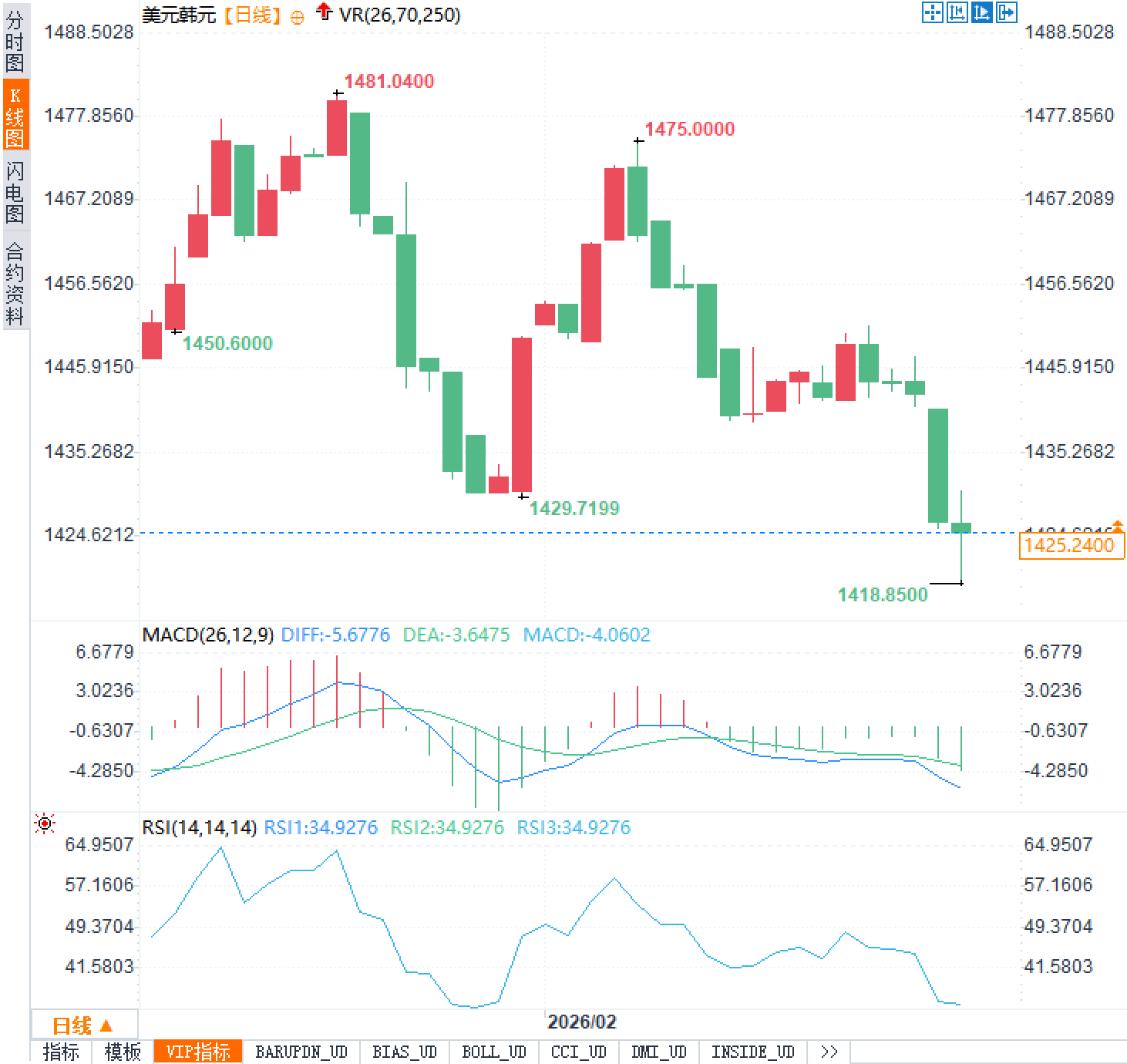
The foreign exchange and bond markets will also reach a new equilibrium against this backdrop. The Korean won has strengthened significantly driven by multiple factors, including the performance of semiconductor giants attracting capital inflows, coupled with passive allocation funds brought by the inclusion of global bond indices. The USD/KRW exchange rate briefly fell below 1420. Scenario projections suggest the exchange rate may stabilize around 1435 in the short term, subsequently moving towards 1375 in the third quarter of 2026. Regarding interest rate bonds, while Korean government bond yields rose rapidly in the early stages, there have been signs of cooling recently. The new dot plot has broadened the market perspective, reducing the impulse to over-trade for "immediate rate hikes." Analysts believe that the 10-year Korean government bond yield is expected to fall back to around 3.25% in the first half of 2026, and the term spread will gradually converge under a neutral policy framework.
To reinforce this neutral stance, the Bank of Korea introduced a six-month dot plot framework, formally aligning itself with the Federal Reserve. The dot plot shows that the median interest rate six months from now remains locked at 2.5%. While four points on the plot fall at 2.25%, suggesting a slightly downside risk, the overall bias is not strong. More importantly, in the three-month short-term guidance, no member believed a rate hike was necessary. This clearly sends a signal: current interest rates are sufficient to effectively constrain inflation; further easing is unnecessary, but tightening is not yet required. Policymakers are attempting to use the length of time to create stability, allowing the market to find a new equilibrium amidst uncertainty.
"Chip inflation" is coming: a double upward revision of growth and prices.
The core driver supporting the central bank's shift to a neutral stance stems from a reassessment of macroeconomic fundamentals. The Bank of Korea simultaneously raised its 2026 economic growth and inflation forecasts, increasing its economic growth expectation from 1.8% to 2.0%, and its consumer price index forecast from 2.1% to 2.2%. Behind this adjustment is a significant improvement in the semiconductor cycle. As an economic engine, exports and investment are receiving stronger support due to the industry's recovery. Meanwhile, the recent rise in dynamic random access memory (DRAM) prices is gradually being passed on to downstream industries through production costs. Although the output gap is currently negative, the central bank anticipates it will narrow rapidly and expects it to turn positive by the second half of 2027.
This supply-side driven cost increase has cast a complex shadow over the inflation outlook. Rising producer prices typically have a delayed impact on the consumer market. While it remains uncertain whether these costs can be fully passed on to end consumers, the upward pressure is already established. Furthermore, strong asset price performance may stimulate demand through the wealth effect, increasing inflation stickiness and making the path to inflation decline more difficult. Based on these clues, market institutions have revised their 2026 inflation forecasts upward from 1.9% to 2.0%, while warning that upside risks have not completely dissipated. This means that the deflationary concerns that once plagued the market are receding, replaced by vigilance regarding "chip inflation" and its chain reactions.
A Panoramic Outlook for 2026: Interest Rate Silence, Currency Flow Back, and Bond Market Equilibrium
Looking ahead to 2026, the prevailing benchmark scenario points to interest rates likely remaining flat. The logic for interest rate hikes hasn't disappeared; it's simply been postponed until conditions become clearer. Only when economic growth continues to exceed potential levels and inflation demonstrates stronger resilience will the window for rate hikes open in 2027, and it's even possible that the market will re-price these figures in the fourth quarter. However, the divergence in the recovery structure (widening differences in the prosperity of the information technology and non-information technology sectors) may limit the formation of widespread overheating, thus suppressing the necessity for premature rate hikes. Meanwhile, financial stability becomes another implicit constraint. If the effects of the government's tightening of housing regulations are validated in mid-year data, it will provide the central bank with more room to remain on hold. Coupled with the significant changes in board members in 2026, the policy response function will become clearer after these personnel changes, at which point volatility in interest rate expectations may increase again.
The foreign exchange and bond markets will also reach a new equilibrium against this backdrop. The Korean won has strengthened significantly driven by multiple factors, including the performance of semiconductor giants attracting capital inflows, coupled with passive allocation funds brought by the inclusion of global bond indices. The USD/KRW exchange rate briefly fell below 1420. Scenario projections suggest the exchange rate may stabilize around 1435 in the short term, subsequently moving towards 1375 in the third quarter of 2026. Regarding interest rate bonds, while Korean government bond yields rose rapidly in the early stages, there have been signs of cooling recently. The new dot plot has broadened the market perspective, reducing the impulse to over-trade for "immediate rate hikes." Analysts believe that the 10-year Korean government bond yield is expected to fall back to around 3.25% in the first half of 2026, and the term spread will gradually converge under a neutral policy framework.
- Risk Warning and Disclaimer
- The market involves risk, and trading may not be suitable for all investors. This article is for reference only and does not constitute personal investment advice, nor does it take into account certain users’ specific investment objectives, financial situation, or other needs. Any investment decisions made based on this information are at your own risk.