Did the US military commander secretly inform Trump that the Middle East is on the brink of war? How will these two options trigger oil price fluctuations?
2026-02-27 09:05:16
According to sources close to the US president, Admiral Brad Cooper, commander of US Central Command, briefed President Trump on Thursday (February 26) on a range of potential military action options against Iran. Central Command oversees all US forces in the Middle East.
Chairman of the Joint Chiefs of Staff and Principal Military Advisor to the President, General Dan Kane, participated in the entire briefing. According to another source familiar with the matter, the timing of this briefing, personally delivered by the top military commander in the Middle East, coincided closely with the indirect nuclear talks held that day between the US and Iran in Geneva.
The talks focused on Iran's nuclear program and ballistic missile project, but no public agreement was reached. The Iranian Foreign Minister stated that some progress had been made in the negotiations and announced that "technical consultations" would continue next week in Vienna, Austria.
In recent days, several prominent Republicans and some officials within the Trump administration have privately and strongly suggested that Israel should strike Iran first, rather than the United States initiating hostile action directly.
As of the evening of February 26, there was no conclusive evidence that Trump had formally adopted the plan. Sources say Trump has shown increasing frustration and impatience with Iran's continued refusal to halt uranium enrichment and limit its ballistic missile program.
Trump's consistent decision-making style involves widely soliciting different opinions before making a final judgment. It has been previously reported that some senior advisors and prominent Republican figures are actively promoting an "Israel-led" approach.
Sources familiar with the matter revealed that the possibility of a joint US-Israeli military operation has not been ruled out. Currently, the US military has deployed a massive naval and fighter fleet to the Middle East, with all combat platforms within direct range of Iran, demonstrating a formidable power projection capability and deterrent posture.
White House Deputy Press Secretary Anna Kelly responded, "The media can continue to speculate on the president's thoughts, but only President Trump himself knows what he will ultimately do or not do."
Several political analysts have pointed out that pushing for a "first strike by Israel" approach is likely intended to provide a political safety net for congressional Republicans facing tough midterm elections. Trump repeatedly promised during his campaign to "end the war and never start a new one."
If Israel launches its first strike, defense officials generally anticipate an almost certain retaliation from Iran. At this point, Trump could package subsequent US military intervention as "fulfilling decades of established policy of defending our ally Israel." However, conservative commentator and editor of the National Review magazine, Ramesh Ponnourou, warns that this strategy carries a serious risk of backlash:
“If the people of the Middle East view the conflict as an Israeli-backed coup, the backlash will be very strong. Once the fighting turns into a protracted campaign and American casualties occur, the political costs will quickly become apparent.”
Ponnuru emphasized that Trump must clearly articulate his strategic goals and mission toward Iran as soon as possible, "but at present, it seems that he has not yet fully finalized a plan."
Sources revealed that the Trump team is seriously evaluating at least two paths:
Limited precision strikes : One or more warning strikes against Iranian ballistic missile launchers and key nuclear facilities, aimed at forcing Tehran back to the negotiating table and accepting core U.S. demands.
Large-scale, sustained operations : conducting prolonged, high-intensity, multi-wave strikes against numerous targets within Iran.
Some analysts believe that if Israel leads the initial strikes, it will not only have a diplomatic blackmail effect but also significantly weaken Iran's air defense system, creating favorable conditions for a longer and deeper military operation (including a campaign aimed at regime change) that the US military may launch subsequently.
However, experts generally warn that such actions could last for weeks or even longer, posing extremely high risks, and there is no guarantee that the new regime will be more pro-American than the current one. Of particular concern is the possibility that Iran could directly attack the 35,000 to 40,000 U.S. troops stationed in the Middle East.
Secretary of State Marco Rubio said in St. Kitts on Thursday: "The U.S. military strikes on Iranian nuclear facilities last June did cause serious damage, but Iran has been trying to rebuild its capabilities. They have not yet resumed uranium enrichment activities, but are clearly working in that direction. At the same time, Iran is also on the path to acquiring long-range ballistic missiles that could threaten the U.S. mainland."
The current large-scale military buildup of the US military in the Middle East clearly reflects the Trump administration's dual-track strategy of "maximum pressure + diplomatic negotiations": prioritizing diplomacy while using an overwhelming military presence to force Iran to make substantial concessions on its nuclear and missile programs. However, if negotiations completely break down, the situation in the Middle East could escalate sharply in the short term, significantly impacting international oil prices, geopolitical risk premiums, and global financial markets .
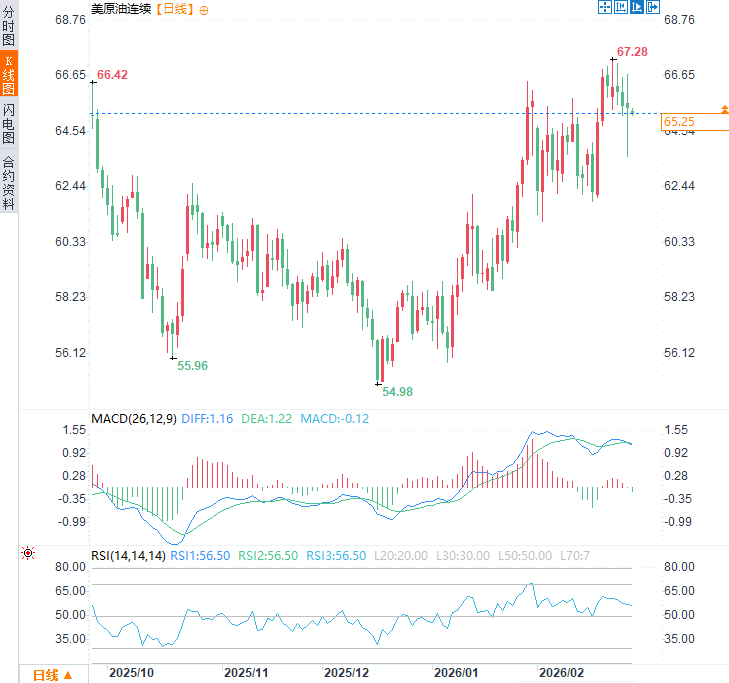
(US crude oil daily chart, source: FX678)
At 9:00 AM Beijing time, US crude oil futures were trading at $65.04 per barrel.
High-level military briefings and Geneva negotiations
Chairman of the Joint Chiefs of Staff and Principal Military Advisor to the President, General Dan Kane, participated in the entire briefing. According to another source familiar with the matter, the timing of this briefing, personally delivered by the top military commander in the Middle East, coincided closely with the indirect nuclear talks held that day between the US and Iran in Geneva.
The talks focused on Iran's nuclear program and ballistic missile project, but no public agreement was reached. The Iranian Foreign Minister stated that some progress had been made in the negotiations and announced that "technical consultations" would continue next week in Vienna, Austria.
Israel-led, US-supported plan emerges
In recent days, several prominent Republicans and some officials within the Trump administration have privately and strongly suggested that Israel should strike Iran first, rather than the United States initiating hostile action directly.
As of the evening of February 26, there was no conclusive evidence that Trump had formally adopted the plan. Sources say Trump has shown increasing frustration and impatience with Iran's continued refusal to halt uranium enrichment and limit its ballistic missile program.
Trump's consistent decision-making style involves widely soliciting different opinions before making a final judgment. It has been previously reported that some senior advisors and prominent Republican figures are actively promoting an "Israel-led" approach.
The large-scale deployment of US troops constitutes a deterrent.
Sources familiar with the matter revealed that the possibility of a joint US-Israeli military operation has not been ruled out. Currently, the US military has deployed a massive naval and fighter fleet to the Middle East, with all combat platforms within direct range of Iran, demonstrating a formidable power projection capability and deterrent posture.
White House Deputy Press Secretary Anna Kelly responded, "The media can continue to speculate on the president's thoughts, but only President Trump himself knows what he will ultimately do or not do."
Political cover and potential risk analysis
Several political analysts have pointed out that pushing for a "first strike by Israel" approach is likely intended to provide a political safety net for congressional Republicans facing tough midterm elections. Trump repeatedly promised during his campaign to "end the war and never start a new one."
If Israel launches its first strike, defense officials generally anticipate an almost certain retaliation from Iran. At this point, Trump could package subsequent US military intervention as "fulfilling decades of established policy of defending our ally Israel." However, conservative commentator and editor of the National Review magazine, Ramesh Ponnourou, warns that this strategy carries a serious risk of backlash:
“If the people of the Middle East view the conflict as an Israeli-backed coup, the backlash will be very strong. Once the fighting turns into a protracted campaign and American casualties occur, the political costs will quickly become apparent.”
Ponnuru emphasized that Trump must clearly articulate his strategic goals and mission toward Iran as soon as possible, "but at present, it seems that he has not yet fully finalized a plan."
Limited strikes vs. all-out campaign: two options coexist
Sources revealed that the Trump team is seriously evaluating at least two paths:
Limited precision strikes : One or more warning strikes against Iranian ballistic missile launchers and key nuclear facilities, aimed at forcing Tehran back to the negotiating table and accepting core U.S. demands.
Large-scale, sustained operations : conducting prolonged, high-intensity, multi-wave strikes against numerous targets within Iran.
Some analysts believe that if Israel leads the initial strikes, it will not only have a diplomatic blackmail effect but also significantly weaken Iran's air defense system, creating favorable conditions for a longer and deeper military operation (including a campaign aimed at regime change) that the US military may launch subsequently.
However, experts generally warn that such actions could last for weeks or even longer, posing extremely high risks, and there is no guarantee that the new regime will be more pro-American than the current one. Of particular concern is the possibility that Iran could directly attack the 35,000 to 40,000 U.S. troops stationed in the Middle East.
Assessment of Iran's nuclear and missile programs
Secretary of State Marco Rubio said in St. Kitts on Thursday: "The U.S. military strikes on Iranian nuclear facilities last June did cause serious damage, but Iran has been trying to rebuild its capabilities. They have not yet resumed uranium enrichment activities, but are clearly working in that direction. At the same time, Iran is also on the path to acquiring long-range ballistic missiles that could threaten the U.S. mainland."
The current large-scale military buildup of the US military in the Middle East clearly reflects the Trump administration's dual-track strategy of "maximum pressure + diplomatic negotiations": prioritizing diplomacy while using an overwhelming military presence to force Iran to make substantial concessions on its nuclear and missile programs. However, if negotiations completely break down, the situation in the Middle East could escalate sharply in the short term, significantly impacting international oil prices, geopolitical risk premiums, and global financial markets .
(US crude oil daily chart, source: FX678)
At 9:00 AM Beijing time, US crude oil futures were trading at $65.04 per barrel.
- Risk Warning and Disclaimer
- The market involves risk, and trading may not be suitable for all investors. This article is for reference only and does not constitute personal investment advice, nor does it take into account certain users’ specific investment objectives, financial situation, or other needs. Any investment decisions made based on this information are at your own risk.