Analysts: Gold has an advantage over silver in the coming months.
2026-02-27 10:59:39
One market analyst said that gold's rally may have cooled from its frenzied start to the year, but the structural forces supporting the precious metals market remain firmly in place and are increasingly favoring gold over silver.
According to Nitesh Shah, head of commodities and macroeconomics research at WisdomTree, while both are facing a volatile macroeconomic backdrop, gold, as a monetary metal, appears to be in a better position than silver in the coming months.
After a sharp surge and sudden pullback in January, gold entered a relatively calm period, with prices consolidating above $5,100. Shah described last month's momentum as unusually speculative.
Shah stated that while it may take more time to deflate the bubble in the market, gold is benefiting from an “expanding scale” of buyers, including insurance companies and pension funds from major Asian countries, central banks, and even demand for tokenized and digital gold.
At the same time, concerns about fiscal dominance—that central banks will eventually be forced to address unsustainable government borrowing—continue to provide structural support for gold.
Speculative positions in the options market also reflect the continued bullish sentiment. Shah noted that call options in the range of "around $10,000 to $15,000" attracted "a considerable number of contracts," describing it as investors feeling "anything can happen now" and putting up "lottery bets."
However, while the gold consolidation appears constructive, he cautioned that silver's trajectory could be more fragile.
He said, "Silver is a bit tricky because it has already had such a strong run." He added that when looking at the gold-silver ratio, it is "well below historical averages," which suggests that " silver is relatively expensive relative to gold ."
Demand for gold is primarily driven by currency and investment, while silver, unlike gold, must contend with price sensitivities in the real economy.
Shah stated, "Given that silver is a much more industrialized commodity, I am concerned that industrial demand may be hampered by these price increases."
Therefore, he said he wouldn't be surprised if silver weakened relative to gold for the remainder of the year. He added that he expects the gold-silver ratio to return to between 60 and 70.
However, there is an unexpected scenario: retail investors may continue to favor silver simply because it appears cheaper in absolute terms. Shah suggests that even with favorable fundamentals for gold, demand for silver coins and bars is likely to remain stable.
As for what might ignite a new momentum in gold and push it back to last month's record high, Shah said investors still need to pay attention to global monetary policy led by the Federal Reserve.
The Federal Reserve continues to maintain a relatively neutral monetary policy, and it appears in no hurry to cut interest rates before summer. However, Shah argues that monetary policy cannot be understood in isolation from fiscal realities.
He said, "Debt is rising everywhere, and if it cannot be controlled... then central banks will have to react."
He added that when debt payments become unsustainable and bond markets become chaotic, central banks will have to take bold action, either cutting interest rates or easing in some other form. He stated that in the current environment, expanding balance sheets may be the more politically popular approach.
Crucially, this is not just a problem for the United States. Japan is seeking to stimulate its economy through significant fiscal measures. Meanwhile, European countries continue to increase deficit spending programs to rebuild the region's infrastructure and strengthen member states' military capabilities.
He said the expansion of global balance sheets will continue to support gold prices.
Shah stated that with so much economic uncertainty facing the global economy, gold and silver allocations remain extremely low, and despite rising prices, there is still significant room for growth in allocation.
He stated that portfolio positioning could be a powerful structural driver for precious metals. While many institutional investors have small exposures to metals, even modest changes in allocation can have a significant impact.
He said, "When we quantitatively analyze the gold market, if you're looking for the optimal holding, we're talking about gold close to 15%, 20% of your portfolio." He added, "Not many people get close to that level. But in a market that's relatively small compared to global bond and stock markets, doubling from 1% to 2%... has a significant impact."
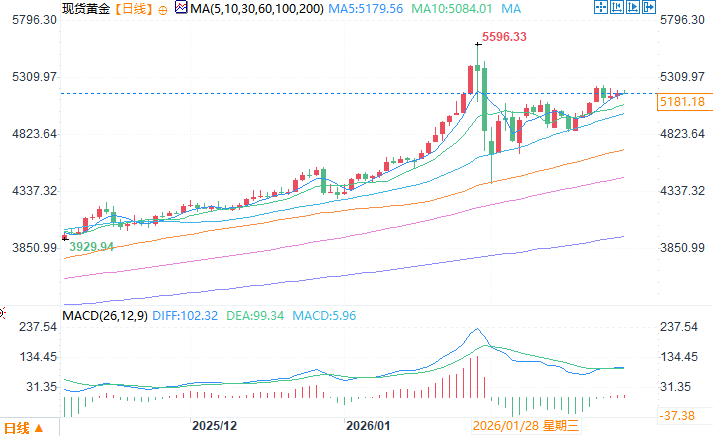
Spot gold daily chart source: EasyForex
At 10:59 AM Beijing time on February 27, spot gold was trading at $5,182.18 per ounce.
According to Nitesh Shah, head of commodities and macroeconomics research at WisdomTree, while both are facing a volatile macroeconomic backdrop, gold, as a monetary metal, appears to be in a better position than silver in the coming months.
After a sharp surge and sudden pullback in January, gold entered a relatively calm period, with prices consolidating above $5,100. Shah described last month's momentum as unusually speculative.
Shah stated that while it may take more time to deflate the bubble in the market, gold is benefiting from an “expanding scale” of buyers, including insurance companies and pension funds from major Asian countries, central banks, and even demand for tokenized and digital gold.
At the same time, concerns about fiscal dominance—that central banks will eventually be forced to address unsustainable government borrowing—continue to provide structural support for gold.
Speculative positions in the options market also reflect the continued bullish sentiment. Shah noted that call options in the range of "around $10,000 to $15,000" attracted "a considerable number of contracts," describing it as investors feeling "anything can happen now" and putting up "lottery bets."
However, while the gold consolidation appears constructive, he cautioned that silver's trajectory could be more fragile.
He said, "Silver is a bit tricky because it has already had such a strong run." He added that when looking at the gold-silver ratio, it is "well below historical averages," which suggests that " silver is relatively expensive relative to gold ."
Demand for gold is primarily driven by currency and investment, while silver, unlike gold, must contend with price sensitivities in the real economy.
Shah stated, "Given that silver is a much more industrialized commodity, I am concerned that industrial demand may be hampered by these price increases."
Therefore, he said he wouldn't be surprised if silver weakened relative to gold for the remainder of the year. He added that he expects the gold-silver ratio to return to between 60 and 70.
However, there is an unexpected scenario: retail investors may continue to favor silver simply because it appears cheaper in absolute terms. Shah suggests that even with favorable fundamentals for gold, demand for silver coins and bars is likely to remain stable.
As for what might ignite a new momentum in gold and push it back to last month's record high, Shah said investors still need to pay attention to global monetary policy led by the Federal Reserve.
The Federal Reserve continues to maintain a relatively neutral monetary policy, and it appears in no hurry to cut interest rates before summer. However, Shah argues that monetary policy cannot be understood in isolation from fiscal realities.
He said, "Debt is rising everywhere, and if it cannot be controlled... then central banks will have to react."
He added that when debt payments become unsustainable and bond markets become chaotic, central banks will have to take bold action, either cutting interest rates or easing in some other form. He stated that in the current environment, expanding balance sheets may be the more politically popular approach.
Crucially, this is not just a problem for the United States. Japan is seeking to stimulate its economy through significant fiscal measures. Meanwhile, European countries continue to increase deficit spending programs to rebuild the region's infrastructure and strengthen member states' military capabilities.
He said the expansion of global balance sheets will continue to support gold prices.
Shah stated that with so much economic uncertainty facing the global economy, gold and silver allocations remain extremely low, and despite rising prices, there is still significant room for growth in allocation.
He stated that portfolio positioning could be a powerful structural driver for precious metals. While many institutional investors have small exposures to metals, even modest changes in allocation can have a significant impact.
He said, "When we quantitatively analyze the gold market, if you're looking for the optimal holding, we're talking about gold close to 15%, 20% of your portfolio." He added, "Not many people get close to that level. But in a market that's relatively small compared to global bond and stock markets, doubling from 1% to 2%... has a significant impact."
Spot gold daily chart source: EasyForex
At 10:59 AM Beijing time on February 27, spot gold was trading at $5,182.18 per ounce.
- Risk Warning and Disclaimer
- The market involves risk, and trading may not be suitable for all investors. This article is for reference only and does not constitute personal investment advice, nor does it take into account certain users’ specific investment objectives, financial situation, or other needs. Any investment decisions made based on this information are at your own risk.