Crude Oil Trading Alert: Oil Prices Fluctuate Amidst Progressive US-Iran Negotiations and Supply Disruptions
2026-02-27 10:01:45
On Friday during Asian trading hours, US crude oil prices retreated slightly, trading around $65, continuing its short-term range-bound movement. On the fundamental front, Goldman Sachs noted in its latest report that the volume of Iranian crude oil transported through the Strait of Hormuz has increased significantly, with floating storage and in-transit crude oil volumes reaching a relatively high level.
The report estimates that current international oil prices include a risk premium of approximately $5-6 per barrel, which mainly stems from the uncertainty surrounding US-Iran relations and the risk of potential supply disruptions.
 Meanwhile, disruptions to Russia's energy infrastructure have exacerbated expectations of supply-side volatility. Damage to facilities along the Druzhba pipeline has temporarily restricted some export routes. The widening discount between Iranian and Russian crude oil on the international market reflects the market's complex assessment of future supply trends.
Yesterday, the US and Iran held their third round of indirect talks in Geneva. Omani Foreign Minister Badr stated that the talks had made "significant progress" and that both sides would resume negotiations as soon as possible after consultations between their respective governments. Technical discussions will be held next week in Vienna.
International Atomic Energy Agency (IAEA) Director Rafael Grossi also participated in the related communications. However, media reports indicate that significant differences remain between the two sides regarding the methods of dismantling nuclear facilities, the disposal of enriched uranium, and the timeline of the agreement.
The US emphasized the complete dismantling of key facilities and the removal of enriched uranium from the country, and stressed that the agreement must be permanent; Iran, on the other hand, proposed limiting the scale of enrichment within a specified period and resuming related activities under a regulatory framework. The market is maintaining a cautious balance between the "negative impact of the expected agreement" and the "positive impact of escalating conflict."
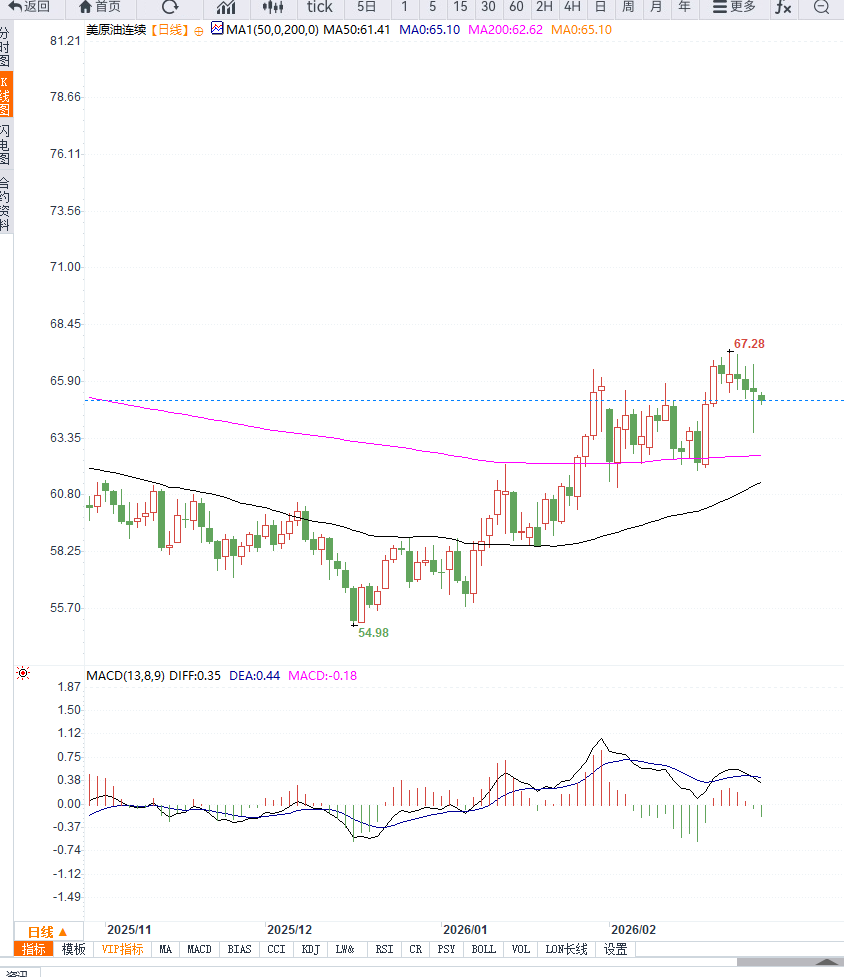
From a technical perspective, WTI daily chart shows that after rebounding from the $60 area, it has formed a sideways consolidation platform in the $65-$67 range. The moving average system is gradually flattening, indicating that the trend momentum is weakening. The RSI indicator is around 50, reflecting neutral market sentiment.
The first support level is $64. If this level is broken, the price may test the strong support zone of $60-$62. On the upside, $67 is the short-term resistance level. A break above this level could lead to a test of the $70 psychological level.
On the 4-hour chart, the price is trading within a converging consolidation pattern with significantly reduced volatility. Short-term support is around $64.5, while short-term resistance is around $66.8. A breakout in either direction with significant volume could lead to a $2-3 extension in the price movement. Overall, the technical picture shows typical range-bound trading, awaiting a directional move.
Editor's Note:
The core driver of current WTI price movements is not inventory or demand changes, but rather the pace of diplomatic progress. Risk premiums remain a significant component of prices; once the Vienna technical negotiations release a more substantial implementation framework, the market may quickly price in the potential impact of increased Iranian supply, thereby depressing the price level.
If negotiations stall or new signs of tension emerge, oil prices could quickly rise further. In the short term, the market is driven by news, but in the medium term, the trend will be constrained by the realities of supply recovery and the pace of global demand.
The report estimates that current international oil prices include a risk premium of approximately $5-6 per barrel, which mainly stems from the uncertainty surrounding US-Iran relations and the risk of potential supply disruptions.
Meanwhile, disruptions to Russia's energy infrastructure have exacerbated expectations of supply-side volatility. Damage to facilities along the Druzhba pipeline has temporarily restricted some export routes. The widening discount between Iranian and Russian crude oil on the international market reflects the market's complex assessment of future supply trends.Yesterday, the US and Iran held their third round of indirect talks in Geneva. Omani Foreign Minister Badr stated that the talks had made "significant progress" and that both sides would resume negotiations as soon as possible after consultations between their respective governments. Technical discussions will be held next week in Vienna.
International Atomic Energy Agency (IAEA) Director Rafael Grossi also participated in the related communications. However, media reports indicate that significant differences remain between the two sides regarding the methods of dismantling nuclear facilities, the disposal of enriched uranium, and the timeline of the agreement.
The US emphasized the complete dismantling of key facilities and the removal of enriched uranium from the country, and stressed that the agreement must be permanent; Iran, on the other hand, proposed limiting the scale of enrichment within a specified period and resuming related activities under a regulatory framework. The market is maintaining a cautious balance between the "negative impact of the expected agreement" and the "positive impact of escalating conflict."
From a technical perspective, WTI daily chart shows that after rebounding from the $60 area, it has formed a sideways consolidation platform in the $65-$67 range. The moving average system is gradually flattening, indicating that the trend momentum is weakening. The RSI indicator is around 50, reflecting neutral market sentiment.
The first support level is $64. If this level is broken, the price may test the strong support zone of $60-$62. On the upside, $67 is the short-term resistance level. A break above this level could lead to a test of the $70 psychological level.
On the 4-hour chart, the price is trading within a converging consolidation pattern with significantly reduced volatility. Short-term support is around $64.5, while short-term resistance is around $66.8. A breakout in either direction with significant volume could lead to a $2-3 extension in the price movement. Overall, the technical picture shows typical range-bound trading, awaiting a directional move.
Editor's Note:
The core driver of current WTI price movements is not inventory or demand changes, but rather the pace of diplomatic progress. Risk premiums remain a significant component of prices; once the Vienna technical negotiations release a more substantial implementation framework, the market may quickly price in the potential impact of increased Iranian supply, thereby depressing the price level.
If negotiations stall or new signs of tension emerge, oil prices could quickly rise further. In the short term, the market is driven by news, but in the medium term, the trend will be constrained by the realities of supply recovery and the pace of global demand.
- Risk Warning and Disclaimer
- The market involves risk, and trading may not be suitable for all investors. This article is for reference only and does not constitute personal investment advice, nor does it take into account certain users’ specific investment objectives, financial situation, or other needs. Any investment decisions made based on this information are at your own risk.