Safe-haven demand and panic trading have kept gold prices at a stalemate at high levels.
2026-02-27 18:12:18
On Thursday (February 27), spot gold maintained a narrow range of fluctuation during the Asian and European sessions, with the price hovering around 5173. With the spot price remaining stable, short-term funds showed signs of actively reducing their positions, and the market as a whole was in a state of high-level game.
The core focus of current gold trading remains on the US-Iran nuclear talks and the Russia-Ukraine conflict. Meanwhile, repeated US tariffs and the sharp decline in US tech stocks are also exerting downward pressure on gold prices.
Investors are paying close attention to the negotiation process and outcome. The uncertainty surrounding the outcome continues to provide safe-haven buying support for gold prices. The fluctuating tariffs also provide support. However, the adjustment in US technology stocks has affected market risk appetite, which has instead suppressed the rise in gold prices.
Other major asset classes followed a similar pattern, with oil prices falling slightly on Thursday as the market weighed geopolitical risk premiums against market risk appetite.
The current focus of gold trading is on the third round of indirect nuclear talks between the US and Iran in Geneva.
On February 26 local time, after the conclusion of the third round of indirect negotiations between Iran and the United States, Iranian Foreign Minister Araqchi stated that this was the most serious and longest-running round of negotiations, and that good progress had been made. The two sides were close to reaching a consensus in some areas, and their technical teams would hold technical negotiations in Vienna, Austria next Monday (March 2).
Iran maintained a firm stance during the negotiations, explicitly refusing to transfer its enriched uranium abroad, insisting on retaining its right to peaceful use of nuclear technology and its ability to produce nuclear fuel, and demanding that the United States lift sanctions against Iran.
The United States, on the other hand, demands that Iran dismantle its main nuclear facilities and ship its remaining enriched uranium to the United States, highlighting the core differences between the two sides.
Araghchi also emphasized that the Iranian nuclear issue cannot be resolved through military action, and that past pressure efforts have been ineffective, with this round of increased pressure also yielding no results.
On February 27 local time, the Iranian military sent a strong signal. Iranian Army Deputy Commander-in-Chief of Operations, Sirous, stated that with its drones, defense capabilities, missile capabilities, and the firm conviction of its officers and soldiers, Iran is fully prepared to respond to any enemy action and defend national sovereignty.
Sirus pointed out that after learning from the experience of the "12-Day War" in June last year and conducting numerous exercises, the troops have reached an ideal level of organization, and their equipment has been updated and trained according to the battlefield situation. It has now been put into combat deployment, and the Iranian Army will be ready to defend national security at any time.
The words suggest that Iran is taking a more proactive stance in the negotiations, and investors are paying close attention to the progress and outcome of the talks.
In addition to the situation in the Middle East, new developments have also emerged in the geopolitical situation in Europe.
On February 26 local time, the talks between representatives of Ukraine and the United States in Geneva, Switzerland, concluded. Ukrainian President Zelenskyy stated that the next round of trilateral talks between Ukraine, the United States, and Russia may be held in early March in Abu Dhabi, the capital of the United Arab Emirates. Ukraine hopes that this round of talks will finalize concrete security guarantees for Ukraine and prepare for a leaders' meeting.
US media reports that Trump hopes the Russia-Ukraine conflict will "end within a month," while Polish Foreign Minister Sikorski points out that Trump is trying to cut off aid to Ukraine to force concessions, but the conflict cannot end without the agreement of Ukraine and Europe. He notes that US influence has declined, indicating that Europe's continuously increasing defense spending is having a greater impact on the Russia-Ukraine situation, and that the US's plan to exert maximum pressure on Ukraine to influence the Russia-Ukraine negotiations may not be successful.
The increasing complexity of global geopolitical competition continues to provide safe-haven support for gold.
Officials from multiple departments of the Trump administration are expediting legal strategies to preserve billions of dollars in tariffs that the Supreme Court ruled were illegally imposed.
According to five sources familiar with the matter, the initial ideas include introducing policies to prevent companies from applying for tax refunds, restricting the return of funds, or at least retaining some of the customs revenue.
Two of the individuals stated that a proposal suggests that tariffs levied over the past year are legally valid under a new tariff framework drafted by the government based on other legal authority. Additionally...
Reports indicate that another proposal suggests that companies that voluntarily forgo partial refunds could receive priority processing in the tax refund process.
The fluctuating US trade policies and legal battles have further exacerbated the uncertainty of the global trade environment, continuously increasing market risk aversion and providing additional support for gold.
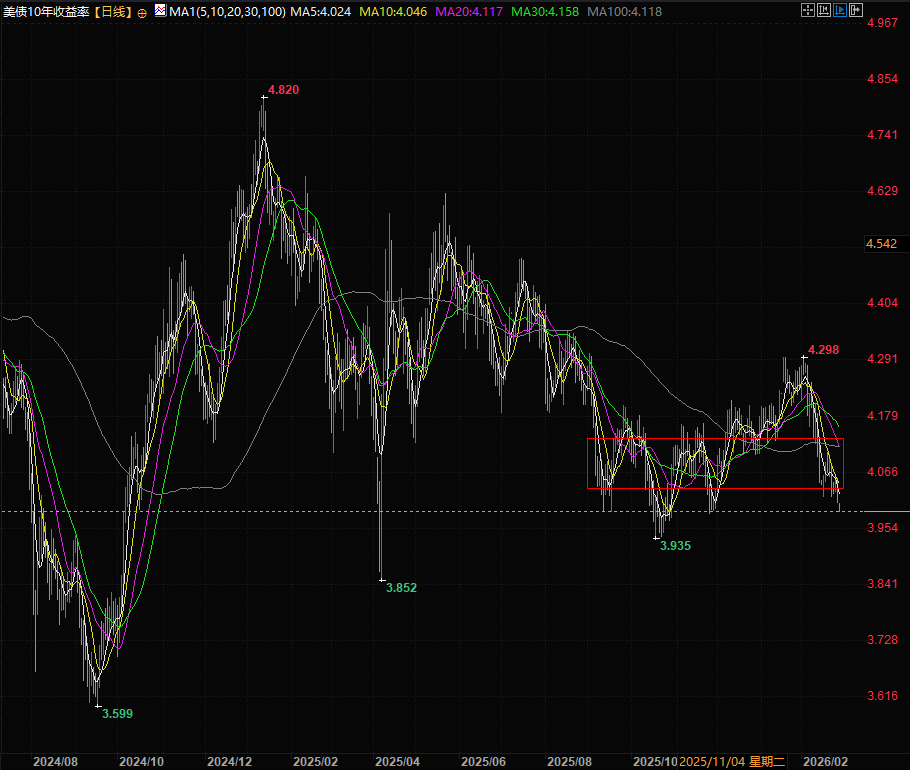
The 10-year US Treasury yield has continued to decline, currently falling below 4%, a level that indicates the market is actively seeking safe havens. One of the main reasons for this is the decline in US technology stocks, including provisions for the risk of a sharp drop in Nvidia's stock price. This contraction in risk appetite will also affect the price of gold.
Meanwhile, a weak dollar and strong US Treasury bonds indicate that funds acknowledge the near-term risks but are unwilling to hold more dollars, which is slightly beneficial to gold.
The US dollar index remained stable in the 97.7-97.8 range, with a slight decline, which did not exert significant downward pressure on gold prices.
 ,
,
(US Treasury yield daily chart)
Currently, gold prices remain bullish, mainly due to the uncertainty surrounding the US-Iran and Russia-Ukraine negotiations scheduled for early March. The potential for new conflicts and unforeseen events related to tariffs between the US and other countries and multinational corporations could support higher gold prices. Additionally, the performance of US tech stocks will influence market risk appetite, which will also impact precious metals; a recovery in risk appetite will contribute to higher gold prices.
However, since the focus of the negotiations still includes avoiding more serious conflicts and wars, if gold prices rise rapidly, funds may be tempted to sell off as the negative news is fully priced in.
In addition to the factors mentioned above, the next key macroeconomic turning point for the gold market is the release of the US Personal Income and Expenditure Report for January 2026 on March 13. The PCE price index, as the Fed's core inflation indicator, will directly affect policy expectations and thus guide the direction of US Treasury yields, the US dollar, and gold.
In terms of technical trends, spot gold performed stronger than expected during the US-Iran talks, but hesitated to rise as US stocks fell. Currently, the gold price is fluctuating around the 5-day moving average, with support at the middle line of the blue dotted channel and the 5125 area. If the gold price breaks down quickly, bulls can still position themselves, as the aforementioned geopolitical issues have a basis for continued recurrence.
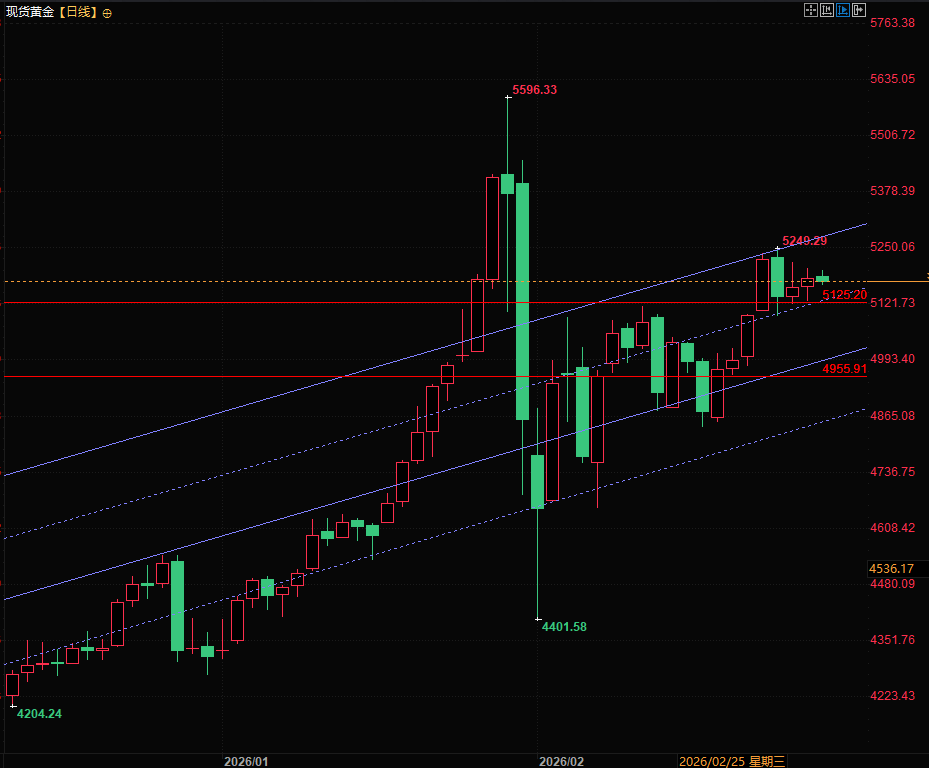
(Spot gold daily chart, source: FX678)
At 18:10 Beijing time, spot gold was trading at $5,174 per ounce.
The core focus of current gold trading remains on the US-Iran nuclear talks and the Russia-Ukraine conflict. Meanwhile, repeated US tariffs and the sharp decline in US tech stocks are also exerting downward pressure on gold prices.
Investors are paying close attention to the negotiation process and outcome. The uncertainty surrounding the outcome continues to provide safe-haven buying support for gold prices. The fluctuating tariffs also provide support. However, the adjustment in US technology stocks has affected market risk appetite, which has instead suppressed the rise in gold prices.
Other major asset classes followed a similar pattern, with oil prices falling slightly on Thursday as the market weighed geopolitical risk premiums against market risk appetite.
US-Iran nuclear negotiations: Progress and hardline stances coexist, dominating the core logic of gold price safe-haven demand.
The current focus of gold trading is on the third round of indirect nuclear talks between the US and Iran in Geneva.
On February 26 local time, after the conclusion of the third round of indirect negotiations between Iran and the United States, Iranian Foreign Minister Araqchi stated that this was the most serious and longest-running round of negotiations, and that good progress had been made. The two sides were close to reaching a consensus in some areas, and their technical teams would hold technical negotiations in Vienna, Austria next Monday (March 2).
Iran maintained a firm stance during the negotiations, explicitly refusing to transfer its enriched uranium abroad, insisting on retaining its right to peaceful use of nuclear technology and its ability to produce nuclear fuel, and demanding that the United States lift sanctions against Iran.
The United States, on the other hand, demands that Iran dismantle its main nuclear facilities and ship its remaining enriched uranium to the United States, highlighting the core differences between the two sides.
Araghchi also emphasized that the Iranian nuclear issue cannot be resolved through military action, and that past pressure efforts have been ineffective, with this round of increased pressure also yielding no results.
On February 27 local time, the Iranian military sent a strong signal. Iranian Army Deputy Commander-in-Chief of Operations, Sirous, stated that with its drones, defense capabilities, missile capabilities, and the firm conviction of its officers and soldiers, Iran is fully prepared to respond to any enemy action and defend national sovereignty.
Sirus pointed out that after learning from the experience of the "12-Day War" in June last year and conducting numerous exercises, the troops have reached an ideal level of organization, and their equipment has been updated and trained according to the battlefield situation. It has now been put into combat deployment, and the Iranian Army will be ready to defend national security at any time.
The words suggest that Iran is taking a more proactive stance in the negotiations, and investors are paying close attention to the progress and outcome of the talks.
New geopolitical developments in Europe: Advances in Russia-Ukraine negotiations further escalate the global risk aversion landscape.
In addition to the situation in the Middle East, new developments have also emerged in the geopolitical situation in Europe.
On February 26 local time, the talks between representatives of Ukraine and the United States in Geneva, Switzerland, concluded. Ukrainian President Zelenskyy stated that the next round of trilateral talks between Ukraine, the United States, and Russia may be held in early March in Abu Dhabi, the capital of the United Arab Emirates. Ukraine hopes that this round of talks will finalize concrete security guarantees for Ukraine and prepare for a leaders' meeting.
US media reports that Trump hopes the Russia-Ukraine conflict will "end within a month," while Polish Foreign Minister Sikorski points out that Trump is trying to cut off aid to Ukraine to force concessions, but the conflict cannot end without the agreement of Ukraine and Europe. He notes that US influence has declined, indicating that Europe's continuously increasing defense spending is having a greater impact on the Russia-Ukraine situation, and that the US's plan to exert maximum pressure on Ukraine to influence the Russia-Ukraine negotiations may not be successful.
The increasing complexity of global geopolitical competition continues to provide safe-haven support for gold.
US Tariff Game: Government Accelerates Retention of Illegal Tariff Revenues, Trade Uncertainty Rises
Officials from multiple departments of the Trump administration are expediting legal strategies to preserve billions of dollars in tariffs that the Supreme Court ruled were illegally imposed.
According to five sources familiar with the matter, the initial ideas include introducing policies to prevent companies from applying for tax refunds, restricting the return of funds, or at least retaining some of the customs revenue.
Two of the individuals stated that a proposal suggests that tariffs levied over the past year are legally valid under a new tariff framework drafted by the government based on other legal authority. Additionally...
Reports indicate that another proposal suggests that companies that voluntarily forgo partial refunds could receive priority processing in the tax refund process.
The fluctuating US trade policies and legal battles have further exacerbated the uncertainty of the global trade environment, continuously increasing market risk aversion and providing additional support for gold.
Reference factor: US Treasury yields reflect market risk appetite.
The 10-year US Treasury yield has continued to decline, currently falling below 4%, a level that indicates the market is actively seeking safe havens. One of the main reasons for this is the decline in US technology stocks, including provisions for the risk of a sharp drop in Nvidia's stock price. This contraction in risk appetite will also affect the price of gold.
Meanwhile, a weak dollar and strong US Treasury bonds indicate that funds acknowledge the near-term risks but are unwilling to hold more dollars, which is slightly beneficial to gold.
The US dollar index remained stable in the 97.7-97.8 range, with a slight decline, which did not exert significant downward pressure on gold prices.
,(US Treasury yield daily chart)
Summary and Technical Analysis:
Currently, gold prices remain bullish, mainly due to the uncertainty surrounding the US-Iran and Russia-Ukraine negotiations scheduled for early March. The potential for new conflicts and unforeseen events related to tariffs between the US and other countries and multinational corporations could support higher gold prices. Additionally, the performance of US tech stocks will influence market risk appetite, which will also impact precious metals; a recovery in risk appetite will contribute to higher gold prices.
However, since the focus of the negotiations still includes avoiding more serious conflicts and wars, if gold prices rise rapidly, funds may be tempted to sell off as the negative news is fully priced in.
In addition to the factors mentioned above, the next key macroeconomic turning point for the gold market is the release of the US Personal Income and Expenditure Report for January 2026 on March 13. The PCE price index, as the Fed's core inflation indicator, will directly affect policy expectations and thus guide the direction of US Treasury yields, the US dollar, and gold.
In terms of technical trends, spot gold performed stronger than expected during the US-Iran talks, but hesitated to rise as US stocks fell. Currently, the gold price is fluctuating around the 5-day moving average, with support at the middle line of the blue dotted channel and the 5125 area. If the gold price breaks down quickly, bulls can still position themselves, as the aforementioned geopolitical issues have a basis for continued recurrence.
(Spot gold daily chart, source: FX678)
At 18:10 Beijing time, spot gold was trading at $5,174 per ounce.
- Risk Warning and Disclaimer
- The market involves risk, and trading may not be suitable for all investors. This article is for reference only and does not constitute personal investment advice, nor does it take into account certain users’ specific investment objectives, financial situation, or other needs. Any investment decisions made based on this information are at your own risk.