Crude oil refuses to fall: What are the bulls betting on in this geopolitical powder keg?
2026-02-27 19:57:39
On Friday, February 27th, Brent crude oil traded around $72.30 during the European session, remaining at a relatively high level. Market interpretations of the progress of the US-Iran negotiations showed clear fluctuations. Earlier reports indicated a breakdown in the third round of talks, even suggesting Iran had rejected US demands, causing oil prices to surge. However, subsequent developments indicated significant progress in the dialogue, with another round of communication scheduled for next week, causing prices to give back some of their gains.

As the weekend approaches, funds tend to buy in advance to protect or reduce short exposure, mitigating the risk of gaps caused by unexpected events. This explains why prices have recently stabilized and rebounded after a pullback. For traders, the uncertainty of weekend news is a typical tail risk, especially in a highly volatile market where risk appetite shifts more frequently from offensive to defensive. Looking back at recent market performance, the market experienced intraday volatility of nearly 5%, highlighting its strong news-driven nature.
Yesterday's trading saw a sharp intraday swing, with the price rapidly shifting from -1.5% to +2.5%. Subsequently, after the mediators stated that significant progress had been made and technical communications would resume next week in Vienna, the gains receded, ultimately closing near flat at -0.14% at $70.90 per barrel. This dramatic back-and-forth movement suggests that a clear trend has not yet fully formed, but it also indicates a fierce battle between bulls and bears at high levels. As long as the uncertainty remains unresolved, funds are more inclined to maintain a certain level of long protective positions.
If the situation escalates further and triggers a military conflict, oil prices often surge rapidly. The core reason is that the risk premium for passage through the Strait of Hormuz is significantly amplified. As a vital choke point for global energy transportation, any disruption to this route could lead to a simultaneous strengthening of spot supply and the spot price spread, and the futures curve is more likely to tilt towards the near end, pushing prices up in the short term due to the risk premium.
Conversely, only if clear signs of de-escalation emerge, such as a significant de-escalation on the military front or a verifiable breakthrough in negotiations, will the market likely re-trade based on the supply-demand rebalancing logic, with prices retracing and seeking a new equilibrium range around $70. Currently, the risk premium remains, meaning that stronger negative catalysts are needed to open up downside potential. Looking ahead, short-term pricing will continue to revolve around two main themes: whether negotiations continue to release verifiable progress signals, and whether the risk premium for key trading lanes will rise further.
From a chart perspective, Brent crude oil maintains a high-level pattern within an upward channel on the daily chart. Near-term resistance is around $73; a sustained hold above this level could lead to further upward movement towards new highs. Support is seen around $70.20; a break below this level could trigger a short-term pullback to the key support zone around $67.50. In terms of indicators, the MACD parameters are DIFF 1.57, DEA 1.48, and MACD 0.18, still indicating a bullish bias above the zero line, but the histogram momentum is not strong, suggesting that upward movement is more driven by news than by a simple trend expansion. The RSI is 64.83, in a slightly bullish but not extreme zone, indicating that while bulls are in control, there is also a need for profit-taking at some point.
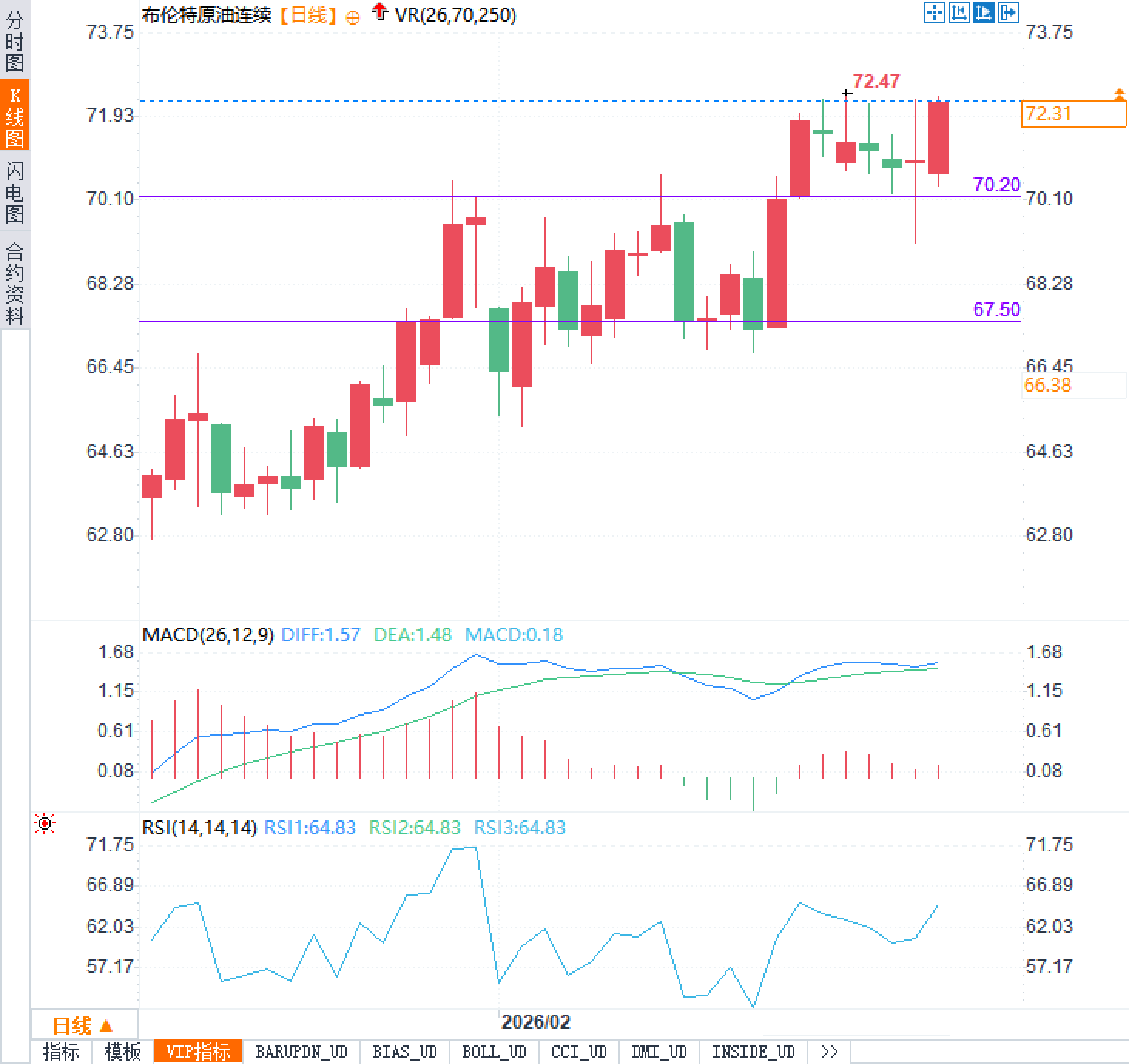
Overall, current oil prices remain supported by uncertainty, and the bullish trend is unlikely to change significantly in the short term. If prices remain resilient above $70.20, bulls can maintain a structural advantage, but a rapid pullback due to sudden reversals in news should be watched closely. If prices break upwards and find effective support above $73, the market may re-induce a higher risk premium.
Weekend effect and tail risk: Why do funds choose a "defensive counterattack" strategy?
As the weekend approaches, funds tend to buy in advance to protect or reduce short exposure, mitigating the risk of gaps caused by unexpected events. This explains why prices have recently stabilized and rebounded after a pullback. For traders, the uncertainty of weekend news is a typical tail risk, especially in a highly volatile market where risk appetite shifts more frequently from offensive to defensive. Looking back at recent market performance, the market experienced intraday volatility of nearly 5%, highlighting its strong news-driven nature.
Yesterday's trading saw a sharp intraday swing, with the price rapidly shifting from -1.5% to +2.5%. Subsequently, after the mediators stated that significant progress had been made and technical communications would resume next week in Vienna, the gains receded, ultimately closing near flat at -0.14% at $70.90 per barrel. This dramatic back-and-forth movement suggests that a clear trend has not yet fully formed, but it also indicates a fierce battle between bulls and bears at high levels. As long as the uncertainty remains unresolved, funds are more inclined to maintain a certain level of long protective positions.
A critical juncture: Will risk premiums recede or will war reignite?
If the situation escalates further and triggers a military conflict, oil prices often surge rapidly. The core reason is that the risk premium for passage through the Strait of Hormuz is significantly amplified. As a vital choke point for global energy transportation, any disruption to this route could lead to a simultaneous strengthening of spot supply and the spot price spread, and the futures curve is more likely to tilt towards the near end, pushing prices up in the short term due to the risk premium.
Conversely, only if clear signs of de-escalation emerge, such as a significant de-escalation on the military front or a verifiable breakthrough in negotiations, will the market likely re-trade based on the supply-demand rebalancing logic, with prices retracing and seeking a new equilibrium range around $70. Currently, the risk premium remains, meaning that stronger negative catalysts are needed to open up downside potential. Looking ahead, short-term pricing will continue to revolve around two main themes: whether negotiations continue to release verifiable progress signals, and whether the risk premium for key trading lanes will rise further.
Technical Analysis:
From a chart perspective, Brent crude oil maintains a high-level pattern within an upward channel on the daily chart. Near-term resistance is around $73; a sustained hold above this level could lead to further upward movement towards new highs. Support is seen around $70.20; a break below this level could trigger a short-term pullback to the key support zone around $67.50. In terms of indicators, the MACD parameters are DIFF 1.57, DEA 1.48, and MACD 0.18, still indicating a bullish bias above the zero line, but the histogram momentum is not strong, suggesting that upward movement is more driven by news than by a simple trend expansion. The RSI is 64.83, in a slightly bullish but not extreme zone, indicating that while bulls are in control, there is also a need for profit-taking at some point.
Overall, current oil prices remain supported by uncertainty, and the bullish trend is unlikely to change significantly in the short term. If prices remain resilient above $70.20, bulls can maintain a structural advantage, but a rapid pullback due to sudden reversals in news should be watched closely. If prices break upwards and find effective support above $73, the market may re-induce a higher risk premium.
- Risk Warning and Disclaimer
- The market involves risk, and trading may not be suitable for all investors. This article is for reference only and does not constitute personal investment advice, nor does it take into account certain users’ specific investment objectives, financial situation, or other needs. Any investment decisions made based on this information are at your own risk.