A chart shows that the Baltic Dry Index closed higher for the week due to rising freight rates across all ship types.
2026-02-28 01:39:37
Latest data shows that the Baltic Dry Index (BDI) reached 2140 points on February 27, 2026, a new high since January 30, 2026, up 1.09% month-on-month, marking the largest increase in four days. Looking at the recent short-term charts, the BDI has seen positive growth 5 times, negative growth 6 times, and zero growth 0 times. Specifically, the Panamax Freight Index (BPI) was 1942 points, up 1.36% from the previous value; the Capesize Freight Index (BCI) was 3056 points, up 0.16%; and the Supramax Freight Index (BSI) was 1338 points, up 3.00%. For detailed 720-day and 10-year trend charts of the Baltic Dry Index and its three main sub-indices, please refer to the specially designed charts.
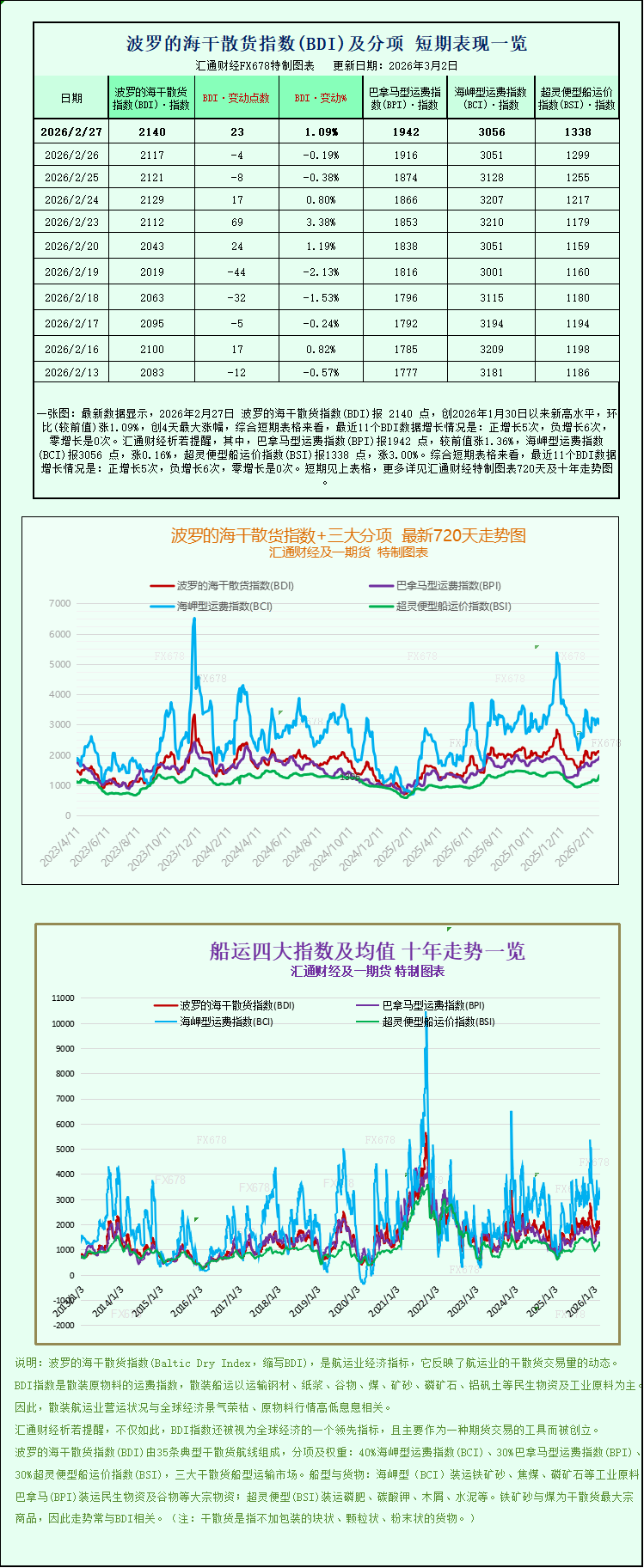
The Baltic Dry Index rose on Friday, boosted by increases in freight rates across all vessel types, ultimately closing the week higher. This index primarily monitors freight rates for dry bulk carriers.
The Baltic Dry Index (BDI) rose 23 points, or 1.1%, to close at 2140. The index gained 4.7% this week, but its monthly performance was weak, recording a 1.4% decline. The BDI covers freight rates for the three main dry bulk carrier types: Capesize, Panamax, and Supramax.
The Capesize freight index rose slightly by 5 points, or 0.2%, to close at 3056. Capesize vessels are mainly responsible for transporting bulk dry cargoes such as iron ore and coal, with a single vessel carrying up to 150,000 tons of cargo. Their average daily earnings increased by $42 to $24,211.
Iron ore futures closed higher on the day, primarily supported by strong port profits for seaborne iron ore, while tight supply in the spot market also boosted prices. However, upcoming production cuts in the steel industry, coupled with weak demand for raw materials such as iron ore, limited the upside potential for iron ore futures prices.
The Panamax freight index rose 26 points, or 1.4%, to close at 1942. Panamax vessels typically carry between 60,000 and 70,000 tons of cargo, mainly coal, grain, and other commodities. The average daily profit for this type of vessel increased by $234 to $17,481.
In the small dry bulk carrier sector, the Supramax freight rate index performed exceptionally well, surging 39 points, or 3%, to close at 1338 points.
The Baltic Dry Index rose on Friday, boosted by increases in freight rates across all vessel types, ultimately closing the week higher. This index primarily monitors freight rates for dry bulk carriers.
The Baltic Dry Index (BDI) rose 23 points, or 1.1%, to close at 2140. The index gained 4.7% this week, but its monthly performance was weak, recording a 1.4% decline. The BDI covers freight rates for the three main dry bulk carrier types: Capesize, Panamax, and Supramax.
The Capesize freight index rose slightly by 5 points, or 0.2%, to close at 3056. Capesize vessels are mainly responsible for transporting bulk dry cargoes such as iron ore and coal, with a single vessel carrying up to 150,000 tons of cargo. Their average daily earnings increased by $42 to $24,211.
Iron ore futures closed higher on the day, primarily supported by strong port profits for seaborne iron ore, while tight supply in the spot market also boosted prices. However, upcoming production cuts in the steel industry, coupled with weak demand for raw materials such as iron ore, limited the upside potential for iron ore futures prices.
The Panamax freight index rose 26 points, or 1.4%, to close at 1942. Panamax vessels typically carry between 60,000 and 70,000 tons of cargo, mainly coal, grain, and other commodities. The average daily profit for this type of vessel increased by $234 to $17,481.
In the small dry bulk carrier sector, the Supramax freight rate index performed exceptionally well, surging 39 points, or 3%, to close at 1338 points.
- Risk Warning and Disclaimer
- The market involves risk, and trading may not be suitable for all investors. This article is for reference only and does not constitute personal investment advice, nor does it take into account certain users’ specific investment objectives, financial situation, or other needs. Any investment decisions made based on this information are at your own risk.