Increased geopolitical risks could push gold prices above $5,250.
2026-02-28 01:54:46
On Friday (February 27), during the US trading session, the global spot gold market showed a slight upward trend, with prices continuing to approach the one-month high of $5250.00. Market activity was significantly higher than in the previous few trading days. From the daily chart perspective, $5250.00 is not only a key resistance level in the near term, but also a crucial gateway for gold prices to accelerate their upward movement and retest the historical high of $5602.23. Once this level is successfully broken and held, it will open up a new round of upward potential and attract more trend-following buying.

Meanwhile, after five consecutive trading days of repeated testing and consolidation, the key support level for gold prices has been firmly established at $5143.89. Multiple dips to this level have resulted in rapid rebounds, indicating ample buying power in this range and the formation of solid bottom support. Currently, gold's technical pattern is intact, and the upward trend remains unbroken. Global traders are holding their breath awaiting a key catalyst to drive a stronger-than-expected rally in gold prices.
International spot gold was quoted at $5,230.58 during the session, up $45.40 from the previous trading day's closing price, a gain of 0.88%. The intraday fluctuation range was controlled between $5,192.30 and $5,235.10, showing an overall upward trend.
With US-Iran negotiations stalled, a window of opportunity opens for Trump to take action.
In the current gold market, traditional fundamental factors (such as the dollar's performance, real interest rates, and global inflation data) have temporarily taken a backseat, with the market's focus entirely on geopolitical dynamics in the Middle East. Thursday (February 26) was a crucial deadline set by former US President Trump for US-Iran nuclear negotiations, but after multiple rounds of consultations, the two sides failed to reach any substantial nuclear agreement, and the negotiations reached a stalemate.
This outcome instantly heightened tensions in the Middle East and opened the door for a potential US military strike against Iran. Previously, Trump had publicly stated that if Iran failed to reach an agreement within the stipulated timeframe, "very bad things" would happen in the next 10 to 15 days. This crucial window officially opened this weekend, and market concerns about military conflict continued to escalate, further driving safe-haven funds into the gold market.
A moderate display of force may be the next step.
Although the US and Iran have agreed to extend nuclear negotiations until next week, I believe that with Trump's public announcement on Thursday evening of sending more US troops to the Middle East, regional tensions have not eased but are escalating further. Judging from the current situation, it is precisely the military deterrence created by the three US naval fleets deployed near Iran that has forced Iran back to the negotiating table and initiated multiple rounds of nuclear talks.
Given the lack of breakthrough after three rounds of formal talks, I believe that a moderate demonstration of force may be the next key step for the US in pushing for an agreement with Iran—by further strengthening military deterrence, exerting greater pressure on Iran, and forcing it to make concessions on core issues. Trump's personal style also indicates that he is not a patient person; if negotiations continue to stall, he may resort to more forceful measures, which would further increase geopolitical risk premiums.
Gold is a demand-driven investment, not a "war commodity."
In the face of the current geopolitical situation, many investors naturally equate gold with "war trade," but I believe this perception is somewhat one-sided. Basic trading theory does indeed suggest that gold is a classic safe-haven asset; during periods of geopolitical turmoil and increased global economic uncertainty, investors rush to buy gold to mitigate risk, as if gold would become a globally accepted hard currency should a large-scale conflict erupt.
Gold is currently in a clear uptrend and is forming a standard breakout pattern, with strong bullish signals from a technical perspective. However, from a fundamental perspective, before gold finally breaks out of its long-term trading range and reaches a new historical high in 2025, it has maintained a range-bound trading pattern for nearly 40 years. During these 40 years, there have been many large-scale wars and regional conflicts around the world, but gold prices have consistently failed to break out of the range and have remained within a relatively stable fluctuation range.
Gold is essentially a demand-driven investment, and its price movement is primarily determined by market supply and demand—when demand for gold increases, the price rises; when demand decreases and supply increases, the price falls. Current geopolitical risks are merely a short-term catalyst for increased gold demand. We can define the current price increase as a long-term demand-driven rally, with short-term political issues providing additional support for this trend.
Technical Analysis
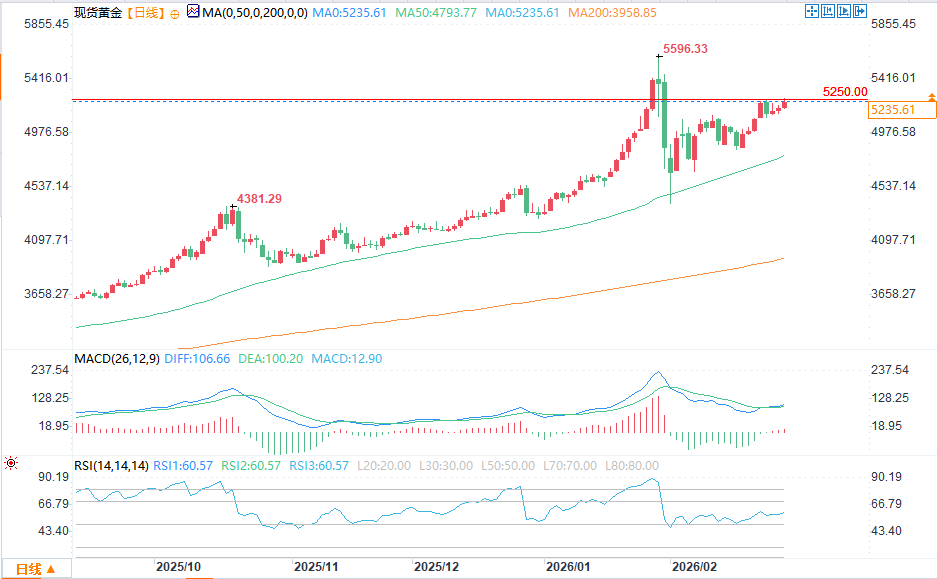
(Spot gold daily chart source: FX678)
From a technical perspective, whether gold can successfully challenge the historical high of $5602.23 in the short term hinges on how it breaks through the key resistance level of $5250.00. Different breakout methods will directly determine the strength and sustainability of subsequent price movements, which is currently the core issue of greatest concern to global traders.
The ideal breakout pattern is as follows: after consolidating around $5250.00, gold prices break through this level with a significant increase in trading volume, driven by new buying. This type of breakout indicates strong bullish sentiment in the market, continuous inflow of new funds, and stronger sustainability of the subsequent rally, potentially leading to a rapid approach to historical highs. The weakest breakout pattern is one driven solely by short covering – meaning investors who previously shorted gold close their positions to mitigate risk, passively pushing up prices. This type of breakout lacks the support of new funds, and once short covering ends, prices are likely to fall back, making a sustained upward trend difficult.
From a support level perspective, the current secondary support for gold lies in the retracement range of $5143.89 to $5002.31. This range was a significant consolidation zone during the previous gold price rally and is also an area where bullish forces are relatively concentrated, making it a relatively ideal range for establishing positions. If the gold price fails to break through $5250.00 in the short term and instead falls back into this range to consolidate and await new catalysts, this is also a reasonable technical trend, and investors should not panic excessively.
Meanwhile, for value investors seeking high-quality, low-cost-performance investments with strong upside potential, the current 50-day moving average for gold ($4795.22) is a key price level to watch. This moving average is not only an important support line for gold's medium-term trend but also a crucial entry point for a long-term bullish trend. If the price subsequently retraces to this level, it will be an ideal entry point to start the next bullish trend, offering both a high safety margin and the opportunity to capitalize on future upside potential.
Meanwhile, after five consecutive trading days of repeated testing and consolidation, the key support level for gold prices has been firmly established at $5143.89. Multiple dips to this level have resulted in rapid rebounds, indicating ample buying power in this range and the formation of solid bottom support. Currently, gold's technical pattern is intact, and the upward trend remains unbroken. Global traders are holding their breath awaiting a key catalyst to drive a stronger-than-expected rally in gold prices.
International spot gold was quoted at $5,230.58 during the session, up $45.40 from the previous trading day's closing price, a gain of 0.88%. The intraday fluctuation range was controlled between $5,192.30 and $5,235.10, showing an overall upward trend.
With US-Iran negotiations stalled, a window of opportunity opens for Trump to take action.
In the current gold market, traditional fundamental factors (such as the dollar's performance, real interest rates, and global inflation data) have temporarily taken a backseat, with the market's focus entirely on geopolitical dynamics in the Middle East. Thursday (February 26) was a crucial deadline set by former US President Trump for US-Iran nuclear negotiations, but after multiple rounds of consultations, the two sides failed to reach any substantial nuclear agreement, and the negotiations reached a stalemate.
This outcome instantly heightened tensions in the Middle East and opened the door for a potential US military strike against Iran. Previously, Trump had publicly stated that if Iran failed to reach an agreement within the stipulated timeframe, "very bad things" would happen in the next 10 to 15 days. This crucial window officially opened this weekend, and market concerns about military conflict continued to escalate, further driving safe-haven funds into the gold market.
A moderate display of force may be the next step.
Although the US and Iran have agreed to extend nuclear negotiations until next week, I believe that with Trump's public announcement on Thursday evening of sending more US troops to the Middle East, regional tensions have not eased but are escalating further. Judging from the current situation, it is precisely the military deterrence created by the three US naval fleets deployed near Iran that has forced Iran back to the negotiating table and initiated multiple rounds of nuclear talks.
Given the lack of breakthrough after three rounds of formal talks, I believe that a moderate demonstration of force may be the next key step for the US in pushing for an agreement with Iran—by further strengthening military deterrence, exerting greater pressure on Iran, and forcing it to make concessions on core issues. Trump's personal style also indicates that he is not a patient person; if negotiations continue to stall, he may resort to more forceful measures, which would further increase geopolitical risk premiums.
Gold is a demand-driven investment, not a "war commodity."
In the face of the current geopolitical situation, many investors naturally equate gold with "war trade," but I believe this perception is somewhat one-sided. Basic trading theory does indeed suggest that gold is a classic safe-haven asset; during periods of geopolitical turmoil and increased global economic uncertainty, investors rush to buy gold to mitigate risk, as if gold would become a globally accepted hard currency should a large-scale conflict erupt.
Gold is currently in a clear uptrend and is forming a standard breakout pattern, with strong bullish signals from a technical perspective. However, from a fundamental perspective, before gold finally breaks out of its long-term trading range and reaches a new historical high in 2025, it has maintained a range-bound trading pattern for nearly 40 years. During these 40 years, there have been many large-scale wars and regional conflicts around the world, but gold prices have consistently failed to break out of the range and have remained within a relatively stable fluctuation range.
Gold is essentially a demand-driven investment, and its price movement is primarily determined by market supply and demand—when demand for gold increases, the price rises; when demand decreases and supply increases, the price falls. Current geopolitical risks are merely a short-term catalyst for increased gold demand. We can define the current price increase as a long-term demand-driven rally, with short-term political issues providing additional support for this trend.
Technical Analysis
(Spot gold daily chart source: FX678)
From a technical perspective, whether gold can successfully challenge the historical high of $5602.23 in the short term hinges on how it breaks through the key resistance level of $5250.00. Different breakout methods will directly determine the strength and sustainability of subsequent price movements, which is currently the core issue of greatest concern to global traders.
The ideal breakout pattern is as follows: after consolidating around $5250.00, gold prices break through this level with a significant increase in trading volume, driven by new buying. This type of breakout indicates strong bullish sentiment in the market, continuous inflow of new funds, and stronger sustainability of the subsequent rally, potentially leading to a rapid approach to historical highs. The weakest breakout pattern is one driven solely by short covering – meaning investors who previously shorted gold close their positions to mitigate risk, passively pushing up prices. This type of breakout lacks the support of new funds, and once short covering ends, prices are likely to fall back, making a sustained upward trend difficult.
From a support level perspective, the current secondary support for gold lies in the retracement range of $5143.89 to $5002.31. This range was a significant consolidation zone during the previous gold price rally and is also an area where bullish forces are relatively concentrated, making it a relatively ideal range for establishing positions. If the gold price fails to break through $5250.00 in the short term and instead falls back into this range to consolidate and await new catalysts, this is also a reasonable technical trend, and investors should not panic excessively.
Meanwhile, for value investors seeking high-quality, low-cost-performance investments with strong upside potential, the current 50-day moving average for gold ($4795.22) is a key price level to watch. This moving average is not only an important support line for gold's medium-term trend but also a crucial entry point for a long-term bullish trend. If the price subsequently retraces to this level, it will be an ideal entry point to start the next bullish trend, offering both a high safety margin and the opportunity to capitalize on future upside potential.
- Risk Warning and Disclaimer
- The market involves risk, and trading may not be suitable for all investors. This article is for reference only and does not constitute personal investment advice, nor does it take into account certain users’ specific investment objectives, financial situation, or other needs. Any investment decisions made based on this information are at your own risk.