













The Strait of Hormuz crisis is escalating, and the global energy sector may face a repeat of the 1970s-style Great Depression, with oil prices potentially soaring to triple digits.
2026-03-02 07:49:13
Currently, the geopolitical situation in the Middle East is deteriorating rapidly, and the US military strike against Iran has drawn significant international attention. This event has quickly focused global attention on the Strait of Hormuz—a narrow waterway known as the "world's oil choke point." If the strait is subjected to a prolonged blockade or severe disruption, oil supplies will face an unprecedented shock, and oil prices could potentially break through the triple-digit mark, reminiscent of the dramatic fluctuations of the energy crisis of the 1970s. The market is closely monitoring the situation, and any sustained disruption could trigger a profound reshaping of the global energy landscape.
The US strikes against Iran over the weekend marked a new phase in the confrontation between the two countries. This military action not only directly targeted objectives within Iran but also triggered a strong backlash from Iran and its proxies. Analysts point out that the situation is now close to the brink of full-blown military conflict, and its trajectory is difficult to predict accurately. Vandana Hari, CEO of energy research firm Vanda Insights, emphasized that if the conflict continues for several days and is accompanied by maximum retaliation from Iran and its allies, Middle Eastern oil flows will suffer significant disruption. Unless the US can quickly disarm the Iranian navy and military forces and ensure the normal passage of oil tankers through the Straits of Hormuz, the worst-case scenario is difficult to avoid.
The Iranian Revolutionary Guard has issued a radio warning to merchant ships, stating that "no vessel may pass through the Strait of Hormuz." Although Tehran has not officially announced the closure of the waterway, this signal has been enough to trigger market panic. Several shipping companies and oil traders have begun suspending or detouring through the area, resulting in a significant drop in ship traffic. Industry observers believe this is not merely a localized impact on Iranian exports, but could potentially escalate into a regional crisis involving multiple Gulf oil-producing nations.
The Strait of Hormuz, located between Iran and Oman, is the only sea passage connecting the Persian Gulf and the Gulf of Oman. Despite its limited width, the strait carries a significant share of global energy trade. According to the latest data, approximately 20 million barrels of crude oil, condensate, and petroleum products pass through the strait daily in recent years, accounting for about one-fifth of global liquid petroleum consumption and one-quarter to one-third of seaborne crude oil trade. Major exporting countries include Saudi Arabia, Iraq, the United Arab Emirates, Kuwait, and Iran itself, with the vast majority of their crude oil exports relying on this passage to markets in Asia, Europe, and North America.
Furthermore, the Strait of Hormuz is a crucial route for Qatar and the UAE's liquefied natural gas (LNG) exports, accounting for a significant proportion of global LNG trade. Any disruption would have a simultaneous impact on the oil and gas markets, with Asia, as a major importer, bearing the brunt of the energy security challenges.
The market is currently pricing in a multi-layered risk spectrum. In the short term, Iran's own exports could lose up to 2 million barrels per day; if the conflict spills over, attacks on regional infrastructure will become a real threat. The most extreme scenario is that Iran, driven by an existential crisis, attempts to completely blockade the Strait of Hormuz. Although the US and its allies may deploy warships to escort it, a successful blockade would still have catastrophic consequences.
Bob McNally, president of Rapidan Energy Group, described this as a "very serious development" in the global oil and gas market. Saul Kavonic, head of energy research at MST Marquee, further pointed out that if Iran believes its regime faces an existential threat, a blockade of the Straits is not impossible. Experts agree that the duration of the disruption is the key variable determining the magnitude of the price surge: short-term disruptions may lead to a modest price increase, while a blockade lasting weeks or even months will trigger the largest supply shortage in history.
In the most extreme scenario, a complete closure of the Strait of Hormuz would cut off approximately 20 million barrels per day of global supply, far exceeding the combined impact of the 1973 Arab oil embargo and the 1979 Iranian Revolution. Analysts estimate that such a scenario could be more than three times as severe as the energy crisis of the 1970s, with international benchmark Brent crude oil prices expected to quickly fall into triple digits, while LNG prices could return to their historical peak reached in 2022.
Brent crude oil prices have risen significantly recently due to accumulated geopolitical risks, with a cumulative increase of nearly 20% this year. If the Strait of Hormuz remains blocked for an extended period, the global economy will face multiple challenges, including heightened inflationary pressures, forced supply chain restructuring, and an accelerated energy transition. Some analysts even assess the probability of a complete blockade at around one-third, especially if Iran feels cornered.
The oil market is currently in a state of high tension. On Monday (March 2nd) in early Asian trading, US crude oil jumped nearly $8 (almost 12%) to $74.99 per barrel, a new high since June 23, 2025, before slightly retreating to around $72.41 per barrel. Analysts point out that whether it's a short-term "knee-jerk" rise or a long-term supply crisis, the fate of the Strait of Hormuz will profoundly affect the global energy landscape and economic stability. This event reminds the international community that geopolitical risks remain the most unpredictable variable in the energy market, and the structural vulnerability of relying on a single choke point urgently needs to be mitigated through diversified routes, strategic reserves, and diplomatic efforts. The developments in the coming days and weeks will determine whether we are truly facing a new round of "energy shocks."
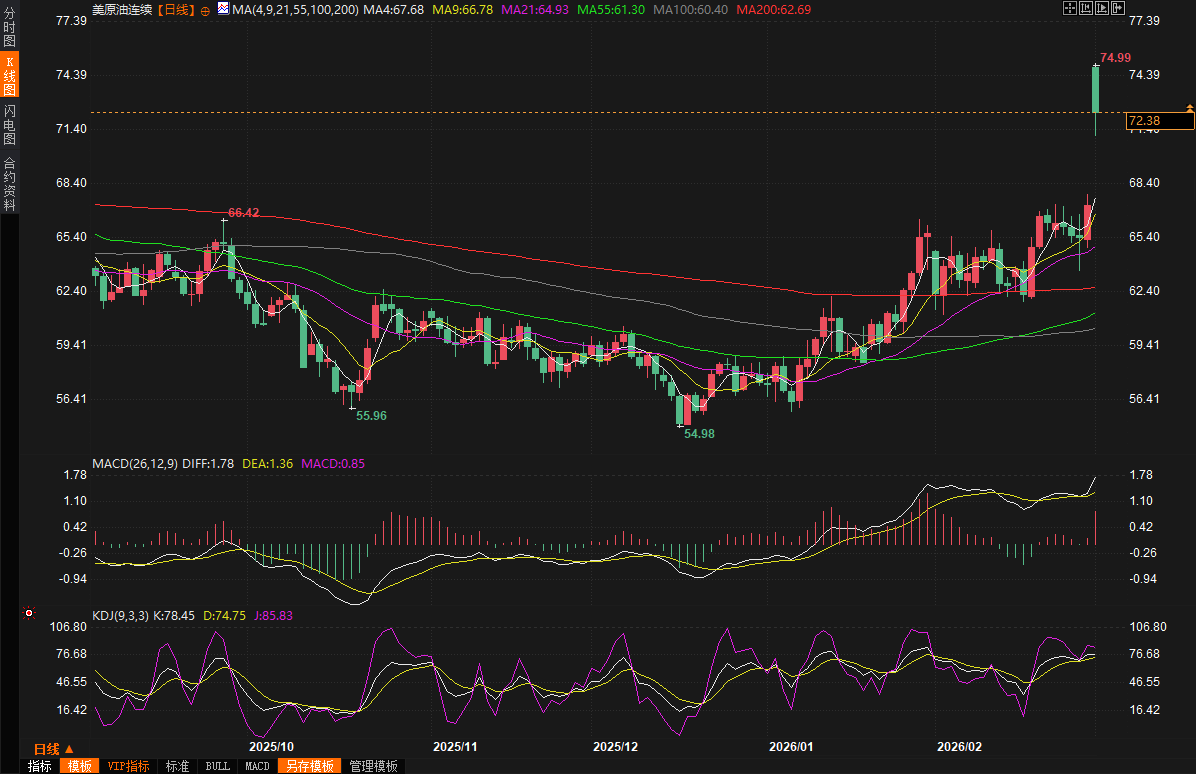
At 07:47 Beijing time, US crude oil is currently trading at $72.36 per barrel.
Background: Escalation of the US-Iran conflict triggers supply chain panic
The US strikes against Iran over the weekend marked a new phase in the confrontation between the two countries. This military action not only directly targeted objectives within Iran but also triggered a strong backlash from Iran and its proxies. Analysts point out that the situation is now close to the brink of full-blown military conflict, and its trajectory is difficult to predict accurately. Vandana Hari, CEO of energy research firm Vanda Insights, emphasized that if the conflict continues for several days and is accompanied by maximum retaliation from Iran and its allies, Middle Eastern oil flows will suffer significant disruption. Unless the US can quickly disarm the Iranian navy and military forces and ensure the normal passage of oil tankers through the Straits of Hormuz, the worst-case scenario is difficult to avoid.
The Iranian Revolutionary Guard has issued a radio warning to merchant ships, stating that "no vessel may pass through the Strait of Hormuz." Although Tehran has not officially announced the closure of the waterway, this signal has been enough to trigger market panic. Several shipping companies and oil traders have begun suspending or detouring through the area, resulting in a significant drop in ship traffic. Industry observers believe this is not merely a localized impact on Iranian exports, but could potentially escalate into a regional crisis involving multiple Gulf oil-producing nations.
The strategic importance of the Strait of Hormuz: a fragile bottleneck to the global energy lifeline.
The Strait of Hormuz, located between Iran and Oman, is the only sea passage connecting the Persian Gulf and the Gulf of Oman. Despite its limited width, the strait carries a significant share of global energy trade. According to the latest data, approximately 20 million barrels of crude oil, condensate, and petroleum products pass through the strait daily in recent years, accounting for about one-fifth of global liquid petroleum consumption and one-quarter to one-third of seaborne crude oil trade. Major exporting countries include Saudi Arabia, Iraq, the United Arab Emirates, Kuwait, and Iran itself, with the vast majority of their crude oil exports relying on this passage to markets in Asia, Europe, and North America.
Furthermore, the Strait of Hormuz is a crucial route for Qatar and the UAE's liquefied natural gas (LNG) exports, accounting for a significant proportion of global LNG trade. Any disruption would have a simultaneous impact on the oil and gas markets, with Asia, as a major importer, bearing the brunt of the energy security challenges.
Potential Risk Assessment: Multiple Scenarios from Partial Disruptions to Complete Lockdown
The market is currently pricing in a multi-layered risk spectrum. In the short term, Iran's own exports could lose up to 2 million barrels per day; if the conflict spills over, attacks on regional infrastructure will become a real threat. The most extreme scenario is that Iran, driven by an existential crisis, attempts to completely blockade the Strait of Hormuz. Although the US and its allies may deploy warships to escort it, a successful blockade would still have catastrophic consequences.
Bob McNally, president of Rapidan Energy Group, described this as a "very serious development" in the global oil and gas market. Saul Kavonic, head of energy research at MST Marquee, further pointed out that if Iran believes its regime faces an existential threat, a blockade of the Straits is not impossible. Experts agree that the duration of the disruption is the key variable determining the magnitude of the price surge: short-term disruptions may lead to a modest price increase, while a blockade lasting weeks or even months will trigger the largest supply shortage in history.
Worst-case scenario: Oil prices break into triple digits, energy shock comparable to three times that of the 1970s.
In the most extreme scenario, a complete closure of the Strait of Hormuz would cut off approximately 20 million barrels per day of global supply, far exceeding the combined impact of the 1973 Arab oil embargo and the 1979 Iranian Revolution. Analysts estimate that such a scenario could be more than three times as severe as the energy crisis of the 1970s, with international benchmark Brent crude oil prices expected to quickly fall into triple digits, while LNG prices could return to their historical peak reached in 2022.
Brent crude oil prices have risen significantly recently due to accumulated geopolitical risks, with a cumulative increase of nearly 20% this year. If the Strait of Hormuz remains blocked for an extended period, the global economy will face multiple challenges, including heightened inflationary pressures, forced supply chain restructuring, and an accelerated energy transition. Some analysts even assess the probability of a complete blockade at around one-third, especially if Iran feels cornered.
Conclusion: Market Games Dominated by Uncertainty and Global Alert
The oil market is currently in a state of high tension. On Monday (March 2nd) in early Asian trading, US crude oil jumped nearly $8 (almost 12%) to $74.99 per barrel, a new high since June 23, 2025, before slightly retreating to around $72.41 per barrel. Analysts point out that whether it's a short-term "knee-jerk" rise or a long-term supply crisis, the fate of the Strait of Hormuz will profoundly affect the global energy landscape and economic stability. This event reminds the international community that geopolitical risks remain the most unpredictable variable in the energy market, and the structural vulnerability of relying on a single choke point urgently needs to be mitigated through diversified routes, strategic reserves, and diplomatic efforts. The developments in the coming days and weeks will determine whether we are truly facing a new round of "energy shocks."
At 07:47 Beijing time, US crude oil is currently trading at $72.36 per barrel.
- Risk Warning and Disclaimer
- The market involves risk, and trading may not be suitable for all investors. This article is for reference only and does not constitute personal investment advice, nor does it take into account certain users’ specific investment objectives, financial situation, or other needs. Any investment decisions made based on this information are at your own risk.

