Iran has refused to negotiate, drawing Gulf states into a war of words, and the market is pricing things out of control?
2026-03-02 13:52:22
The situation in the Middle East has deteriorated sharply, with the United States and Israel launching a large-scale joint attack on Iran, resulting in the death of Iran's Supreme Leader Ayatollah Ali Khamenei in the attack last Saturday (February 28). This event marks the most serious leadership crisis Iran has faced since the 1979 Islamic Revolution, and has triggered a chain reaction in many countries in the region, causing international oil prices to soar.
Concerns about supply disruptions have surged following Iran's retaliatory drone and missile attacks that affected several Gulf states. On Monday (March 2nd) during Asian trading hours, US crude oil prices rose more than 12% at one point, hitting a near nine-month high of $75.33 per barrel, before retreating somewhat and currently trading around $71.30 per barrel, a daily gain of approximately 6.4%.
Ali Larijani, secretary of Iran's Supreme National Security Council, stated explicitly on Monday via the X platform that Tehran has no intention of engaging in any negotiations with the United States. He refuted some media reports that Iran's new leadership was seeking to restart dialogue, saying the Trump administration was dragging the region into chaos through "false hope," and expressed concern about further U.S. casualties.
Larijani emphasized, "We will not negotiate with the United States." This stance highlights Iran's tough position following the attack on its Supreme Leader. Currently, Iran is under the leadership of an interim council composed of President Masoud Pezeshkian and senior cleric Ayatollah Alireza Alafi, among others, until a new Supreme Leader is elected.
Iranian state media reported that more than 200 people have died in the latest round of conflict in Iran. The United States confirmed that three U.S. soldiers were killed and five others seriously wounded. President Trump warned that the conflict could last up to four weeks and could result in further U.S. casualties. He also claimed that Iran's new leadership was willing to resume negotiations, but did not provide details.
Since last weekend, Iran has launched a wave of drone and missile attacks on several Arab countries, including Kuwait, the UAE, Bahrain, Saudi Arabia, Oman, and Qatar. Kuwait's Civil Defense Authority stated that its air force successfully intercepted most of the Iranian drones approaching from the sea, with no casualties reported. Officials in Bahrain and the UAE confirmed intercepting hundreds of Iranian Shahed-136 suicide drones, a low-cost drone with precision-guided capabilities.
The United States and several Middle Eastern countries issued a joint statement Sunday night condemning the Iranian attack as a violation of the sovereignty of multiple countries, a threat to regional stability, and reaffirming the right to self-defense. The statement emphasized: “The Islamic Republic’s actions constitute a dangerous escalation, and its irresponsible actions against civilians and non-belligerent states undermine stability. We are committed to regional security and commend effective air defense missile cooperation that prevented further casualties and destruction.”
The Israel Defense Forces (IDF) announced that it has launched strikes against Hezbollah targets in Lebanon in response to Hezbollah's rocket attacks into northern Israel. The IDF statement claimed that Hezbollah, acting on behalf of the Iranian regime, is dragging Lebanon into destruction. Israel is prepared for Operation Roaring Lion and is ready to engage in multi-front warfare. In 2024, Israel killed Hezbollah leader Hassan Nasrallah.
British Prime Minister Keir Starmer announced last Sunday that the United States would be allowed to use British military bases in the Middle East to destroy Iranian missiles and launchers. He characterized the move as collective self-defense, emphasizing that Britain did not participate in the initial strikes against Iran, but that Iran's "scorched earth" strategy threatened British interests, citizens, and the safety of its allies. Starmer stated that the decision was in accordance with international law and drew lessons from the Iraq War to avoid involvement in offensive actions.
U.S. Secretary of State Marco Rubio will brief leaders of the Senate and House of Representatives on the latest situation at 5:00 a.m. Beijing time on Tuesday. This comes after the U.S. and Israel coordinated strikes against Iran, which retaliated against U.S. military bases in the region, including facilities in the UAE and Saudi Arabia. The attacks have reignited the heated debate in Washington over the president's war powers.
Currently, tensions in the Middle East continue to escalate, posing severe challenges to the oil market, geopolitical risk premiums, and global supply chains. Markets are closely watching whether the conflict will escalate further and whether the leadership transition in Iran will lead to a policy shift.
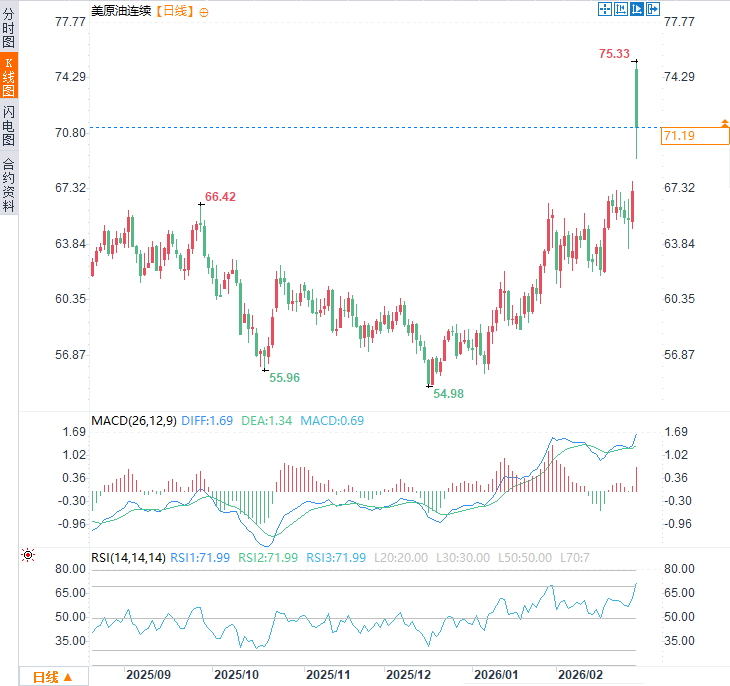
(US crude oil daily chart, source: FX678)
At 13:52 Beijing time, US crude oil futures were trading at $71.48 per barrel.
Concerns about supply disruptions have surged following Iran's retaliatory drone and missile attacks that affected several Gulf states. On Monday (March 2nd) during Asian trading hours, US crude oil prices rose more than 12% at one point, hitting a near nine-month high of $75.33 per barrel, before retreating somewhat and currently trading around $71.30 per barrel, a daily gain of approximately 6.4%.
Iranian leaders take a hard line: refusing to negotiate with the US.
Ali Larijani, secretary of Iran's Supreme National Security Council, stated explicitly on Monday via the X platform that Tehran has no intention of engaging in any negotiations with the United States. He refuted some media reports that Iran's new leadership was seeking to restart dialogue, saying the Trump administration was dragging the region into chaos through "false hope," and expressed concern about further U.S. casualties.
Larijani emphasized, "We will not negotiate with the United States." This stance highlights Iran's tough position following the attack on its Supreme Leader. Currently, Iran is under the leadership of an interim council composed of President Masoud Pezeshkian and senior cleric Ayatollah Alireza Alafi, among others, until a new Supreme Leader is elected.
Conflict casualties and escalating retaliation
Iranian state media reported that more than 200 people have died in the latest round of conflict in Iran. The United States confirmed that three U.S. soldiers were killed and five others seriously wounded. President Trump warned that the conflict could last up to four weeks and could result in further U.S. casualties. He also claimed that Iran's new leadership was willing to resume negotiations, but did not provide details.
Since last weekend, Iran has launched a wave of drone and missile attacks on several Arab countries, including Kuwait, the UAE, Bahrain, Saudi Arabia, Oman, and Qatar. Kuwait's Civil Defense Authority stated that its air force successfully intercepted most of the Iranian drones approaching from the sea, with no casualties reported. Officials in Bahrain and the UAE confirmed intercepting hundreds of Iranian Shahed-136 suicide drones, a low-cost drone with precision-guided capabilities.
Joint Statement from the US, Israel, and Gulf Allies: Exercising the Right to Self-Defense
The United States and several Middle Eastern countries issued a joint statement Sunday night condemning the Iranian attack as a violation of the sovereignty of multiple countries, a threat to regional stability, and reaffirming the right to self-defense. The statement emphasized: “The Islamic Republic’s actions constitute a dangerous escalation, and its irresponsible actions against civilians and non-belligerent states undermine stability. We are committed to regional security and commend effective air defense missile cooperation that prevented further casualties and destruction.”
Israel expands its front: striking Hezbollah in Lebanon
The Israel Defense Forces (IDF) announced that it has launched strikes against Hezbollah targets in Lebanon in response to Hezbollah's rocket attacks into northern Israel. The IDF statement claimed that Hezbollah, acting on behalf of the Iranian regime, is dragging Lebanon into destruction. Israel is prepared for Operation Roaring Lion and is ready to engage in multi-front warfare. In 2024, Israel killed Hezbollah leader Hassan Nasrallah.
The UK authorized the use of the US military base.
British Prime Minister Keir Starmer announced last Sunday that the United States would be allowed to use British military bases in the Middle East to destroy Iranian missiles and launchers. He characterized the move as collective self-defense, emphasizing that Britain did not participate in the initial strikes against Iran, but that Iran's "scorched earth" strategy threatened British interests, citizens, and the safety of its allies. Starmer stated that the decision was in accordance with international law and drew lessons from the Iraq War to avoid involvement in offensive actions.
Washington Updates: Congressional Briefings and War Power Debates
U.S. Secretary of State Marco Rubio will brief leaders of the Senate and House of Representatives on the latest situation at 5:00 a.m. Beijing time on Tuesday. This comes after the U.S. and Israel coordinated strikes against Iran, which retaliated against U.S. military bases in the region, including facilities in the UAE and Saudi Arabia. The attacks have reignited the heated debate in Washington over the president's war powers.
Currently, tensions in the Middle East continue to escalate, posing severe challenges to the oil market, geopolitical risk premiums, and global supply chains. Markets are closely watching whether the conflict will escalate further and whether the leadership transition in Iran will lead to a policy shift.
(US crude oil daily chart, source: FX678)
At 13:52 Beijing time, US crude oil futures were trading at $71.48 per barrel.
- Risk Warning and Disclaimer
- The market involves risk, and trading may not be suitable for all investors. This article is for reference only and does not constitute personal investment advice, nor does it take into account certain users’ specific investment objectives, financial situation, or other needs. Any investment decisions made based on this information are at your own risk.