From a swift victory to a quagmire: A protracted energy war
2026-03-03 21:38:21
Table of Contents
- Crude oil price surge trend
- Trump's military action statement
- Iran blocks the Strait of Hormuz
- Energy prices surge across the board
- Shipping costs hit a record high
- Inflationary pressures lead to central bank interest rate cuts
- Stock markets plunge, prompting responses from multiple countries
Crude oil price surge trend
On Tuesday, US crude oil continued its strong performance, rising over 10% intraday from Monday, and is currently trading at $ 76.28 per barrel, up 7.17% . As a seasoned crude oil trader, I believe this movement has completely deviated from fundamental supply and demand, and is purely driven by geopolitical risk premiums. Long positions can be maintained in the short term, but a strict stop-loss order must be placed below $72, as prices will quickly give back gains should there be any signs of easing military tensions. In terms of trading strategy, I recommend prioritizing WTI crude oil futures or related ETFs, with leverage kept below 5 times to avoid overnight gap risks.
Trump's military action statement
US President Trump publicly stated that the "epic fury" military action against Iran may last longer than the market's initial expectation of four weeks, directly implying a prolonged disruption to oil shipping capacity . He emphasized that the US will take all necessary measures, initially estimating four to five weeks, but possessing the capability for a protracted operation. For oil trading, this statement has completely altered market expectations regarding the duration of the conflict. What was initially thought to be a short-term event must now be repriced as a medium- to long-term supply disruption. Traders need to closely monitor the White House's daily briefings; any keyword related to "protracted operation" will trigger a new wave of bullish sentiment.
Iran blocks the Strait of Hormuz
In retaliation for a joint US-Israeli strike, Iran officially announced the blockade of the Strait of Hormuz , warning that it would burn any ships attempting to cross it. The strait carries one-fifth of the world's oil and gas trade. On Monday, Iran claimed to have completed the blockade, with a senior advisor to the Islamic Revolutionary Guard Corps, Jabari, explicitly stating that all vessels attempting to pass would be attacked. Although the US Central Command denied an actual blockade, global shipowners, traders, and oil companies were unwilling to risk verifying it, effectively grounding tanker shipping to a standstill. The direct impact on crude oil trading is an instantaneous drain on supply; any tankers attempting to circumnavigate the Cape of Good Hope will face an additional 15-20 days of transit time, further driving up spot premiums.
Energy prices surge across the board
Energy prices surged following the warning of a devastating Iranian strike. UK gas prices jumped over 46%, hitting a three-year high; Brent crude rose over 5%, climbing above $81 a barrel. Qatar Energy, a top global natural gas exporter, announced a production halt due to attacks on its facilities, simultaneously suspending aluminum and methanol production. Since the US-Israeli airstrikes last Saturday, UK gas prices have more than doubled, rising above 165 pence per tsim salvo on Tuesday. In this environment, oil traders should look for cross-commodity arbitrage opportunities, such as going long on the Brent-WTI spread, while being wary of the cascading downward pressure on European industrial demand from natural gas prices.
Shipping costs hit a record high
The Strait of Hormuz is a vital global energy artery, through which approximately 20% of oil and gas trade passes. Following recent attacks on several merchant ships, the strait has been largely shut down. Data from the London Stock Exchange Group shows that daily charter rates for Very Large Crude Carriers (VLCCs) from the Middle East to China have exceeded $400,000, nearly double the level of the previous week. The president of logistics platform Flexport stated that the strait is essentially closed, with insurance companies ceasing coverage, and global shipping prices are highly likely to rise across the board. In the crude oil trading market, this means the premium structure between spot and futures prices will further widen. Traders are advised to establish monthly spread arbitrage or VLCC freight-related derivatives to hedge against transportation cost risks.
Inflationary pressures lead to central bank interest rate cuts
The surge in energy prices has directly impacted sectors such as refined oil products, transportation, and food, raising overall economic operating costs. Market concerns that this round of shocks could mirror the Russia-Ukraine conflict, with rising natural gas prices putting pressure on UK residents' energy bills, gradually becoming apparent from July onwards. Once inflation picks up, the probability and scope for short-term interest rate cuts by central banks will significantly decrease, becoming a key variable suppressing further gains in crude oil prices. Traders need to simultaneously monitor the Federal Reserve's dot plot and the European Central Bank's meeting minutes; any signal that "inflation is not falling back" could trigger profit-taking by crude oil bulls.
Stock markets plunge, prompting responses from multiple countries
Energy cost and inflation concerns combined to trigger significant corrections in European and American stock markets: the UK FTSE 100 fell 2.6%, the German DAX fell 3.7%, and the French CAC40 fell 3%. Risk research firm Avellon Intelligence points out that if lockdowns continue, crude oil could break through $100, and US gasoline could rise by 25 cents per gallon. Trump has met with the Treasury Secretary and Energy Secretary to discuss solutions, and US Secretary of State Rubio stated that a plan to stabilize energy prices will be announced soon. The chairman of MF Group, the UK's largest petrol station operator, said that the increase in retail prices of refined oil products depends on the duration of international oil price increases. Crude oil traders should reduce leverage at this time, focus on shorting opportunities after the $100 psychological level is breached, and be prepared with a quick liquidation mechanism in case of a policy reversal.
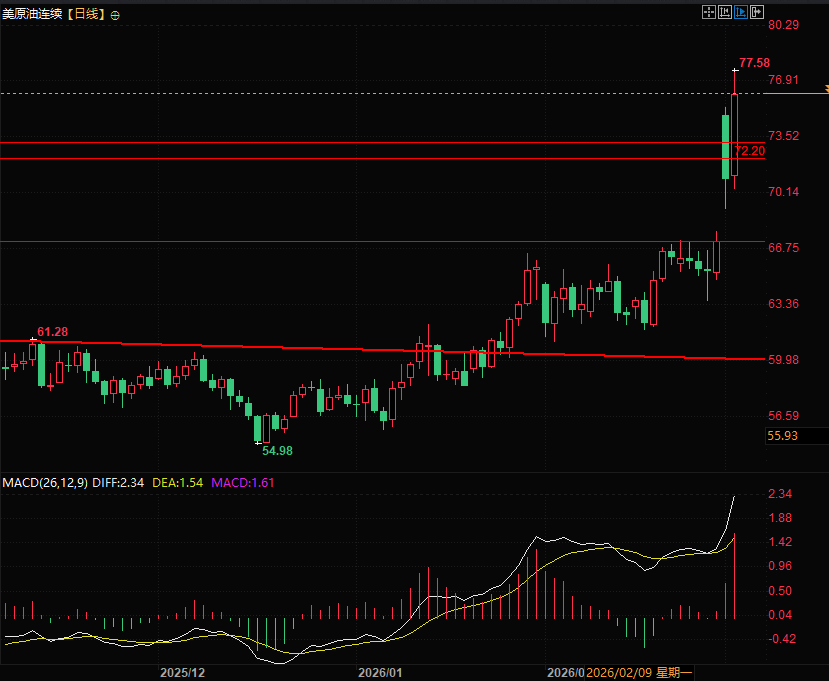
(US crude oil futures daily chart, source: FX678)
Frequently Asked Questions
Q: What are the core impacts of a de facto blockade of the Strait of Hormuz on the crude oil market?
A: The blockade directly cut off 20% of global oil and gas trade routes, causing an immediate drain on the supply side. The de facto shutdown of oil tankers has pushed up risk premiums. US crude oil has continued its 10% surge from Monday to $76.28, and Brent crude has broken through $81. Traders need to recognize that this is not a short-term event, but rather a medium- to long-term disruption to shipping capacity. It is recommended to focus on long positions but with strict risk management.Q: How did Trump's "epic fury" military action announcement change expectations for crude oil trading?
A: Trump's clear actions could extend well beyond four weeks and possess long-term potential, causing the market to shift from a "short-term conflict" pricing model to one of "protracted warfare." This directly amplifies the risk of oil shipping disruptions, and traders should adjust their positions to medium-term long positions while being prepared to quickly reduce their holdings should signs of diplomatic easing emerge.Q: Why are soaring energy prices limiting the central bank's room for interest rate cuts?
A: The 46% surge in natural gas prices and the sharp rise in crude oil prices have directly pushed up inflation. UK household bills will be under pressure starting in July, and business costs are rising across the board. Central banks worldwide will prioritize controlling inflation over stimulating the economy. Crude oil traders should be wary of profit-taking due to the failure of interest rate cut expectations and should pay close attention to the next meetings of the Federal Reserve and the European Central Bank.Q: What practical implications does the record-high shipping costs have for crude oil traders?
A: Daily charter rates for Very Large Crude Carriers (VLCCs) have exceeded $400,000, and the suspension of insurance coverage by insurers has led to a widening of the spot premium. Traders can consider establishing long positions in monthly spreads or hedging with freight derivatives, while also paying attention to the 15-20 day increase in shipping time around the Cape of Good Hope, which will further support the price of longer-term crude oil contracts.Q: If oil prices surge to $100, will the measures taken by various countries be effective in curbing them?
A: Trump has initiated consultations with the Treasury and Energy Secretaries, and the US Secretary of State has pledged to roll out the plan quickly. UK retail oil prices will also adjust accordingly. However, the policy's effectiveness will be limited in the short term, and the $100 mark could still be breached if the lockdown continues. Traders should remain flexible, preparing for both a bullish surge and setting profit-taking points above $100.
- Risk Warning and Disclaimer
- The market involves risk, and trading may not be suitable for all investors. This article is for reference only and does not constitute personal investment advice, nor does it take into account certain users’ specific investment objectives, financial situation, or other needs. Any investment decisions made based on this information are at your own risk.