













The conflict with Iran has triggered a surge in oil prices, signaling the impending end of cheap gasoline in the US and potentially leading to a widespread collapse in prices.
2026-03-04 10:12:06
Under the heavy pressure of persistently high prices, Americans were once able to rely on relatively low gasoline prices to cushion the severe impact of shopping in supermarkets and malls. However, with the US and Israel launching military attacks on Iran, this fragile buffer mechanism is in danger of being completely broken.
Following the attacks, U.S. benchmark crude oil futures prices surged 10% this week, reaching a high of $77.98 per barrel, with a year-to-date increase of nearly 24%. Diesel and gasoline futures prices also experienced significant volatility. Experts generally believe that the subsequent developments of this conflict will directly push up domestic gasoline retail prices in the United States, further contributing to overall inflation. Currently, it is too early to accurately predict the full impact of the conflict on the U.S. price system, but the intrinsic link between gasoline and inflation is clearly visible, and various possible scenarios are gradually unfolding.

In January, the U.S. Consumer Price Index rose 2.4% year-on-year, a slight decrease from 2.7% in December. This moderate performance was largely due to the continued decline in gasoline prices—which fell 7.5% year-on-year that month. However, the outbreak of the conflict in Iran instantly changed market expectations.
Crude oil prices are the most crucial factor determining the cost of refueling for ordinary Americans, far exceeding the impact of refining costs, transportation expenses, and other factors. Long-term data from the U.S. Energy Information Administration has long proven this. Economists have summarized an important rule of thumb: for every 5% increase in international oil prices, the year-on-year increase in the Consumer Price Index (CPI) will rise by approximately 0.1 percentage points. Although individual increases may seem small, this cumulative effect becomes increasingly apparent in daily life over time.
More importantly, rising gasoline prices are not an isolated event. They quickly permeate the entire economic chain. When oil prices climb, the logistics costs of transporting food and daily necessities by truck increase significantly; rising aviation fuel prices directly drive up airfares; and even indirect costs in manufacturing, agriculture, and other sectors rise accordingly, ultimately being passed on to consumers in the form of higher retail prices.
Not all analyses point to catastrophic consequences. Some economists point out that the impact of this conflict on gasoline prices and overall inflation may only be a fleeting, short-term fluctuation, depending on the intensity and duration of the military operation.
If the disruptions in the energy market remain within a limited range, fuel prices may rise significantly, but their inflationary impact is likely to last only one to two months. The 12-day conflict between Iran and Israel last year is a prime example: oil prices rose only briefly by about $10 at their peak before quickly falling back, and energy infrastructure suffered virtually no substantial damage.
It's important to note that although consumers see daily price changes at gas stations, gasoline actually represents a relatively small percentage of total household spending in the United States. According to the latest government inflation report, this figure was only about 3% in December. In comparison, food spending accounts for about 13%, and housing costs make up more than a third of household spending. Therefore, even if gasoline prices rise temporarily, their direct impact on the overall consumer price index is relatively manageable.
JPMorgan Chase CEO Jamie Dimon stated clearly on Monday that he expects the conflict with Iran to have no significant and lasting impact on U.S. inflation, provided the military action does not drag on for too long. He noted, "Currently, gasoline prices will likely see another slight increase, but as long as it doesn't last long, it won't have a major impact on inflation." U.S. President Trump also stated on the same day that the operation in Iran is expected to last four to five weeks, but the U.S. has the capability to sustain it in the long term.
Although the United States is no longer as heavily reliant on foreign oil as it was in the 1970s—the shale oil revolution has significantly increased domestic production and reduced dependence on foreign sources—a large-scale oil supply shock could still have serious consequences.
Alberto Cavallo, an economist at Harvard Business School who has long tracked the pricing behavior of major retailers, points out that after the Russia-Ukraine conflict in early 2022, crude oil and gasoline prices both rose by about 30% in just four months, directly causing the overall US inflation rate to surge to over 9% by mid-2022. If the conflict in Iran leads to sustained high crude oil prices, its impact will be quickly reflected in gas station prices within weeks, further pushing up overall inflation.
Cavalló emphasized that the pass-through efficiency of fuel costs is extremely high because the oil industry chain is relatively short, price information is updated frequently, and market competition is fierce, allowing retailers to feel upstream fluctuations almost in real time.
Neil Shearing, chief economist at Capital Economics, offered a more sobering assessment: if oil prices remain stable above $100 per barrel for an extended period, the increase in overall inflation could reach 0.7 percentage points. This level would be enough to make the Federal Reserve more cautious in its short-term interest rate decisions, and even "less willing" to cut rates prematurely.
A significant rise in inflation will directly squeeze the real income of Americans, thereby suppressing consumer spending, which is the primary engine of US economic growth. Given signs of stabilization in the labor market and lingering price pressures, the Federal Reserve already faced reasons to reduce its easing policies this year. Now, the potential energy shock, coupled with the ongoing impact of last year's tariff adjustments on the price chain, may lead the Fed to further adopt a wait-and-see approach regarding interest rate cuts.
It is worth noting that the Federal Reserve has historically viewed energy price shocks as negligible and temporary disturbances, preferring to absorb rather than actively address such fluctuations. The three rate cuts between September and December were based on the premise of short-term improvements in inflation.
Rising oil prices are undoubtedly bad news for ordinary consumers, but for domestic oil producers in the United States, it could be a long-awaited boon. Industries long plagued by low oil prices are eagerly awaiting a price recovery.
Ben Shepperd, president of the Permian Basin Petroleum Association, stated that in core producing regions like West Texas, prices below $60 per barrel have made it difficult for many producers to remain profitable. However, if oil prices can stabilize at $70 or above for a month or even longer, it will directly translate into increased production and investment confidence. He emphasized that the key is not the short-term "war premium," but whether a sustainable price increase can be achieved that covers all production costs.
Shepard stated bluntly, "We clearly prefer $70 oil to $50 oil per barrel."
In conclusion, the ultimate impact of the Iranian conflict on US gasoline prices and overall inflation still depends on the trajectory and duration of the conflict, as well as the extent of damage to energy infrastructure. It is premature to declare disaster or be optimistic, but historical experience and current data both indicate that once oil prices enter a sustained upward trend, the impact on American households' wallets and the Federal Reserve's policy space will far exceed what surface figures suggest. The "cheap gasoline buffer" that Americans once relied on is facing an unprecedented and severe test, and the price tags on supermarket shelves may soon provide the most direct answer.
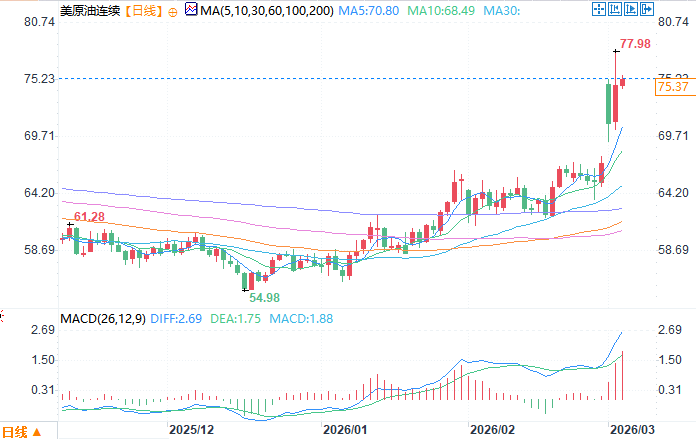
US crude oil daily chart source: EasyTrade
At 10:11 AM Beijing time on March 4th, US crude oil futures were trading at $75.44 per barrel.
Following the attacks, U.S. benchmark crude oil futures prices surged 10% this week, reaching a high of $77.98 per barrel, with a year-to-date increase of nearly 24%. Diesel and gasoline futures prices also experienced significant volatility. Experts generally believe that the subsequent developments of this conflict will directly push up domestic gasoline retail prices in the United States, further contributing to overall inflation. Currently, it is too early to accurately predict the full impact of the conflict on the U.S. price system, but the intrinsic link between gasoline and inflation is clearly visible, and various possible scenarios are gradually unfolding.
The deep transmission mechanism between gasoline prices and inflation
In January, the U.S. Consumer Price Index rose 2.4% year-on-year, a slight decrease from 2.7% in December. This moderate performance was largely due to the continued decline in gasoline prices—which fell 7.5% year-on-year that month. However, the outbreak of the conflict in Iran instantly changed market expectations.
Crude oil prices are the most crucial factor determining the cost of refueling for ordinary Americans, far exceeding the impact of refining costs, transportation expenses, and other factors. Long-term data from the U.S. Energy Information Administration has long proven this. Economists have summarized an important rule of thumb: for every 5% increase in international oil prices, the year-on-year increase in the Consumer Price Index (CPI) will rise by approximately 0.1 percentage points. Although individual increases may seem small, this cumulative effect becomes increasingly apparent in daily life over time.
More importantly, rising gasoline prices are not an isolated event. They quickly permeate the entire economic chain. When oil prices climb, the logistics costs of transporting food and daily necessities by truck increase significantly; rising aviation fuel prices directly drive up airfares; and even indirect costs in manufacturing, agriculture, and other sectors rise accordingly, ultimately being passed on to consumers in the form of higher retail prices.
Short-term disturbance scenarios with relatively limited impact
Not all analyses point to catastrophic consequences. Some economists point out that the impact of this conflict on gasoline prices and overall inflation may only be a fleeting, short-term fluctuation, depending on the intensity and duration of the military operation.
If the disruptions in the energy market remain within a limited range, fuel prices may rise significantly, but their inflationary impact is likely to last only one to two months. The 12-day conflict between Iran and Israel last year is a prime example: oil prices rose only briefly by about $10 at their peak before quickly falling back, and energy infrastructure suffered virtually no substantial damage.
It's important to note that although consumers see daily price changes at gas stations, gasoline actually represents a relatively small percentage of total household spending in the United States. According to the latest government inflation report, this figure was only about 3% in December. In comparison, food spending accounts for about 13%, and housing costs make up more than a third of household spending. Therefore, even if gasoline prices rise temporarily, their direct impact on the overall consumer price index is relatively manageable.
JPMorgan Chase CEO Jamie Dimon stated clearly on Monday that he expects the conflict with Iran to have no significant and lasting impact on U.S. inflation, provided the military action does not drag on for too long. He noted, "Currently, gasoline prices will likely see another slight increase, but as long as it doesn't last long, it won't have a major impact on inflation." U.S. President Trump also stated on the same day that the operation in Iran is expected to last four to five weeks, but the U.S. has the capability to sustain it in the long term.
Potential major shock scenarios: Historical lessons cannot be ignored
Although the United States is no longer as heavily reliant on foreign oil as it was in the 1970s—the shale oil revolution has significantly increased domestic production and reduced dependence on foreign sources—a large-scale oil supply shock could still have serious consequences.
Alberto Cavallo, an economist at Harvard Business School who has long tracked the pricing behavior of major retailers, points out that after the Russia-Ukraine conflict in early 2022, crude oil and gasoline prices both rose by about 30% in just four months, directly causing the overall US inflation rate to surge to over 9% by mid-2022. If the conflict in Iran leads to sustained high crude oil prices, its impact will be quickly reflected in gas station prices within weeks, further pushing up overall inflation.
Cavalló emphasized that the pass-through efficiency of fuel costs is extremely high because the oil industry chain is relatively short, price information is updated frequently, and market competition is fierce, allowing retailers to feel upstream fluctuations almost in real time.
The worst-case scenario: Oil prices breaking through $100 would trigger a chain reaction.
Neil Shearing, chief economist at Capital Economics, offered a more sobering assessment: if oil prices remain stable above $100 per barrel for an extended period, the increase in overall inflation could reach 0.7 percentage points. This level would be enough to make the Federal Reserve more cautious in its short-term interest rate decisions, and even "less willing" to cut rates prematurely.
A significant rise in inflation will directly squeeze the real income of Americans, thereby suppressing consumer spending, which is the primary engine of US economic growth. Given signs of stabilization in the labor market and lingering price pressures, the Federal Reserve already faced reasons to reduce its easing policies this year. Now, the potential energy shock, coupled with the ongoing impact of last year's tariff adjustments on the price chain, may lead the Fed to further adopt a wait-and-see approach regarding interest rate cuts.
It is worth noting that the Federal Reserve has historically viewed energy price shocks as negligible and temporary disturbances, preferring to absorb rather than actively address such fluctuations. The three rate cuts between September and December were based on the premise of short-term improvements in inflation.
The complex mindset of Texas oil producers
Rising oil prices are undoubtedly bad news for ordinary consumers, but for domestic oil producers in the United States, it could be a long-awaited boon. Industries long plagued by low oil prices are eagerly awaiting a price recovery.
Ben Shepperd, president of the Permian Basin Petroleum Association, stated that in core producing regions like West Texas, prices below $60 per barrel have made it difficult for many producers to remain profitable. However, if oil prices can stabilize at $70 or above for a month or even longer, it will directly translate into increased production and investment confidence. He emphasized that the key is not the short-term "war premium," but whether a sustainable price increase can be achieved that covers all production costs.
Shepard stated bluntly, "We clearly prefer $70 oil to $50 oil per barrel."
In conclusion, the ultimate impact of the Iranian conflict on US gasoline prices and overall inflation still depends on the trajectory and duration of the conflict, as well as the extent of damage to energy infrastructure. It is premature to declare disaster or be optimistic, but historical experience and current data both indicate that once oil prices enter a sustained upward trend, the impact on American households' wallets and the Federal Reserve's policy space will far exceed what surface figures suggest. The "cheap gasoline buffer" that Americans once relied on is facing an unprecedented and severe test, and the price tags on supermarket shelves may soon provide the most direct answer.
US crude oil daily chart source: EasyTrade
At 10:11 AM Beijing time on March 4th, US crude oil futures were trading at $75.44 per barrel.
- Risk Warning and Disclaimer
- The market involves risk, and trading may not be suitable for all investors. This article is for reference only and does not constitute personal investment advice, nor does it take into account certain users’ specific investment objectives, financial situation, or other needs. Any investment decisions made based on this information are at your own risk.

