













The Middle East conflict continues, and NATO is now embroiled in internal strife! Trump threatens an embargo on Spain, leaving oil prices bewildered?
2026-03-04 10:22:17
US President Donald Trump publicly threatened on Tuesday (March 3) to impose a comprehensive trade embargo on Spain because Spain refused to allow US troops to use its military bases for missions related to the fight against Iran. During a meeting with German Chancellor Merz, Trump bluntly stated, "Spain is terrible," and has instructed his finance minister to cut off all trade with Spain.
This move marks a rare instance of the Trump administration exerting strong economic pressure on a NATO ally amid escalating tensions in the Middle East. Trump emphasized that Spain had not met NATO's defense spending targets, stating that "Spain simply doesn't have anything we need."
Following the Spanish Socialist government's clear stance, the United States has withdrawn 15 aircraft, primarily aerial refueling tankers, from the Rota Naval Base and Morón Air Base in the south. These bases have long served as key hubs for US military operations in the Mediterranean and Africa, and this withdrawal directly weakens the US's rapid response capability to potential conflicts in the Middle East.
Trump's move aims to force Spain to make concessions through both military and economic means, while sending a signal to other NATO members that refusing to cooperate with the US strategy will have serious consequences.
Trump cited the Supreme Court's previous affirmation of the International Emergency Economic Powers Act (IEEPA), claiming that the president has the authority to impose such an embargo. However, trade law scholars point out that to legally trigger a state of emergency against Spain, a formal declaration that the country poses an "extraordinary and special threat" to the United States is required.
Experts believe that "Spain's refusal to allow the use of the bases is difficult to classify as such a threat," and this move may face challenges from the US Congress and courts.
The Spanish government responded swiftly, emphasizing that the United States must respect the autonomy of private enterprises, international law, and bilateral trade agreements. Madrid stated that it is prepared for the potential impact of an embargo and will continue to firmly promote free trade.
Spain is the world's largest exporter of olive oil, and also exports auto parts, steel and chemical products to the United States. However, compared with other European countries, its trade dependence on the United States is relatively low, and it has a strong buffer capacity.
The latest trade data as of March 2026 shows that while bilateral trade between the US and the West Coast is limited, the embargo will directly impact specific sectors. The following is the latest comparison:
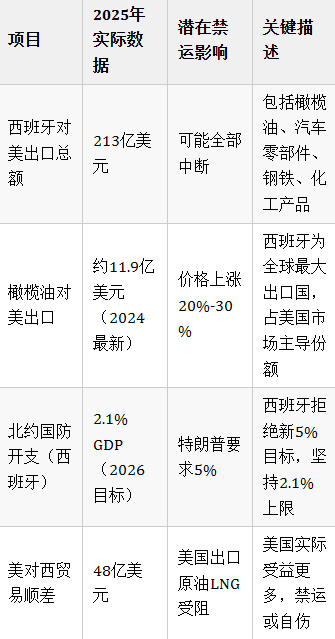
Higher trade barriers will drive up prices for olive oil and industrial components in the United States, while Spain can mitigate its losses by turning to the EU internal market.
The conflict is no longer confined to the Middle East, but is spreading directly to the European continent and transatlantic relations through rifts within NATO. Investors may have previously viewed the risk of war as "local," but what we are now seeing is the United States exerting extreme economic pressure on its traditional allies (even at key military junctures), increasing systemic risks to the global trading system.
Although Spain is not a major oil producer, its refusal to allow US troops to use its bases directly undermines the US military's logistical capabilities in the Middle East. This event provides potential bullish support for oil prices because it weakens the US's ability to quickly intervene in crises and stabilize supply.
On Wednesday during Asian trading hours, US crude oil prices fluctuated upwards and are currently trading around $75 per barrel, up about 0.6% on the day. In the previous trading day, oil prices rose 5.31%, once touching a near nine-month high of $77.98.
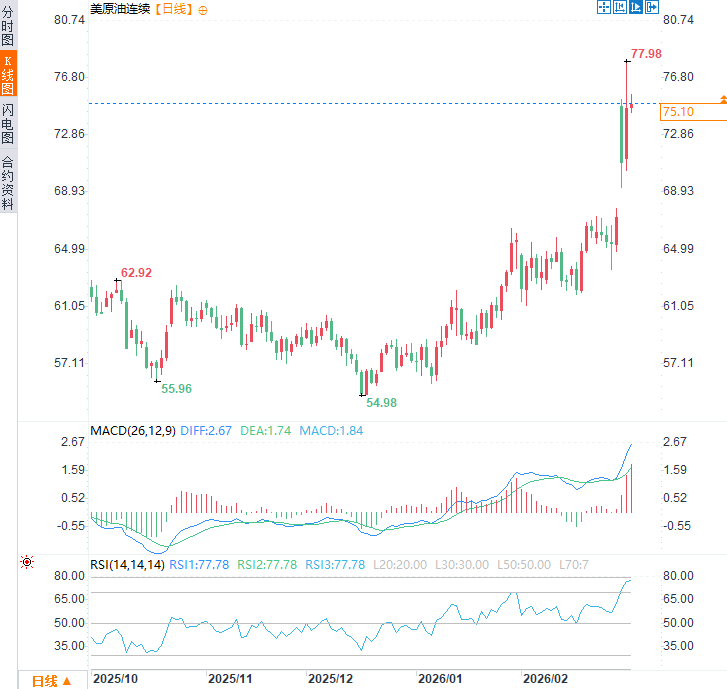
(US crude oil daily chart, source: FX678)
Trump threatened a comprehensive trade embargo against Spain, citing the right to use military bases as leverage, directly linking NATO's internal defense spending disputes with the implementation of its Middle East strategy. While this move may exert short-term pressure on allies, it also exposes the risks of the United States' dependence on European supply chains.
The final outcome will likely depend on the extent of concessions made by Spain, the level of coordination by the EU, and the constraints imposed by US domestic laws and Congress, which could lead to short-term fluctuations in the global trade landscape.
Question 1: Why did Trump choose this time to threaten a trade embargo against Spain?
Answer: In March 2026, the situation in the Middle East escalated due to actions by the US and Iran, and the US urgently needed logistical support from its European bases. After Spain refused to allow the Rota and Morón bases, Trump immediately used economic pressure to force allies to cooperate with his Middle East strategy, while also fulfilling his "America First" commitment and sending a strong signal to other NATO members.
Question 2: How important are Rota and Moron bases to U.S. military operations?
Answer: These two bases are key hubs for the US military in the Mediterranean, where they have long housed support aircraft such as refueling tankers. The withdrawal of these 15 aircraft directly impacts the US military's aerial refueling and rapid deployment capabilities for operations against Iran. The Rota Naval Base also supports Sixth Fleet operations, while Moron Air Base provides logistical support for missions in Africa and the Middle East. Losing access to these bases will force the US military to relocate to bases in Germany or France, increasing operational costs and response time.
Question 3: What is the core of the controversy surrounding Spain's defense spending?
Answer: In June 2025, NATO adopted new targets requiring defense spending to reach 5% of GDP by 2035 (3.5% core military + 1.5% related sectors). Spain was the only country to refuse, insisting that only 2.1% would meet its requirements. Trump used this as a reason to accuse Spain of "free-riding," but actual data shows that Spain's spending was only 1.24% in 2024, and the 2026 target was 2.1%, far below Trump's expectations.
Question 4: How much impact will the trade embargo have on Spanish exports?
Answer: Spain's exports to the US in 2025 are estimated at $21.3 billion, primarily consisting of olive oil (where Spain is the world's largest exporter), auto parts, steel, and chemical products. While the amount is limited, an embargo would cause these products to increase in price by 20%-30% in the US market. However, Spain can quickly shift to the EU internal market, and the US actually has a $4.8 billion trade surplus with Spain; therefore, an embargo also poses a risk of negatively impacting US crude oil and LNG exports.
At 10:21 Beijing time, US crude oil futures were trading at $75.02 per barrel.
This move marks a rare instance of the Trump administration exerting strong economic pressure on a NATO ally amid escalating tensions in the Middle East. Trump emphasized that Spain had not met NATO's defense spending targets, stating that "Spain simply doesn't have anything we need."
US military base withdrawal and military impact
Following the Spanish Socialist government's clear stance, the United States has withdrawn 15 aircraft, primarily aerial refueling tankers, from the Rota Naval Base and Morón Air Base in the south. These bases have long served as key hubs for US military operations in the Mediterranean and Africa, and this withdrawal directly weakens the US's rapid response capability to potential conflicts in the Middle East.
Trump's move aims to force Spain to make concessions through both military and economic means, while sending a signal to other NATO members that refusing to cooperate with the US strategy will have serious consequences.
IEEPA Legal Basis and Expert Questions
Trump cited the Supreme Court's previous affirmation of the International Emergency Economic Powers Act (IEEPA), claiming that the president has the authority to impose such an embargo. However, trade law scholars point out that to legally trigger a state of emergency against Spain, a formal declaration that the country poses an "extraordinary and special threat" to the United States is required.
Experts believe that "Spain's refusal to allow the use of the bases is difficult to classify as such a threat," and this move may face challenges from the US Congress and courts.
Spanish government responds to trade vulnerabilities
The Spanish government responded swiftly, emphasizing that the United States must respect the autonomy of private enterprises, international law, and bilateral trade agreements. Madrid stated that it is prepared for the potential impact of an embargo and will continue to firmly promote free trade.
Spain is the world's largest exporter of olive oil, and also exports auto parts, steel and chemical products to the United States. However, compared with other European countries, its trade dependence on the United States is relatively low, and it has a strong buffer capacity.
US West Coast trade data comparison
The latest trade data as of March 2026 shows that while bilateral trade between the US and the West Coast is limited, the embargo will directly impact specific sectors. The following is the latest comparison:
Higher trade barriers will drive up prices for olive oil and industrial components in the United States, while Spain can mitigate its losses by turning to the EU internal market.
From the US-Iran conflict to infighting among allies, the scope of risk premiums has expanded.
The conflict is no longer confined to the Middle East, but is spreading directly to the European continent and transatlantic relations through rifts within NATO. Investors may have previously viewed the risk of war as "local," but what we are now seeing is the United States exerting extreme economic pressure on its traditional allies (even at key military junctures), increasing systemic risks to the global trading system.
Although Spain is not a major oil producer, its refusal to allow US troops to use its bases directly undermines the US military's logistical capabilities in the Middle East. This event provides potential bullish support for oil prices because it weakens the US's ability to quickly intervene in crises and stabilize supply.
On Wednesday during Asian trading hours, US crude oil prices fluctuated upwards and are currently trading around $75 per barrel, up about 0.6% on the day. In the previous trading day, oil prices rose 5.31%, once touching a near nine-month high of $77.98.
(US crude oil daily chart, source: FX678)
Editor's Summary
Trump threatened a comprehensive trade embargo against Spain, citing the right to use military bases as leverage, directly linking NATO's internal defense spending disputes with the implementation of its Middle East strategy. While this move may exert short-term pressure on allies, it also exposes the risks of the United States' dependence on European supply chains.
The final outcome will likely depend on the extent of concessions made by Spain, the level of coordination by the EU, and the constraints imposed by US domestic laws and Congress, which could lead to short-term fluctuations in the global trade landscape.
Frequently Asked Questions
Question 1: Why did Trump choose this time to threaten a trade embargo against Spain?
Answer: In March 2026, the situation in the Middle East escalated due to actions by the US and Iran, and the US urgently needed logistical support from its European bases. After Spain refused to allow the Rota and Morón bases, Trump immediately used economic pressure to force allies to cooperate with his Middle East strategy, while also fulfilling his "America First" commitment and sending a strong signal to other NATO members.
Question 2: How important are Rota and Moron bases to U.S. military operations?
Answer: These two bases are key hubs for the US military in the Mediterranean, where they have long housed support aircraft such as refueling tankers. The withdrawal of these 15 aircraft directly impacts the US military's aerial refueling and rapid deployment capabilities for operations against Iran. The Rota Naval Base also supports Sixth Fleet operations, while Moron Air Base provides logistical support for missions in Africa and the Middle East. Losing access to these bases will force the US military to relocate to bases in Germany or France, increasing operational costs and response time.
Question 3: What is the core of the controversy surrounding Spain's defense spending?
Answer: In June 2025, NATO adopted new targets requiring defense spending to reach 5% of GDP by 2035 (3.5% core military + 1.5% related sectors). Spain was the only country to refuse, insisting that only 2.1% would meet its requirements. Trump used this as a reason to accuse Spain of "free-riding," but actual data shows that Spain's spending was only 1.24% in 2024, and the 2026 target was 2.1%, far below Trump's expectations.
Question 4: How much impact will the trade embargo have on Spanish exports?
Answer: Spain's exports to the US in 2025 are estimated at $21.3 billion, primarily consisting of olive oil (where Spain is the world's largest exporter), auto parts, steel, and chemical products. While the amount is limited, an embargo would cause these products to increase in price by 20%-30% in the US market. However, Spain can quickly shift to the EU internal market, and the US actually has a $4.8 billion trade surplus with Spain; therefore, an embargo also poses a risk of negatively impacting US crude oil and LNG exports.
At 10:21 Beijing time, US crude oil futures were trading at $75.02 per barrel.
- Risk Warning and Disclaimer
- The market involves risk, and trading may not be suitable for all investors. This article is for reference only and does not constitute personal investment advice, nor does it take into account certain users’ specific investment objectives, financial situation, or other needs. Any investment decisions made based on this information are at your own risk.

