Breaking News! Was the Euro's 1.16 level a "false break" or a genuine breach? What variables are hidden behind the exhaustion of short sellers?
2026-03-04 17:34:32
On Wednesday (March 4), the euro entered a brief consolidation phase against the US dollar after a continuous decline. The exchange rate fluctuated around the 1.16 level during the session, showing a slight rebound from the previous trading day, but remaining within its recent downward trend. The core market driver stemmed from changes in inflation expectations triggered by rising energy prices, leading to a reassessment of the interest rate path, coupled with adjustments in positioning, putting short-term pressure on the euro.
# Table of Contents
Market Background and Market Overview
Macroeconomic and fundamental drivers
Technical Structure and Kinetic Energy Assessment
Key Ranges and Intraday Observation Points
Trend Outlook
---
##
According to the latest quotes, the euro is trading at 1.1615 against the US dollar, with an intraday trading range of 1.1574–1.1627, a fluctuation of approximately 0.46%. Although the price has rebounded slightly from the previous trading day, the rebound is limited and has not yet changed the downward trend that began from the high of 1.1834.
The background to this round of decline is relatively clear: on the one hand, the situation in the Middle East has pushed up energy prices, reinforcing expectations of sticky inflation; on the other hand, the market is repricing its external dependence on the European economy, coupled with previously concentrated long positions in the euro, leading to a concentrated price adjustment after the risk event was triggered. Analysts from well-known institutions point out that the current vulnerability of the euro does not stem from a single fundamental factor, but is the result of the combined effect of "positioning + energy shock".
---
##
1. Rebalancing Inflation and Interest Rate Expectations
Latest data shows that Eurozone inflation rose to 1.9% in February, higher than previously expected by the market. This change has a direct impact on the interest rate path—money market expectations for future easing have cooled significantly, and some probability of interest rate hikes has even been re-priced in. While the change in short-term interest rate expectations theoretically provides some support for the euro, the actual trend has not strengthened accordingly, reflecting the market's greater focus on growth and external shocks.
Meanwhile, the final reading of the Eurozone services PMI came in at 51.9, a slight improvement from the previous reading, indicating a moderate recovery in demand, but employment expansion remained limited. This means that while the economy has not deteriorated significantly, it also lacks sufficient momentum to support further currency strengthening.
2. Energy Price and Terms of Trade Pressures
The more critical variable at present lies in energy. The escalating situation in the Middle East is driving up oil prices, and the Eurozone, as a net energy importer, is extremely sensitive to energy prices in its terms of trade. Analysts generally believe that if energy prices remain high, it will directly erode the Eurozone's external balance of payments, thereby suppressing exchange rate performance.
An institutional economist pointed out that if the energy shock persists for a long time, the euro may need to be repriced in the 1.10–1.12 range; while if the shock eases in stages, the 1.15 level may form a temporary support. This judgment essentially links the euro's movement directly to the energy cycle.
3. Bond Market and Yield Spread Structure
The European bond market stabilized after a sharp sell-off, with the German 10-year yield falling back to around 2.78%, while short-term yields declined slightly, indicating continued market disagreement on the policy path. Meanwhile, the US 10-year yield rose to 4.09%, widening the yield spread and putting external pressure on the euro.
The combined effect of interest rate differentials and energy prices means that the euro lacks sustained upward momentum in the current environment, and even if a rebound occurs, it is more likely to be a technical correction.
---
##
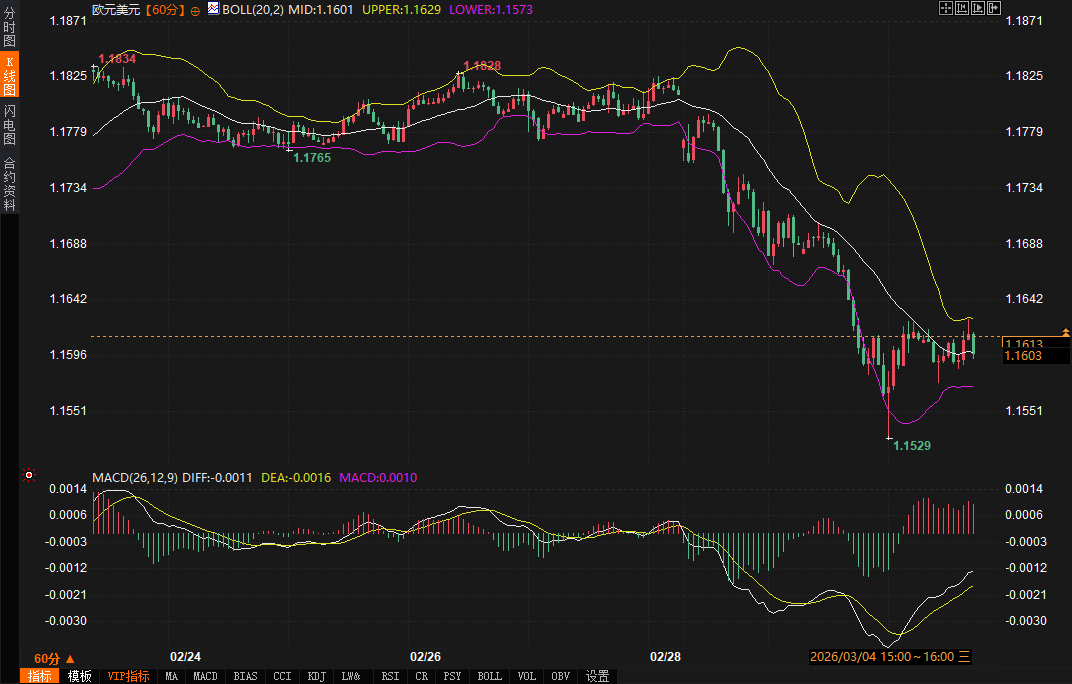
Observing the 60-minute candlestick chart, the euro against the US dollar has formed a clear downward channel since the high of 1.1834. The price has now broken below the middle Bollinger Band (1.1601) and is testing the lower band (1.1573). The trend is still dominated by the bears.
The key technical indicators are as follows:
| Indicator | Current Status | Meaning Interpretation |
| ----------- | ----------------- | ---------- |
Bollinger Bands | The price has broken below the middle band and is approaching the lower band | It remains in a weak short-term range |
| MACD | Both DIFF and DEA are negative, and the histogram is contracting | Short-selling momentum is weakening but has not reversed |
| Price Structure | Lower highs, lower lows| Typical continuation of a downtrend|
It's important to note that the MACD histogram is starting to contract, indicating a weakening of bearish momentum and the market entering a phase of "slowing decline." However, this does not equate to a trend reversal; it is more likely to correspond to consolidation or a weak rebound.
---
##
Based on the current fundamentals and technical structure, the key short-term range can be divided as follows:
Key support range: 1.1596–1.1570
If the area where the corresponding horizontal support coincides with the lower Bollinger Band is effectively broken, it may open up further downside potential.
Short-term resistance range: 1.1625–1.1650
If the rebound is met with resistance at the intraday high and the middle Bollinger Band pullback area, the trend remains weak.
Extended observation range: around 1.1500
Once the previous low area is retested, the market will reassess the medium-term structure.
Key points to watch during trading:
1. Will energy prices continue to rise (directly impacting the euro's fundamentals)?
2. Changes in US Treasury yields (affecting yield spread structure)
3. Will Eurozone interest rate expectations be revised upwards or remain stable?
4. The repeated struggle around the 1.16 level (a key dividing line between bullish and bearish sentiment)
---
##
Based on current information, the euro/dollar exchange rate remains in a phase of confluence between fundamental pressures and a downward technical structure. Although there are signs of weakening momentum in the short term, a clear reversal signal has not yet formed.
If energy prices remain high and interest rate differentials continue to widen, the euro may remain weak and gradually test lower levels. Conversely, if external risks ease, the exchange rate is expected to find support around 1.15 and enter a period of consolidation.
The current phase is closer to "consolidation within a trend" than a trend reversal.
---
## Frequently Asked Questions
# Table of Contents
---
##
Market Background and Market Overview
According to the latest quotes, the euro is trading at 1.1615 against the US dollar, with an intraday trading range of 1.1574–1.1627, a fluctuation of approximately 0.46%. Although the price has rebounded slightly from the previous trading day, the rebound is limited and has not yet changed the downward trend that began from the high of 1.1834.
The background to this round of decline is relatively clear: on the one hand, the situation in the Middle East has pushed up energy prices, reinforcing expectations of sticky inflation; on the other hand, the market is repricing its external dependence on the European economy, coupled with previously concentrated long positions in the euro, leading to a concentrated price adjustment after the risk event was triggered. Analysts from well-known institutions point out that the current vulnerability of the euro does not stem from a single fundamental factor, but is the result of the combined effect of "positioning + energy shock".
---
##
Macroeconomic and fundamental drivers
1. Rebalancing Inflation and Interest Rate Expectations
Latest data shows that Eurozone inflation rose to 1.9% in February, higher than previously expected by the market. This change has a direct impact on the interest rate path—money market expectations for future easing have cooled significantly, and some probability of interest rate hikes has even been re-priced in. While the change in short-term interest rate expectations theoretically provides some support for the euro, the actual trend has not strengthened accordingly, reflecting the market's greater focus on growth and external shocks.
Meanwhile, the final reading of the Eurozone services PMI came in at 51.9, a slight improvement from the previous reading, indicating a moderate recovery in demand, but employment expansion remained limited. This means that while the economy has not deteriorated significantly, it also lacks sufficient momentum to support further currency strengthening.
2. Energy Price and Terms of Trade Pressures
The more critical variable at present lies in energy. The escalating situation in the Middle East is driving up oil prices, and the Eurozone, as a net energy importer, is extremely sensitive to energy prices in its terms of trade. Analysts generally believe that if energy prices remain high, it will directly erode the Eurozone's external balance of payments, thereby suppressing exchange rate performance.
An institutional economist pointed out that if the energy shock persists for a long time, the euro may need to be repriced in the 1.10–1.12 range; while if the shock eases in stages, the 1.15 level may form a temporary support. This judgment essentially links the euro's movement directly to the energy cycle.
3. Bond Market and Yield Spread Structure
The European bond market stabilized after a sharp sell-off, with the German 10-year yield falling back to around 2.78%, while short-term yields declined slightly, indicating continued market disagreement on the policy path. Meanwhile, the US 10-year yield rose to 4.09%, widening the yield spread and putting external pressure on the euro.
The combined effect of interest rate differentials and energy prices means that the euro lacks sustained upward momentum in the current environment, and even if a rebound occurs, it is more likely to be a technical correction.
---
##
Technical Structure and Kinetic Energy Assessment
Observing the 60-minute candlestick chart, the euro against the US dollar has formed a clear downward channel since the high of 1.1834. The price has now broken below the middle Bollinger Band (1.1601) and is testing the lower band (1.1573). The trend is still dominated by the bears.
The key technical indicators are as follows:
| Indicator | Current Status | Meaning Interpretation |
| ----------- | ----------------- | ---------- |
Bollinger Bands | The price has broken below the middle band and is approaching the lower band | It remains in a weak short-term range |
| MACD | Both DIFF and DEA are negative, and the histogram is contracting | Short-selling momentum is weakening but has not reversed |
| Price Structure | Lower highs, lower lows| Typical continuation of a downtrend|
It's important to note that the MACD histogram is starting to contract, indicating a weakening of bearish momentum and the market entering a phase of "slowing decline." However, this does not equate to a trend reversal; it is more likely to correspond to consolidation or a weak rebound.
---
##
Key Ranges and Intraday Observation Points
Based on the current fundamentals and technical structure, the key short-term range can be divided as follows:
Key support range: 1.1596–1.1570
If the area where the corresponding horizontal support coincides with the lower Bollinger Band is effectively broken, it may open up further downside potential.
Short-term resistance range: 1.1625–1.1650
If the rebound is met with resistance at the intraday high and the middle Bollinger Band pullback area, the trend remains weak.
Extended observation range: around 1.1500
Once the previous low area is retested, the market will reassess the medium-term structure.
Key points to watch during trading:
1. Will energy prices continue to rise (directly impacting the euro's fundamentals)?
2. Changes in US Treasury yields (affecting yield spread structure)
3. Will Eurozone interest rate expectations be revised upwards or remain stable?
4. The repeated struggle around the 1.16 level (a key dividing line between bullish and bearish sentiment)
---
##
Trend Outlook
Based on current information, the euro/dollar exchange rate remains in a phase of confluence between fundamental pressures and a downward technical structure. Although there are signs of weakening momentum in the short term, a clear reversal signal has not yet formed.
If energy prices remain high and interest rate differentials continue to widen, the euro may remain weak and gradually test lower levels. Conversely, if external risks ease, the exchange rate is expected to find support around 1.15 and enter a period of consolidation.
The current phase is closer to "consolidation within a trend" than a trend reversal.
---
## Frequently Asked Questions
Q1: Why is the euro weakening despite rising inflation?
A: While rising inflation has indeed increased expectations of higher interest rates, the market is more focused on the negative impact of energy prices on the economy. In other words, if inflation is cost-push (such as energy), it may not be beneficial for the exchange rate; instead, it could weaken growth expectations and thus suppress the euro.
Q2: What are the core drivers of the euro at present?
A: There are three main factors: energy prices, interest rate differentials, and market positioning. Among these, energy is currently the most critical variable because it directly affects the Eurozone's terms of trade and inflation structure.
Q3: Does the weakening of MACD bearish momentum mean we can be bullish?
A: This does not mean a trend reversal. Weakening momentum usually corresponds to fluctuations or rebounds, but before the trend changes, it should still be regarded as a temporary buffer in the downward process.
Q4: Why is the position 1.16 important?
A: This position is both a psychologically important psychological level and near the Bollinger Band's middle line, simultaneously reflecting short-term bullish and bearish divergence. A decisive break below and subsequent stabilization below this level would further shift the market structure towards a bearish bias.
Q5: Will the future trend of the euro depend more on European or external factors?
A: At this stage, we are more reliant on external factors, especially the energy and global interest rate environment. Although European data has improved, it is not enough to dominate the direction of exchange rates.
- Risk Warning and Disclaimer
- The market involves risk, and trading may not be suitable for all investors. This article is for reference only and does not constitute personal investment advice, nor does it take into account certain users’ specific investment objectives, financial situation, or other needs. Any investment decisions made based on this information are at your own risk.