UBS makes a startling prediction of $100: Are oil prices really going to skyrocket?
2026-03-04 20:49:37
On Wednesday, March 4, Brent crude oil prices traded around $82.20 per barrel in pre-market trading in the US. Oil prices had recently touched a high of $85.08, rebounding more than 10% from the lows at the beginning of the month. This trend is directly attributable to the risk of a de facto closure of the Strait of Hormuz caused by the escalation of the US-Iran conflict.

Data shows that since Monday, only three oil and gas tankers have successfully transited the strait, with a large number of vessels stranded on both sides, and no one daring to risk passage. The Iranian Revolutionary Guard's threats of attacks on passing tankers have effectively blocked the world's most critical oil transport chokepoint. This strait typically handles approximately 20 million barrels of crude oil and liquefied natural gas daily, accounting for about 20% of global oil trade; any continued disruption would immediately drive up market risk premiums.
A UBS report explicitly points out that current oil prices are already embedded with a higher structural risk premium. If the conflict continues for several weeks, Brent crude could rise further and break through the $100 mark. Even if there is a short-term easing, this premium will not completely disappear, and prices are unlikely to fall back to the $60 range. Such geopolitically driven premium expansion is often accompanied by a sharp surge in volatility, far exceeding the impact of fundamental supply and demand changes.
UBS has raised its average Brent crude oil price forecast for the first quarter of 2026 to $71 per barrel, with an implied target of nearly $80 per barrel for March alone; the full-year average forecast has risen to $72 per barrel, a $10 premium over pre-conflict levels. This adjustment reflects a repricing of the vulnerability of Middle Eastern energy infrastructure. The report emphasizes that if Qatar's LNG facilities are attacked, oil prices could quickly rise above $90, with the specific increase depending on the severity of the attack. In the extreme scenario of the Strait of Hormuz being closed for more than two weeks, prices could break into triple digits. The following is a comparison of forecasts:
Project | Previous Forecast | Latest Forecast
The average price (USD/barrel) in the first quarter of 2026 is approximately 61.71.
March 2026 target (USD/barrel): Approximately 70-80
2026 annual average (USD/barrel): 62 72
The current price of $82.20 has already factored in some upside risks, and the market is currently in a sensitive window for risk premium reassessment. If OPEC+ maintains its current production policy, inventory reduction will accelerate, and refinery crack spreads are expected to widen, providing additional support for bulls. However, once signs of easing emerge, a rapid decline in the premium will test the support level of $82.
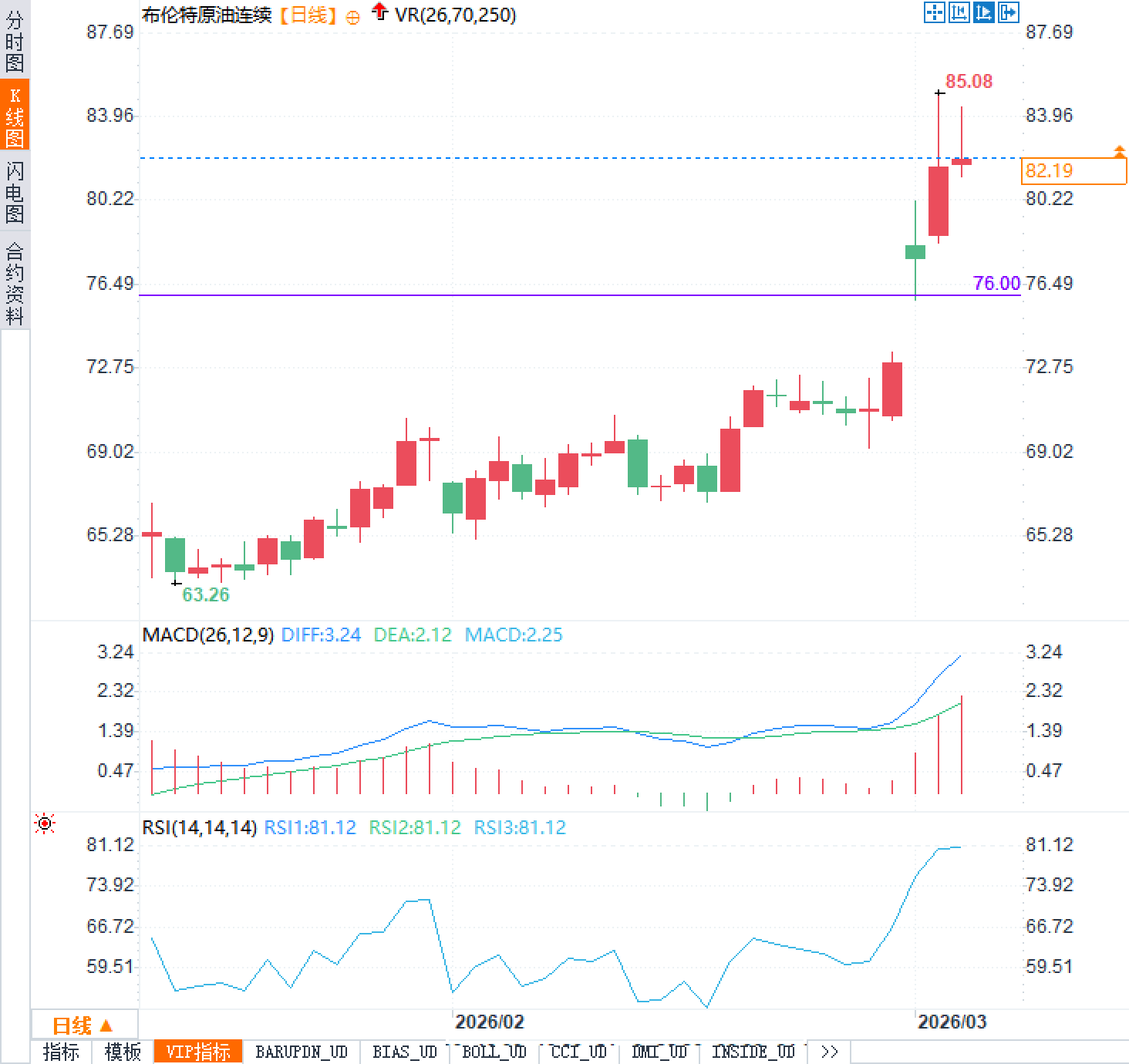
From the daily chart, the upward trend of Brent crude oil, which started from the low of $63.26, continues, but the technical indicators have issued a clear overbought warning. The RSI is at 81.12, entering the typical overbought zone, and historical data shows that the probability of a short-term pullback after reaching this level is over 65%. The MACD indicator shows the DIFF line at 3.24, the DEA line at 2.12, and the MACD histogram at 2.25, maintaining a golden cross. In terms of price, the recent high of $85.08 forms short-term resistance, with significant selling pressure around $83; the support level is at $76.
Data shows that since Monday, only three oil and gas tankers have successfully transited the strait, with a large number of vessels stranded on both sides, and no one daring to risk passage. The Iranian Revolutionary Guard's threats of attacks on passing tankers have effectively blocked the world's most critical oil transport chokepoint. This strait typically handles approximately 20 million barrels of crude oil and liquefied natural gas daily, accounting for about 20% of global oil trade; any continued disruption would immediately drive up market risk premiums.
A UBS report explicitly points out that current oil prices are already embedded with a higher structural risk premium. If the conflict continues for several weeks, Brent crude could rise further and break through the $100 mark. Even if there is a short-term easing, this premium will not completely disappear, and prices are unlikely to fall back to the $60 range. Such geopolitically driven premium expansion is often accompanied by a sharp surge in volatility, far exceeding the impact of fundamental supply and demand changes.
UBS Forecast Adjustment and Multi-Scenario Price Simulation
UBS has raised its average Brent crude oil price forecast for the first quarter of 2026 to $71 per barrel, with an implied target of nearly $80 per barrel for March alone; the full-year average forecast has risen to $72 per barrel, a $10 premium over pre-conflict levels. This adjustment reflects a repricing of the vulnerability of Middle Eastern energy infrastructure. The report emphasizes that if Qatar's LNG facilities are attacked, oil prices could quickly rise above $90, with the specific increase depending on the severity of the attack. In the extreme scenario of the Strait of Hormuz being closed for more than two weeks, prices could break into triple digits. The following is a comparison of forecasts:
Project | Previous Forecast | Latest Forecast
The average price (USD/barrel) in the first quarter of 2026 is approximately 61.71.
March 2026 target (USD/barrel): Approximately 70-80
2026 annual average (USD/barrel): 62 72
The current price of $82.20 has already factored in some upside risks, and the market is currently in a sensitive window for risk premium reassessment. If OPEC+ maintains its current production policy, inventory reduction will accelerate, and refinery crack spreads are expected to widen, providing additional support for bulls. However, once signs of easing emerge, a rapid decline in the premium will test the support level of $82.
Daily technical indicator signals
From the daily chart, the upward trend of Brent crude oil, which started from the low of $63.26, continues, but the technical indicators have issued a clear overbought warning. The RSI is at 81.12, entering the typical overbought zone, and historical data shows that the probability of a short-term pullback after reaching this level is over 65%. The MACD indicator shows the DIFF line at 3.24, the DEA line at 2.12, and the MACD histogram at 2.25, maintaining a golden cross. In terms of price, the recent high of $85.08 forms short-term resistance, with significant selling pressure around $83; the support level is at $76.
Frequently Asked Questions
Question 1: What core impact will the de facto closure of the Strait of Hormuz have on the global oil market supply and demand balance?
A: The disruption in the Taiwan Strait will directly cut off a supply channel of approximately 20 million barrels per day, accelerating the depletion of global available inventory by 2-3 times in the short term, leading to a widening of the spot premium and a narrowing of the discount for longer-term contracts. Traders need to closely monitor the EIA inventory report; if US crude oil inventories decline by more than 3 million barrels for four consecutive weeks, oil prices are likely to experience a sudden surge. Historically, similar events have shown that when supply disruptions last for more than two weeks, the WTI-Brent price spread typically widens to over $5.
Question 2: After UBS raised its forecast, has the current price of $82 fully reflected the risk premium?
A: Not yet fully reflected. UBS raised its full-year average price forecast by $10, but the current price is only about $10 higher than the pre-adjustment average, meaning the market still underestimates the potential gains in extreme scenarios. If the shutdown is extended, a $90 or even $100 target will quickly become the new consensus. Traders can compare the extent of premium expansion in historical risk events; typically, the premium accounts for 40%-60% of the total gains in the early stages of a conflict, while fundamentals dominate later.
- Risk Warning and Disclaimer
- The market involves risk, and trading may not be suitable for all investors. This article is for reference only and does not constitute personal investment advice, nor does it take into account certain users’ specific investment objectives, financial situation, or other needs. Any investment decisions made based on this information are at your own risk.