Ignoring US tariffs and ADP! Why did the Euro stage a V-shaped comeback?
2026-03-04 21:48:38
On Wednesday (March 4), during the European and American trading sessions, the euro rebounded against the US dollar after hitting a low in the morning, exhibiting a bottoming-out and recovery trend. It is currently trading around 1.1637, up 0.22%. Although US data was strong and US Treasury Secretary Bessenter announced tough tariff details, the euro has rebounded after the recent sustained strengthening of the US dollar and the heavy blow from oil prices to the Eurozone economy, indicating that the negative factors have been priced in.
Bob Savage, head of macro strategy at BNY Mellon, pointed out that the Eurozone's composite PMI climbed to a three-month high in February, with continued expansion momentum in the private sector and strong domestic demand driving simultaneous improvement in manufacturing and service sector output, making the Eurozone's economic recovery pattern clear.
The Eurozone's composite PMI rose to 51.9 in February from 51.3 in January, hitting a three-month high, with the private sector expansion cycle extending to 14 months. The services PMI rose to 51.9 from 51.6, reaching a two-month high, with domestic demand orders supporting sales growth, while exports continued to contract slightly.
The economies in the region showed significant divergence, with Germany becoming the core engine of growth, Italy accelerating its expansion, Spain slowing its growth, and France continuing to be in a period of mild contraction.
However, inflationary pressures, including from energy, forced the policymakers to make a crucial reversal. The European Central Bank's policy outlook underwent a dramatic shift within just two trading sessions, with market expectations changing from a marginal probability of interest rate cuts to a 50% probability of interest rate hikes. This hawkish repricing completely reshaped interest rate expectations and became the euro's core supporting force. Central banks in Central and Eastern Europe, the Middle East, and Africa also needed to adjust their policy paths accordingly to narrow potential policy gaps.
U.S. Treasury Secretary Bessant officially announced that the Trump administration's 15% global tariff plan will be formally implemented this week, and predicted that within five months, the U.S. tariff rate will return to the level before the Supreme Court rejected the "reciprocal tariff" ruling.
After the Supreme Court ruled the existing tariffs unconstitutional, Trump quickly signed an executive order to impose a 10% global tariff under Section 122 of the Trade Act of 1974, and then raised the rate to 15% the following day, requiring it to take effect immediately.
Bessant emphasized that this alternative tariff is only valid for 150 days and cannot be extended without congressional approval; during this window, the Office of the United States Trade Representative and the Department of Commerce will complete trade research to pave the way for subsequent long-term tariff policies.
He stated that although the legal framework has progressed slowly, it is well-founded and has withstood more than 4,000 legal challenges.
Faced with inflationary pressures from rising energy prices due to the war, the ensuing tariff pressures caused the euro to plummet against the dollar in the previous trading day, but today it showed a "sell the news" trend, indicating that the negative news had been fully priced in.
The US February ADP employment data was strong, with the market expecting only 50,000 jobs, but the actual figure was 63,000, significantly better than both the expected and previous figures. Logically, this should be beneficial for the US dollar.
However, the market showed an abnormal trend. The dollar did not rise. Instead, there was a clear phenomenon of funds taking advantage of the positive news to sell off their holdings. After the data was released, the euro rose directly against the dollar.
This trend reflects that market concerns about US policy uncertainty outweighed the positive employment data, while the euro's own economic and policy support continued to exert its strength, driving the euro higher against the dollar.
In theory, war raises overall interest rates and global inflation. For the United States, both imported inflation and forced interest rate increases due to rising US Treasury yields are detrimental to the US economy. For US shale oil, the recent large-scale layoffs and initial jobless claims in the oil industry mean that even with the recent rapid rise in oil prices, the industry is unable to effectively expand production. Therefore, once the risk aversion subsides, the US dollar index is likely to weaken again and be liquidated by the US domestic economy.
Although the Eurozone's PMI has recently returned above the expansion/contraction threshold, the euro continues to be under pressure due to the sharp rise in oil and natural gas prices, which are pushing up inflation and affecting economic growth. Rising inflation expectations have given the European Central Bank the option to raise interest rates. Combined with the fact that the recent rapid decline in the euro exchange rate has already priced in the negative factors, the euro has shown a trend of not falling despite the negative news, indicating that the negative news has been fully priced in and is now a positive sign.
From a technical perspective, the euro/dollar pair found strong support near the key level of 1.1500, while the recent resistance level is around 1.1650, which is also the neckline of the previous high-volume trading zone.
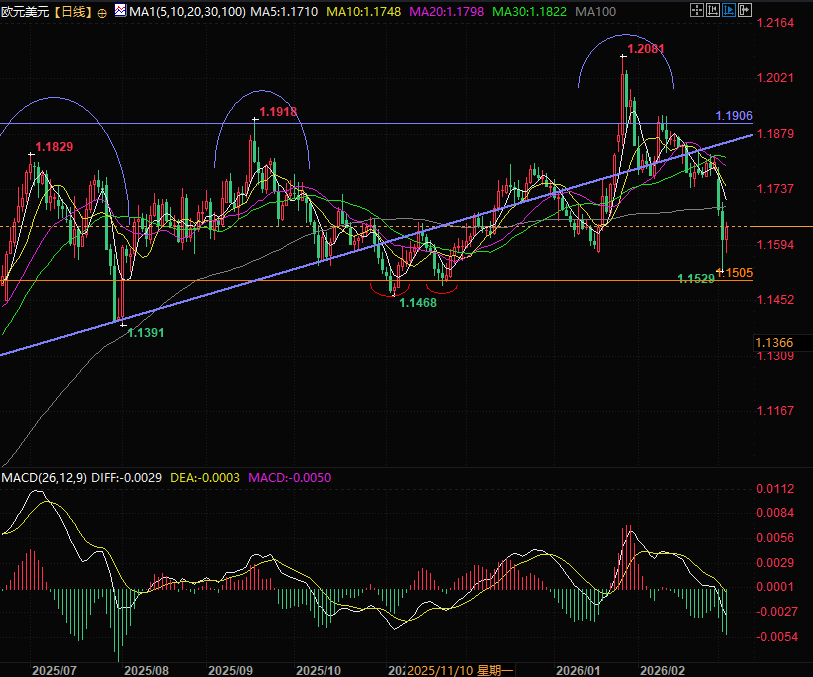
(Euro/USD daily chart, source: FX678)
At 21:40 Beijing time, the euro was trading at 1.1638/39 against the US dollar.
The Eurozone economy is recovering, but this is met with expectations of a shift in the stance of hawks.
Bob Savage, head of macro strategy at BNY Mellon, pointed out that the Eurozone's composite PMI climbed to a three-month high in February, with continued expansion momentum in the private sector and strong domestic demand driving simultaneous improvement in manufacturing and service sector output, making the Eurozone's economic recovery pattern clear.
The Eurozone's composite PMI rose to 51.9 in February from 51.3 in January, hitting a three-month high, with the private sector expansion cycle extending to 14 months. The services PMI rose to 51.9 from 51.6, reaching a two-month high, with domestic demand orders supporting sales growth, while exports continued to contract slightly.
The economies in the region showed significant divergence, with Germany becoming the core engine of growth, Italy accelerating its expansion, Spain slowing its growth, and France continuing to be in a period of mild contraction.
However, inflationary pressures, including from energy, forced the policymakers to make a crucial reversal. The European Central Bank's policy outlook underwent a dramatic shift within just two trading sessions, with market expectations changing from a marginal probability of interest rate cuts to a 50% probability of interest rate hikes. This hawkish repricing completely reshaped interest rate expectations and became the euro's core supporting force. Central banks in Central and Eastern Europe, the Middle East, and Africa also needed to adjust their policy paths accordingly to narrow potential policy gaps.
Uncertainty surrounding the implementation of US global tariffs this week continues to escalate.
U.S. Treasury Secretary Bessant officially announced that the Trump administration's 15% global tariff plan will be formally implemented this week, and predicted that within five months, the U.S. tariff rate will return to the level before the Supreme Court rejected the "reciprocal tariff" ruling.
After the Supreme Court ruled the existing tariffs unconstitutional, Trump quickly signed an executive order to impose a 10% global tariff under Section 122 of the Trade Act of 1974, and then raised the rate to 15% the following day, requiring it to take effect immediately.
Bessant emphasized that this alternative tariff is only valid for 150 days and cannot be extended without congressional approval; during this window, the Office of the United States Trade Representative and the Department of Commerce will complete trade research to pave the way for subsequent long-term tariff policies.
He stated that although the legal framework has progressed slowly, it is well-founded and has withstood more than 4,000 legal challenges.
Faced with inflationary pressures from rising energy prices due to the war, the ensuing tariff pressures caused the euro to plummet against the dollar in the previous trading day, but today it showed a "sell the news" trend, indicating that the negative news had been fully priced in.
Better-than-expected US ADP data boosted liquidity, leading to selling pressure and a weaker dollar.
The US February ADP employment data was strong, with the market expecting only 50,000 jobs, but the actual figure was 63,000, significantly better than both the expected and previous figures. Logically, this should be beneficial for the US dollar.
However, the market showed an abnormal trend. The dollar did not rise. Instead, there was a clear phenomenon of funds taking advantage of the positive news to sell off their holdings. After the data was released, the euro rose directly against the dollar.
This trend reflects that market concerns about US policy uncertainty outweighed the positive employment data, while the euro's own economic and policy support continued to exert its strength, driving the euro higher against the dollar.
In theory, war raises overall interest rates and global inflation. For the United States, both imported inflation and forced interest rate increases due to rising US Treasury yields are detrimental to the US economy. For US shale oil, the recent large-scale layoffs and initial jobless claims in the oil industry mean that even with the recent rapid rise in oil prices, the industry is unable to effectively expand production. Therefore, once the risk aversion subsides, the US dollar index is likely to weaken again and be liquidated by the US domestic economy.
Summary and Technical Analysis:
Although the Eurozone's PMI has recently returned above the expansion/contraction threshold, the euro continues to be under pressure due to the sharp rise in oil and natural gas prices, which are pushing up inflation and affecting economic growth. Rising inflation expectations have given the European Central Bank the option to raise interest rates. Combined with the fact that the recent rapid decline in the euro exchange rate has already priced in the negative factors, the euro has shown a trend of not falling despite the negative news, indicating that the negative news has been fully priced in and is now a positive sign.
From a technical perspective, the euro/dollar pair found strong support near the key level of 1.1500, while the recent resistance level is around 1.1650, which is also the neckline of the previous high-volume trading zone.
(Euro/USD daily chart, source: FX678)
At 21:40 Beijing time, the euro was trading at 1.1638/39 against the US dollar.
- Risk Warning and Disclaimer
- The market involves risk, and trading may not be suitable for all investors. This article is for reference only and does not constitute personal investment advice, nor does it take into account certain users’ specific investment objectives, financial situation, or other needs. Any investment decisions made based on this information are at your own risk.