Fifth day of the Gulf shipping crisis: Trump promises insurance and naval escort, experts warn it won't solve the energy supply "deadlock".
2026-03-05 01:57:56
On Wednesday (March 4), the US-Iran conflict entered its fifth day. The US launched a fatal attack on the Iranian Navy's Mojer-class frigate IRIS Dena off the coast of Sri Lanka. This marks the first time since World War II that a US submarine has sunk an enemy ship with a torpedo, signifying the rapid spillover of the war from the Persian Gulf to the Indian Ocean and further escalating the global energy shipping crisis. Shipping in the Strait of Hormuz has been effectively paralyzed for the fifth consecutive day, with approximately 200 oil tankers, LNG carriers, and cargo ships stranded off the coasts of major oil-producing countries in the Gulf. Hundreds of vessels are unable to enter the strait, cutting off about one-fifth of the world's oil and gas supply.

Military escalation: US sinks Iranian ship, conflict continues to spill over.
A U.S. Navy submarine attacked the USS Dena in waters near Sri Lanka on April 4, causing severe damage to the ship and sending numerous crew members overboard. The Sri Lankan Navy and Air Force launched a massive search and rescue operation, rescuing approximately 32 seriously injured sailors. At least 101 people (some reports say over 87) remain missing or confirmed dead. U.S. Defense Secretary Hegseth confirmed the operation as "historic," and the Pentagon even released related footage. To date, the U.S. military has claimed to have sunk 17 Iranian naval vessels and is proceeding with its plan to destroy the entire Iranian naval force.
Mohammad Akbarzadeh, a naval official with Iran's Islamic Revolutionary Guard Corps (IRGC), countered that the Strait of Hormuz is currently under the "complete control" of the Iranian navy, and any forced passage would be considered a hostile act. This statement exacerbated market panic. The conflict originated from the joint US-Israeli Operation Lion's Roar and Operation Epic Fury in late February, which targeted Iranian leadership and nuclear facilities, resulting in the deaths of Khomeini and other high-ranking officials, and triggering a full-scale Iranian retaliation.
Current shipping situation: Strait traffic is frozen, with rare cases of "risky passage" emerging.
MarineTraffic and LSEG vessel tracking data show that traffic in the Strait of Hormuz has decreased by 80%-94% compared to normal. The Maltese-flagged container ship Safeen Prestige was hit by a projectile while heading towards the northern end of the Strait, causing an engine fire. The crew abandoned ship and were rescued by the Omani Navy. There were no reports of casualties.
Despite this, a rare breakthrough occurred on Tuesday: the Suezmax tanker Pola (IMO: 9493767) turned off its AIS transponder as it approached the strait and appeared near Abu Dhabi the following day, successfully entering the Jebel Ali Port in the UAE to load Murban crude oil, destined for Thailand. This is considered one of the few "risky passage" cases, highlighting that some shipowners are still trying to maintain critical supplies despite the high risks.
Energy ripple effects: Production disruptions in multiple countries, widening supply gaps
Qatar Energy declared force majeure after attacks on its production facilities, shutting down its liquefied natural gas (LNG) plants and preventing normal exports from resuming for at least a month—directly impacting about 20% of global LNG supply. Iraq has already cut oil production by approximately 1.5 million barrels per day (nearly half) due to saturated storage facilities. Loading operations in Saudi Arabia, the UAE, and Kuwait are facing difficulties. Saudi Aramco's largest refinery and export terminal, Ras Tanura (with a capacity of 550,000 barrels per day), was attacked again on Wednesday by drones or unidentified projectiles; although the damage was limited, it has been shut down for the second time.
US Intervention: Trump Promises Escorts and Insurance, Experts Question Feasibility
On April 4, US President Trump announced on social media that he had instructed the US International Development Finance Corporation (DFC) to provide "reasonably priced" political risk insurance and financial guarantees for maritime trade in the Gulf (primarily energy transport), adding that "the US Navy will escort tankers as soon as possible if necessary." He emphasized, "The United States will ensure the free flow of energy to the world in any way." Following this announcement, Brent crude and WTI crude oil prices fell by more than $2.50 in the short term, providing a brief respite for the market.
However, experts such as Jakob Larsen, Chief Safety Officer of the shipping association BIMCO, bluntly stated, "Protecting all threatened oil tankers would require a large number of warships and military assets, which is unrealistic in practice." Goldman Sachs raised its second-quarter Brent crude oil forecast by $10 to $76 per barrel (potentially exceeding $100 in an extreme scenario), and its WTI forecast by $9 to $71, while warning of the risk of a significant drop in inventories. Oil prices have risen by a cumulative 12% since the conflict began.
Asian shock: Refineries face production cuts and shift to alternative sources
Asia relies on the Middle East for 60% of its oil, making it particularly vulnerable to the impact of this disruption. Mangalore Refining & Petrochemicals Limited (MRPL) and Petronet LNG in India have issued force majeure notices, and refineries may reduce production by 20-30%. Indonesian and Japanese refineries are increasing imports from the United States; India is considering purchasing more crude oil from Russia. Chinese buyers, through diplomatic channels, have "urgently requested" all parties to immediately restore passage through the Strait of Hormuz, and some companies have turned to alternative sources in Africa or Latin America. Global supply chains are under pressure, and the cancellation of war risk insurance has led to a surge in freight rates, forcing some shipping routes to detour around the Cape of Good Hope, adding two weeks to the journey.
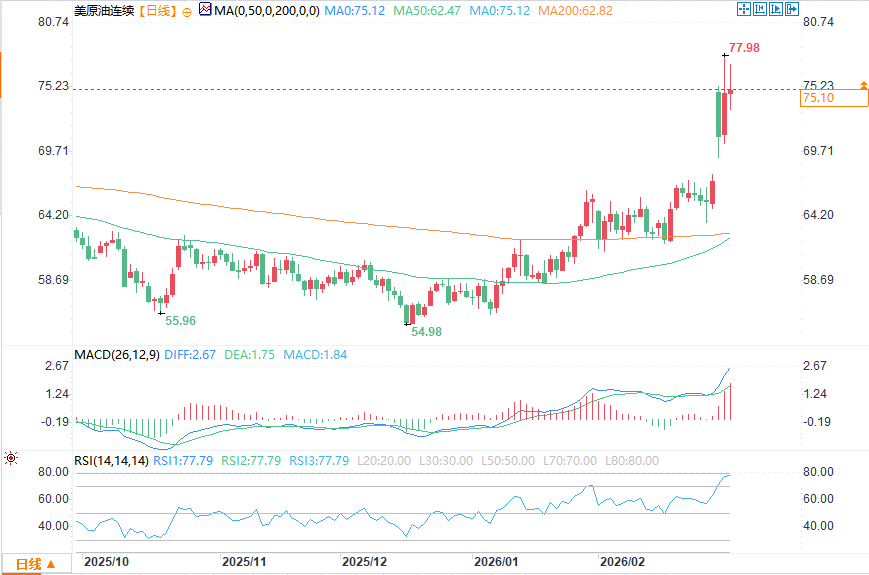
(WTI crude oil daily chart source: FX678)
Deeper Impacts and Outlook: Intensified Geopolitical Competition and Reshaping of the Global Energy Landscape
This crisis is not only about disruptions to shipping and energy supplies, but also a signal that the US-Iran conflict is escalating into a "new tanker war" (a repeat of the 1980s Gulf oil tanker war). The Strait of Hormuz carries approximately 20 million barrels of oil daily; if the disruption lasts for more than a month, OECD inventories will drop significantly, highlighting the risk of slowing growth in emerging Asian economies and potentially even pushing up global inflation and triggering the closure of some refineries. Experts believe that while Trump's insurance and escort measures can alleviate short-term panic, they cannot fundamentally address the asymmetric threats from Iran (drones, missiles, blockades). China, as the largest energy importer, is accelerating energy diversification (alternative routes along the Belt and Road Initiative, release of strategic reserves) while urging diplomatic intervention. Russia may seize the opportunity to expand its export share to Asia, and in the long term, this crisis may accelerate the global transition to renewable energy. As of press time, the market remains highly tense: IRGC control statement vs. Trump's "more actions are coming." In the next 72 hours, without a diplomatic breakthrough and with continued low traffic in the strait, the probability of oil prices returning to the $80-85 range is extremely high. Global investors need to closely monitor key variables such as the actual deployment of the U.S. Navy, China's diplomatic statements, and the operating rates of Asian refineries. This "fifth-day crisis" has far exceeded a simple shipping issue, becoming a turning point in reshaping the global energy geopolitical landscape.
Military escalation: US sinks Iranian ship, conflict continues to spill over.
A U.S. Navy submarine attacked the USS Dena in waters near Sri Lanka on April 4, causing severe damage to the ship and sending numerous crew members overboard. The Sri Lankan Navy and Air Force launched a massive search and rescue operation, rescuing approximately 32 seriously injured sailors. At least 101 people (some reports say over 87) remain missing or confirmed dead. U.S. Defense Secretary Hegseth confirmed the operation as "historic," and the Pentagon even released related footage. To date, the U.S. military has claimed to have sunk 17 Iranian naval vessels and is proceeding with its plan to destroy the entire Iranian naval force.
Mohammad Akbarzadeh, a naval official with Iran's Islamic Revolutionary Guard Corps (IRGC), countered that the Strait of Hormuz is currently under the "complete control" of the Iranian navy, and any forced passage would be considered a hostile act. This statement exacerbated market panic. The conflict originated from the joint US-Israeli Operation Lion's Roar and Operation Epic Fury in late February, which targeted Iranian leadership and nuclear facilities, resulting in the deaths of Khomeini and other high-ranking officials, and triggering a full-scale Iranian retaliation.
Current shipping situation: Strait traffic is frozen, with rare cases of "risky passage" emerging.
MarineTraffic and LSEG vessel tracking data show that traffic in the Strait of Hormuz has decreased by 80%-94% compared to normal. The Maltese-flagged container ship Safeen Prestige was hit by a projectile while heading towards the northern end of the Strait, causing an engine fire. The crew abandoned ship and were rescued by the Omani Navy. There were no reports of casualties.
Despite this, a rare breakthrough occurred on Tuesday: the Suezmax tanker Pola (IMO: 9493767) turned off its AIS transponder as it approached the strait and appeared near Abu Dhabi the following day, successfully entering the Jebel Ali Port in the UAE to load Murban crude oil, destined for Thailand. This is considered one of the few "risky passage" cases, highlighting that some shipowners are still trying to maintain critical supplies despite the high risks.
Energy ripple effects: Production disruptions in multiple countries, widening supply gaps
Qatar Energy declared force majeure after attacks on its production facilities, shutting down its liquefied natural gas (LNG) plants and preventing normal exports from resuming for at least a month—directly impacting about 20% of global LNG supply. Iraq has already cut oil production by approximately 1.5 million barrels per day (nearly half) due to saturated storage facilities. Loading operations in Saudi Arabia, the UAE, and Kuwait are facing difficulties. Saudi Aramco's largest refinery and export terminal, Ras Tanura (with a capacity of 550,000 barrels per day), was attacked again on Wednesday by drones or unidentified projectiles; although the damage was limited, it has been shut down for the second time.
US Intervention: Trump Promises Escorts and Insurance, Experts Question Feasibility
On April 4, US President Trump announced on social media that he had instructed the US International Development Finance Corporation (DFC) to provide "reasonably priced" political risk insurance and financial guarantees for maritime trade in the Gulf (primarily energy transport), adding that "the US Navy will escort tankers as soon as possible if necessary." He emphasized, "The United States will ensure the free flow of energy to the world in any way." Following this announcement, Brent crude and WTI crude oil prices fell by more than $2.50 in the short term, providing a brief respite for the market.
However, experts such as Jakob Larsen, Chief Safety Officer of the shipping association BIMCO, bluntly stated, "Protecting all threatened oil tankers would require a large number of warships and military assets, which is unrealistic in practice." Goldman Sachs raised its second-quarter Brent crude oil forecast by $10 to $76 per barrel (potentially exceeding $100 in an extreme scenario), and its WTI forecast by $9 to $71, while warning of the risk of a significant drop in inventories. Oil prices have risen by a cumulative 12% since the conflict began.
Asian shock: Refineries face production cuts and shift to alternative sources
Asia relies on the Middle East for 60% of its oil, making it particularly vulnerable to the impact of this disruption. Mangalore Refining & Petrochemicals Limited (MRPL) and Petronet LNG in India have issued force majeure notices, and refineries may reduce production by 20-30%. Indonesian and Japanese refineries are increasing imports from the United States; India is considering purchasing more crude oil from Russia. Chinese buyers, through diplomatic channels, have "urgently requested" all parties to immediately restore passage through the Strait of Hormuz, and some companies have turned to alternative sources in Africa or Latin America. Global supply chains are under pressure, and the cancellation of war risk insurance has led to a surge in freight rates, forcing some shipping routes to detour around the Cape of Good Hope, adding two weeks to the journey.
(WTI crude oil daily chart source: FX678)
Deeper Impacts and Outlook: Intensified Geopolitical Competition and Reshaping of the Global Energy Landscape
This crisis is not only about disruptions to shipping and energy supplies, but also a signal that the US-Iran conflict is escalating into a "new tanker war" (a repeat of the 1980s Gulf oil tanker war). The Strait of Hormuz carries approximately 20 million barrels of oil daily; if the disruption lasts for more than a month, OECD inventories will drop significantly, highlighting the risk of slowing growth in emerging Asian economies and potentially even pushing up global inflation and triggering the closure of some refineries. Experts believe that while Trump's insurance and escort measures can alleviate short-term panic, they cannot fundamentally address the asymmetric threats from Iran (drones, missiles, blockades). China, as the largest energy importer, is accelerating energy diversification (alternative routes along the Belt and Road Initiative, release of strategic reserves) while urging diplomatic intervention. Russia may seize the opportunity to expand its export share to Asia, and in the long term, this crisis may accelerate the global transition to renewable energy. As of press time, the market remains highly tense: IRGC control statement vs. Trump's "more actions are coming." In the next 72 hours, without a diplomatic breakthrough and with continued low traffic in the strait, the probability of oil prices returning to the $80-85 range is extremely high. Global investors need to closely monitor key variables such as the actual deployment of the U.S. Navy, China's diplomatic statements, and the operating rates of Asian refineries. This "fifth-day crisis" has far exceeded a simple shipping issue, becoming a turning point in reshaping the global energy geopolitical landscape.
- Risk Warning and Disclaimer
- The market involves risk, and trading may not be suitable for all investors. This article is for reference only and does not constitute personal investment advice, nor does it take into account certain users’ specific investment objectives, financial situation, or other needs. Any investment decisions made based on this information are at your own risk.