US submarine fires in Indian Ocean, Iranian missiles target Türkiye, global energy lifeline in jeopardy.
2026-03-05 09:37:30
On Thursday (March 5), the US-Israeli coalition's military operation against Iran entered its sixth day, with the scope of the conflict expanding rapidly. On Wednesday (March 4), a US submarine sank an Iranian naval frigate in international waters near Sri Lanka, causing significant casualties; simultaneously, Iran launched a ballistic missile at Turkey, which was successfully intercepted by NATO air defense systems. This marks the first time Turkey has been drawn into the current conflict, signifying the spread of the war from the Persian Gulf to a wider area.
U.S. Defense Secretary Hergsays stated in a Pentagon briefing that the U.S. military holds a clear advantage, adding that "this war was destined to be unfair from the start," and emphasizing that the U.S. can sustain high-intensity operations for an extended period as needed. Chairman of the Joint Chiefs of Staff Kane pointed out that the number of Iranian missile launches has decreased significantly, indicating a severe weakening of its long-range strike capabilities.
The Strait of Hormuz's disruption has caused 20% of global oil shipping to be interrupted, leaving at least 200 ships stranded. War risk premiums have surged, and some operators are diverting their routes to the Cape of Good Hope, adding two weeks to the journey. High oil prices are pushing up inflation expectations. During Thursday's Asian trading session, US crude oil prices fluctuated upwards, currently trading around $76.60 per barrel, a daily increase of approximately 2.6%.
U.S. Central Command confirmed on Wednesday that a U.S. submarine torpedoed and sank the Iranian Navy frigate IRIS Dena. The ship was en route from eastern India to Iran and was in international waters near the southern coast of Sri Lanka. Sri Lankan authorities reported that 32 survivors had been rescued and 87 bodies recovered, with approximately 60 people still missing, bringing the total death toll to at least 80.
Hegsays stated, "An Iranian warship that thought it was safe was silently sunk." Central Command data shows that the U.S. military has struck or sunk more than 20 Iranian ships. This is the first time since World War II that U.S. submarines have carried out such a mission in such distant waters, highlighting the extreme expansion of the geographical scope of the conflict.
Turkish authorities in Ankara announced that NATO's air defense system successfully intercepted and destroyed a ballistic missile launched from Iran and heading towards Turkey. This marks the first time Iran has directly attacked the territory of a NATO member state. US Defense Secretary Hergsays stated explicitly that there is currently no indication that the incident will trigger NATO's Article 5 Collective Defense Clause.
The Iranian Revolutionary Guard had previously delegated some attack decision-making authority to mid-level commanders, and this missile launch may have originated from a grassroots-level independent action, increasing the risk of miscalculation and spillover of conflict.
Despite the deaths of several senior commanders in the US-Israeli airstrikes, the Iranian Revolutionary Guard has strengthened wartime control and pursued a more assertive regional confrontation strategy. A senior source revealed on Wednesday that the Guard had completed a decentralization mechanism before the US-Israeli operations began, ensuring that lower-level units could still operate independently should the chain of command break. This strategy stems from the lessons learned from the rapid collapse of Saddam Hussein's army during the 2003 Iraq War.
Kasra Aarabi, research director at United Against Nuclear Iran, noted, "If the conflict were to suddenly end and the regime were to continue, the Revolutionary Guard would play an even more central role." He emphasized that while decentralized power enhances organizational resilience, it could also lead to strategic miscalculations or a larger-scale regional war. Currently, although factional divisions exist within the Guard, it has demonstrated unprecedented unity in the face of external attacks.
Following the assassination of Iran's Supreme Leader Ayatollah Khamenei, his son Mojtaba Khamenei has become the leading candidate to succeed him. Two Iranian sources confirmed that Mojtaba was not in Tehran when Khamenei was attacked. The Council of Experts has finalized its list of candidates and stated that a decision will be announced soon. This is the second Supreme Leader selection since 1979.
Mojtaba controls a vast business empire and security forces, maintains close ties with the Revolutionary Guard, and enjoys widespread support from hardliners at the grassroots level. If elected, he is expected to continue the hardline approach. The Israeli military has publicly stated that it will pursue any newly elected Supreme Leader.
Shipping in the Strait of Hormuz has been paralyzed for five days, with at least 200 ships stranded in the waters. Trump promised insurance and naval escorts, but market confidence remained weak. Asian stock markets plummeted, with Seoul experiencing a historic crash; European markets recovered slightly after two days of heavy losses, buoyed by reports that Iran had contacted the CIA to discuss a ceasefire (which Iranian officials dismissed as a "psychological warfare lie").
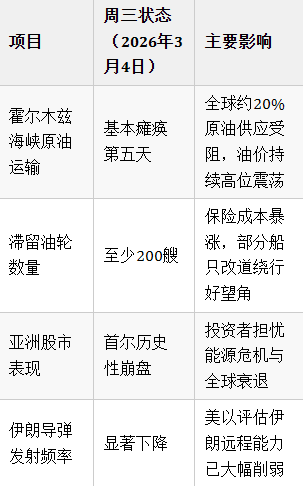
The US-Iran war was characterized by the expansion of battlefields on multiple fronts: US submarines sank Iranian ships at long range, NATO intercepted Iranian missile attacks on member states for the first time, the Revolutionary Guard's power was decentralized to enhance its resilience, and Mojtaba's succession prospects became clear.
The conflict is unlikely to end quickly in the short term, and the continued closure of the Strait of Hormuz and disruptions to the global energy supply chain have already triggered sharp market volatility. Future developments depend on the direction of Iran's new leadership, the degree of restraint in the actions of the Revolutionary Guard's grassroots units, and whether the US and Israel will further expand their offensive. While the events in Turkey have not triggered NATO Article 5, they have significantly increased the risk of spillover effects into the region.
Question 1: Why did a US submarine sink an Iranian warship near Sri Lanka?
Answer: The USS IRIS Dena was en route from eastern India back to Iran in international waters. U.S. Central Command considered it part of a potential Iranian naval threat, and the sinking was intended to weaken Iran's sea-projection capabilities and expand its deterrent range. This was the first time a U.S. submarine had conducted such a mission in the Indian Ocean since World War II, demonstrating that the U.S. military had extended its operational radius to thousands of kilometers, aiming to cut off potential Iranian supply or evacuation routes.
Question 2: Will Iran's missile launch at Türkiye trigger NATO's collective defense?
Answer: Not at present. US Defense Secretary Hergsays has explicitly stated that there are no indications of triggering Article 5. NATO collective defense requires confirmation of an "armed attack," while the interception of a single missile without causing substantial damage might be considered a limited provocation rather than a full-scale invasion. Turkey possesses the second-largest military in NATO, but Ankara has so far exercised restraint and has not requested the activation of Article 5, reflecting its unwillingness to escalate the conflict into a full-blown NATO-Iran confrontation.
Question 3: What are the risks and advantages of the Revolutionary Guard's strategy of decentralizing power?
Answer: The advantage lies in enhanced organizational resilience, enabling the organization to maintain operational readiness and internal control even if high-ranking officers are "decapitated," a lesson learned from the 2003 Iraq War. The risk lies in granting greater autonomy to lower-ranking commanders, potentially leading to miscalculations, overreactions, or unintentional expansion of the front lines. In the long term, continued high-level losses will test strategic cohesion, but current external pressures have actually strengthened internal unity within the Guard.
Question 4: What are the chances of Mojtaba Khamenei being elected Supreme Leader?
Answer: Extremely high. He controls security forces and a vast business empire, maintains close ties with the Revolutionary Guard, and enjoys support from hardliners at the grassroots level. His absence from Tehran at the time of the attack also averted direct risk. The expert panel has finalized its candidate list, which is expected to be announced soon. If elected, he will continue the hardline confrontational approach, reducing the likelihood of a ceasefire in the short term. Israel has publicly threatened to hunt down the new leader, increasing uncertainty during the transition period.
Question 5: What are the most direct impacts of the current conflict on global energy and financial markets?
Answer: The Strait of Hormuz's paralysis disrupted 20% of global oil shipping, leaving at least 200 ships stranded. War risk insurance premiums skyrocketed, and some operators diverted their routes to the Cape of Good Hope, adding two weeks to the journey. High oil prices fueled inflation expectations, leading to a historic collapse in Asian stock markets, particularly in Seoul. European markets briefly rebounded due to ceasefire rumors, but Iran denied these reports, leaving market sentiment extremely fragile. Trump's insurance and escort promises have not effectively alleviated the pressure on stranded ships, and the risk of an energy crisis remains high in the short term.
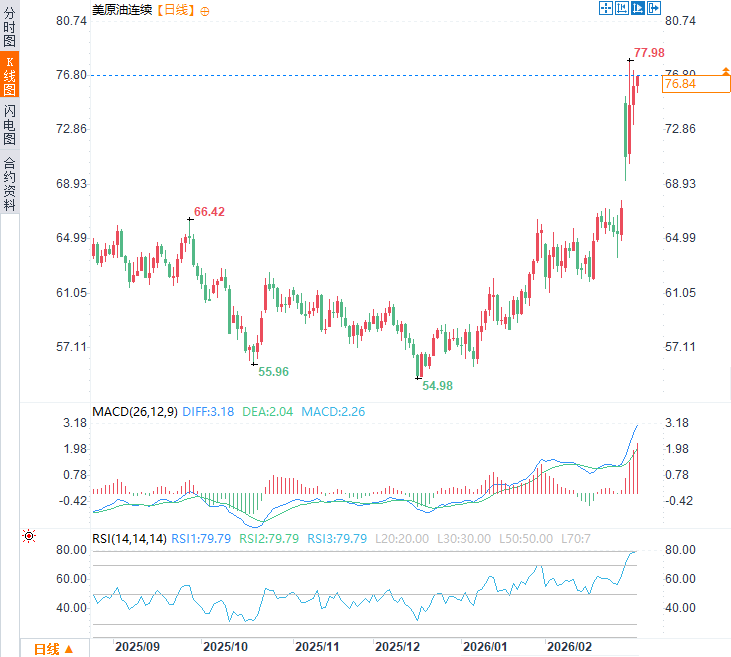
(US crude oil daily chart, source: FX678)
At 9:37 Beijing time, US crude oil futures were trading at $76.52 per barrel.
U.S. Defense Secretary Hergsays stated in a Pentagon briefing that the U.S. military holds a clear advantage, adding that "this war was destined to be unfair from the start," and emphasizing that the U.S. can sustain high-intensity operations for an extended period as needed. Chairman of the Joint Chiefs of Staff Kane pointed out that the number of Iranian missile launches has decreased significantly, indicating a severe weakening of its long-range strike capabilities.
The Strait of Hormuz's disruption has caused 20% of global oil shipping to be interrupted, leaving at least 200 ships stranded. War risk premiums have surged, and some operators are diverting their routes to the Cape of Good Hope, adding two weeks to the journey. High oil prices are pushing up inflation expectations. During Thursday's Asian trading session, US crude oil prices fluctuated upwards, currently trading around $76.60 per barrel, a daily increase of approximately 2.6%.
US submarine sinks Iranian warship
U.S. Central Command confirmed on Wednesday that a U.S. submarine torpedoed and sank the Iranian Navy frigate IRIS Dena. The ship was en route from eastern India to Iran and was in international waters near the southern coast of Sri Lanka. Sri Lankan authorities reported that 32 survivors had been rescued and 87 bodies recovered, with approximately 60 people still missing, bringing the total death toll to at least 80.
Hegsays stated, "An Iranian warship that thought it was safe was silently sunk." Central Command data shows that the U.S. military has struck or sunk more than 20 Iranian ships. This is the first time since World War II that U.S. submarines have carried out such a mission in such distant waters, highlighting the extreme expansion of the geographical scope of the conflict.
NATO air defense systems intercept Iranian missiles
Turkish authorities in Ankara announced that NATO's air defense system successfully intercepted and destroyed a ballistic missile launched from Iran and heading towards Turkey. This marks the first time Iran has directly attacked the territory of a NATO member state. US Defense Secretary Hergsays stated explicitly that there is currently no indication that the incident will trigger NATO's Article 5 Collective Defense Clause.
The Iranian Revolutionary Guard had previously delegated some attack decision-making authority to mid-level commanders, and this missile launch may have originated from a grassroots-level independent action, increasing the risk of miscalculation and spillover of conflict.
Iran's Revolutionary Guard's Decentralization of Power and Hardline Stance
Despite the deaths of several senior commanders in the US-Israeli airstrikes, the Iranian Revolutionary Guard has strengthened wartime control and pursued a more assertive regional confrontation strategy. A senior source revealed on Wednesday that the Guard had completed a decentralization mechanism before the US-Israeli operations began, ensuring that lower-level units could still operate independently should the chain of command break. This strategy stems from the lessons learned from the rapid collapse of Saddam Hussein's army during the 2003 Iraq War.
Kasra Aarabi, research director at United Against Nuclear Iran, noted, "If the conflict were to suddenly end and the regime were to continue, the Revolutionary Guard would play an even more central role." He emphasized that while decentralized power enhances organizational resilience, it could also lead to strategic miscalculations or a larger-scale regional war. Currently, although factional divisions exist within the Guard, it has demonstrated unprecedented unity in the face of external attacks.
Analysis of the prospects for Morjetaba Khamenei's succession
Following the assassination of Iran's Supreme Leader Ayatollah Khamenei, his son Mojtaba Khamenei has become the leading candidate to succeed him. Two Iranian sources confirmed that Mojtaba was not in Tehran when Khamenei was attacked. The Council of Experts has finalized its list of candidates and stated that a decision will be announced soon. This is the second Supreme Leader selection since 1979.
Mojtaba controls a vast business empire and security forces, maintains close ties with the Revolutionary Guard, and enjoys widespread support from hardliners at the grassroots level. If elected, he is expected to continue the hardline approach. The Israeli military has publicly stated that it will pursue any newly elected Supreme Leader.
Latest Impacts on Global Markets and Energy Shipping
Shipping in the Strait of Hormuz has been paralyzed for five days, with at least 200 ships stranded in the waters. Trump promised insurance and naval escorts, but market confidence remained weak. Asian stock markets plummeted, with Seoul experiencing a historic crash; European markets recovered slightly after two days of heavy losses, buoyed by reports that Iran had contacted the CIA to discuss a ceasefire (which Iranian officials dismissed as a "psychological warfare lie").
Editor's Summary
The US-Iran war was characterized by the expansion of battlefields on multiple fronts: US submarines sank Iranian ships at long range, NATO intercepted Iranian missile attacks on member states for the first time, the Revolutionary Guard's power was decentralized to enhance its resilience, and Mojtaba's succession prospects became clear.
The conflict is unlikely to end quickly in the short term, and the continued closure of the Strait of Hormuz and disruptions to the global energy supply chain have already triggered sharp market volatility. Future developments depend on the direction of Iran's new leadership, the degree of restraint in the actions of the Revolutionary Guard's grassroots units, and whether the US and Israel will further expand their offensive. While the events in Turkey have not triggered NATO Article 5, they have significantly increased the risk of spillover effects into the region.
Frequently Asked Questions
Question 1: Why did a US submarine sink an Iranian warship near Sri Lanka?
Answer: The USS IRIS Dena was en route from eastern India back to Iran in international waters. U.S. Central Command considered it part of a potential Iranian naval threat, and the sinking was intended to weaken Iran's sea-projection capabilities and expand its deterrent range. This was the first time a U.S. submarine had conducted such a mission in the Indian Ocean since World War II, demonstrating that the U.S. military had extended its operational radius to thousands of kilometers, aiming to cut off potential Iranian supply or evacuation routes.
Question 2: Will Iran's missile launch at Türkiye trigger NATO's collective defense?
Answer: Not at present. US Defense Secretary Hergsays has explicitly stated that there are no indications of triggering Article 5. NATO collective defense requires confirmation of an "armed attack," while the interception of a single missile without causing substantial damage might be considered a limited provocation rather than a full-scale invasion. Turkey possesses the second-largest military in NATO, but Ankara has so far exercised restraint and has not requested the activation of Article 5, reflecting its unwillingness to escalate the conflict into a full-blown NATO-Iran confrontation.
Question 3: What are the risks and advantages of the Revolutionary Guard's strategy of decentralizing power?
Answer: The advantage lies in enhanced organizational resilience, enabling the organization to maintain operational readiness and internal control even if high-ranking officers are "decapitated," a lesson learned from the 2003 Iraq War. The risk lies in granting greater autonomy to lower-ranking commanders, potentially leading to miscalculations, overreactions, or unintentional expansion of the front lines. In the long term, continued high-level losses will test strategic cohesion, but current external pressures have actually strengthened internal unity within the Guard.
Question 4: What are the chances of Mojtaba Khamenei being elected Supreme Leader?
Answer: Extremely high. He controls security forces and a vast business empire, maintains close ties with the Revolutionary Guard, and enjoys support from hardliners at the grassroots level. His absence from Tehran at the time of the attack also averted direct risk. The expert panel has finalized its candidate list, which is expected to be announced soon. If elected, he will continue the hardline confrontational approach, reducing the likelihood of a ceasefire in the short term. Israel has publicly threatened to hunt down the new leader, increasing uncertainty during the transition period.
Question 5: What are the most direct impacts of the current conflict on global energy and financial markets?
Answer: The Strait of Hormuz's paralysis disrupted 20% of global oil shipping, leaving at least 200 ships stranded. War risk insurance premiums skyrocketed, and some operators diverted their routes to the Cape of Good Hope, adding two weeks to the journey. High oil prices fueled inflation expectations, leading to a historic collapse in Asian stock markets, particularly in Seoul. European markets briefly rebounded due to ceasefire rumors, but Iran denied these reports, leaving market sentiment extremely fragile. Trump's insurance and escort promises have not effectively alleviated the pressure on stranded ships, and the risk of an energy crisis remains high in the short term.
(US crude oil daily chart, source: FX678)
At 9:37 Beijing time, US crude oil futures were trading at $76.52 per barrel.
- Risk Warning and Disclaimer
- The market involves risk, and trading may not be suitable for all investors. This article is for reference only and does not constitute personal investment advice, nor does it take into account certain users’ specific investment objectives, financial situation, or other needs. Any investment decisions made based on this information are at your own risk.