US-Iran conflict + inflation rebound: Why did the USD/JPY 157 level suddenly become a rock-solid support?
2026-03-05 16:57:25
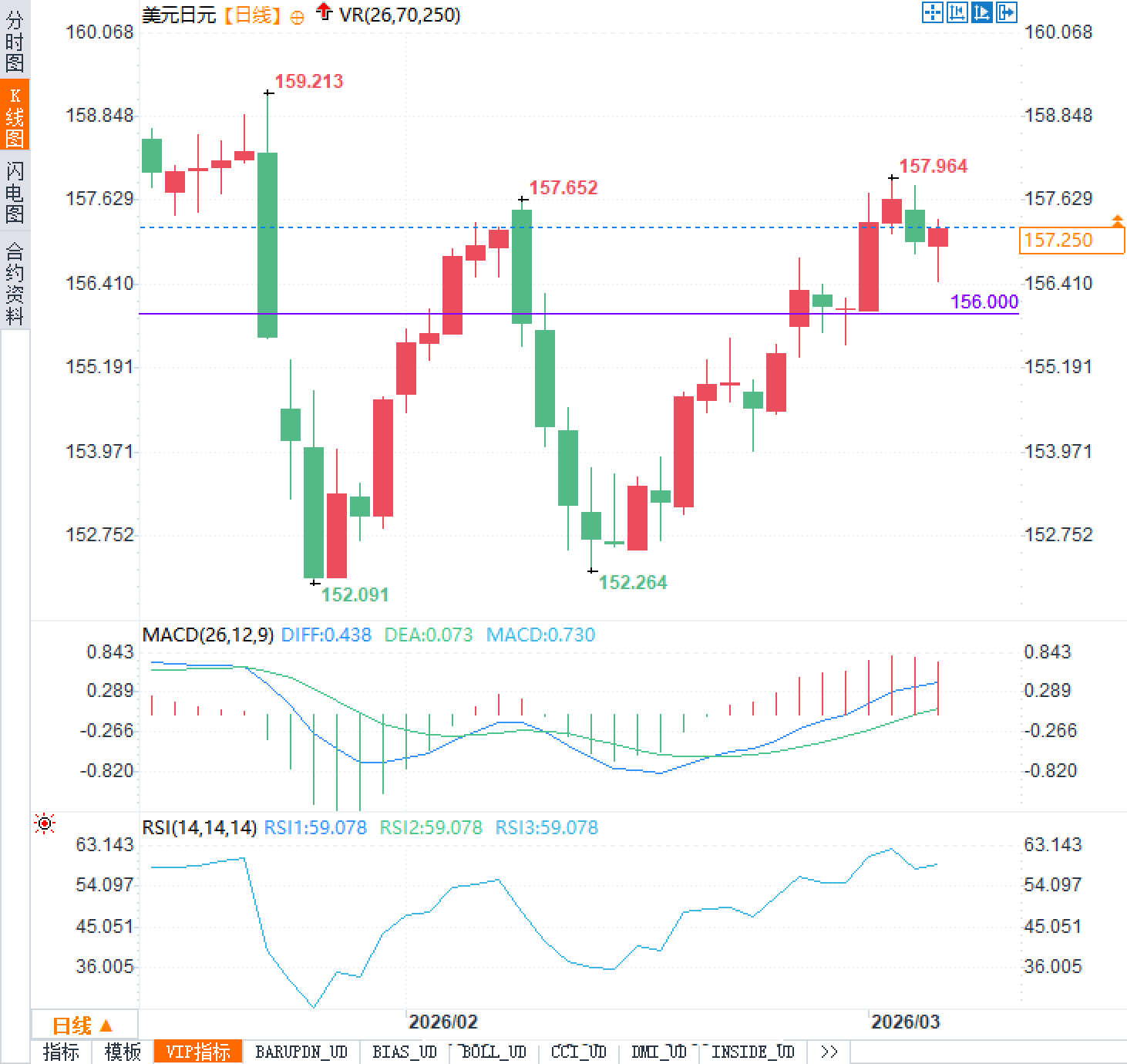
On Thursday, March 5th, the USD/JPY pair traded around 157.25 during the European session. After retracing from the previous high of 159.213, it quickly found support at the trendline and rebounded. The current market context is clear: escalating geopolitical tensions between the US and Iran triggered safe-haven inflows into the US dollar, leading to a significant reduction in market expectations for a Fed rate cut this year; in Japan, the latest consumer price index rose by 1.5% year-on-year, falling below the Bank of Japan's 2% inflation target, further delaying expectations of a rate hike. With both fundamental and technical factors converging, the USD/JPY exchange rate is showing a distinct divergence.

The USD/JPY exchange rate recently retreated from its highs to near the trendline before quickly stabilizing and rebounding, currently trading around 157.25. Technically, the MACD indicator remains positive, with the histogram showing a gradual recovery in momentum, while the RSI fluctuates around 59, indicating that buying interest remains strong. However, fundamental factors are more crucial. Signs of renewed acceleration in the US economy and escalating geopolitical risks are jointly boosting the dollar's safe-haven appeal, while the yen continues to face pressure due to differing interest rate expectations.
US nonfarm payrolls increased by 130,000 in January, exceeding market expectations, while the unemployment rate remained stable at 4.3%, indicating a resilient labor market and a recovery in economic growth. Coupled with the US-Iran conflict pushing up oil prices, this factor will be transmitted to overall inflation through energy costs, creating upward pressure. As a result, the market is repricing the Federal Reserve's policy path, with expectations for a total rate cut this year falling from 58 basis points last Friday to around 41 basis points, providing direct support for the US dollar index.
The following is a comparison of changes in the Fed's interest rate cut expectations this year:
Comparison of Fed rate cut expectations this year
|Period|Expected Interest Rate Cut Basis Points|
|---|---|
|Last Friday|58|
|Current|41|
This adjustment in expectations amplified the interest rate differential between the US dollar and other low-interest currencies, directly supporting the strong performance of the US dollar against the Japanese yen .
The waning expectations of a Federal Reserve rate cut are the core driver of the current dollar strength. The market initially believed that a slowdown in the US economy would prompt the Fed to accelerate its easing measures, but a series of recent data indicate robust economic growth. Stronger-than-expected non-farm payrolls in January, coupled with sticky inflation due to rising oil prices caused by geopolitical conflicts, have made Fed policymakers highly cautious about cutting rates too quickly. Higher oil prices not only push up the consumer price index but could also affect business costs through the supply chain, further solidifying inflation expectations.
In this environment, safe-haven funds shifted from risky assets to dollar-denominated assets, creating a positive cycle. In contrast, while low-interest-rate currencies still retain their financing attributes, the widening yield gap has reduced their relative attractiveness. The USD/JPY exchange rate thus benefits from two supports: first, expectations of a tightening Federal Reserve policy path; and second, US economic data confirming its resilience.
This shift also reflects the growing divergence in global monetary policy. The Federal Reserve may maintain higher interest rates for an extended period, while other major economies face different pressures, with the US dollar holding a clear advantage in this divergence.
In Japan, the latest January consumer price index rose only 1.5% year-on-year, a significant drop from 2.1% in the previous month, and fell below the Bank of Japan's 2% inflation target. This data directly undermined market confidence in further tightening of policy by the Bank of Japan. Prime Minister Sanae Takaichi's opposition and related economic indicators have failed to provide sufficient support for an interest rate hike.
The market is currently pricing in the earliest possible interest rate hike by the Bank of Japan (BOJ) in June, and expectations of two rate hikes this year may be overly optimistic. The BOJ's current benchmark interest rate remains at 0.75%, but the failure to meet its inflation target means that the policy normalization process will be more cautious. The low-inflation environment has weakened the yen's attractiveness as a funding currency and also limited the potential for a recovery in domestic consumption and investment.
The following is a comparison of recent year-on-year data for Japan's Consumer Price Index:
Japan's Consumer Price Index (CPI) year-on-year data
|Month|Increase|
|---|---|
|December 2025|2.1%|
|January 2026|1.5%|
There is disagreement within the Bank of Japan regarding the timing of interest rate hikes. While some members have proposed raising rates, the overall decision-making process leans towards observing more data. Rising oil prices may push up inflation expectations in the short term, but in the long term, they will put pressure on Japan's import-dependent economy, further dragging down the yen's performance. The USD/JPY exchange rate has therefore continued to receive support amid this policy divergence.
The current USD/JPY exchange rate reflects a typical interaction between global monetary policy divergence and geopolitical risks. The combination of adjusted Federal Reserve policy expectations and weak Japanese data has shaped a pattern of a strong dollar and a pressured yen. Going forward, continued attention should be paid to US employment and inflation data, as well as signals from the Bank of Japan's meeting, to understand whether this divergence will continue.
Technical and Fundamental Analysis of the USD/JPY Exchange Rate Movement
The USD/JPY exchange rate recently retreated from its highs to near the trendline before quickly stabilizing and rebounding, currently trading around 157.25. Technically, the MACD indicator remains positive, with the histogram showing a gradual recovery in momentum, while the RSI fluctuates around 59, indicating that buying interest remains strong. However, fundamental factors are more crucial. Signs of renewed acceleration in the US economy and escalating geopolitical risks are jointly boosting the dollar's safe-haven appeal, while the yen continues to face pressure due to differing interest rate expectations.
US nonfarm payrolls increased by 130,000 in January, exceeding market expectations, while the unemployment rate remained stable at 4.3%, indicating a resilient labor market and a recovery in economic growth. Coupled with the US-Iran conflict pushing up oil prices, this factor will be transmitted to overall inflation through energy costs, creating upward pressure. As a result, the market is repricing the Federal Reserve's policy path, with expectations for a total rate cut this year falling from 58 basis points last Friday to around 41 basis points, providing direct support for the US dollar index.
The following is a comparison of changes in the Fed's interest rate cut expectations this year:
Comparison of Fed rate cut expectations this year
|Period|Expected Interest Rate Cut Basis Points|
|---|---|
|Last Friday|58|
|Current|41|
This adjustment in expectations amplified the interest rate differential between the US dollar and other low-interest currencies, directly supporting the strong performance of the US dollar against the Japanese yen .
The profound macroeconomic impact of the Fed's shift in policy expectations
The waning expectations of a Federal Reserve rate cut are the core driver of the current dollar strength. The market initially believed that a slowdown in the US economy would prompt the Fed to accelerate its easing measures, but a series of recent data indicate robust economic growth. Stronger-than-expected non-farm payrolls in January, coupled with sticky inflation due to rising oil prices caused by geopolitical conflicts, have made Fed policymakers highly cautious about cutting rates too quickly. Higher oil prices not only push up the consumer price index but could also affect business costs through the supply chain, further solidifying inflation expectations.
In this environment, safe-haven funds shifted from risky assets to dollar-denominated assets, creating a positive cycle. In contrast, while low-interest-rate currencies still retain their financing attributes, the widening yield gap has reduced their relative attractiveness. The USD/JPY exchange rate thus benefits from two supports: first, expectations of a tightening Federal Reserve policy path; and second, US economic data confirming its resilience.
This shift also reflects the growing divergence in global monetary policy. The Federal Reserve may maintain higher interest rates for an extended period, while other major economies face different pressures, with the US dollar holding a clear advantage in this divergence.
Analysis of Weak Japanese Economic Data and the Prospects for Interest Rate Hikes by the Bank of Japan
In Japan, the latest January consumer price index rose only 1.5% year-on-year, a significant drop from 2.1% in the previous month, and fell below the Bank of Japan's 2% inflation target. This data directly undermined market confidence in further tightening of policy by the Bank of Japan. Prime Minister Sanae Takaichi's opposition and related economic indicators have failed to provide sufficient support for an interest rate hike.
The market is currently pricing in the earliest possible interest rate hike by the Bank of Japan (BOJ) in June, and expectations of two rate hikes this year may be overly optimistic. The BOJ's current benchmark interest rate remains at 0.75%, but the failure to meet its inflation target means that the policy normalization process will be more cautious. The low-inflation environment has weakened the yen's attractiveness as a funding currency and also limited the potential for a recovery in domestic consumption and investment.
The following is a comparison of recent year-on-year data for Japan's Consumer Price Index:
Japan's Consumer Price Index (CPI) year-on-year data
|Month|Increase|
|---|---|
|December 2025|2.1%|
|January 2026|1.5%|
There is disagreement within the Bank of Japan regarding the timing of interest rate hikes. While some members have proposed raising rates, the overall decision-making process leans towards observing more data. Rising oil prices may push up inflation expectations in the short term, but in the long term, they will put pressure on Japan's import-dependent economy, further dragging down the yen's performance. The USD/JPY exchange rate has therefore continued to receive support amid this policy divergence.
Frequently Asked Questions
Question 1: Why is the USD/JPY pair maintaining a bullish bias around 157?
A: This is mainly due to the widening divergence in policy expectations between the Federal Reserve and the Bank of Japan. Strong US economic data, better-than-expected non-farm payrolls, and rising oil prices due to the US-Iran conflict leading to increased inflationary pressures have caused the market to revise its expectation of a Fed rate cut this year down from 58 basis points to around 41 basis points, boosting the US dollar. Meanwhile, Japan's January consumer price index was only 1.5% year-on-year, below the 2% target, and the Bank of Japan has postponed its rate hike to at least June, with the expectation of two rate hikes this year being viewed optimistically, putting pressure on the yen. This fundamental divergence, coupled with technical trendline support, has jointly maintained a bullish outlook for USD/JPY .
Question 2: What specific impact will the latest Japanese inflation data have on the Bank of Japan's policy?
A: The January CPI rose 1.5% year-on-year, far below the target level, directly weakening the basis for the Bank of Japan to raise interest rates. Currently, the Bank of Japan's interest rate is 0.75%, and the market had initially expected a faster normalization. However, the data showed weak domestic demand and poor inflation transmission, and Prime Minister Sanae Takashi's opposition further increased uncertainty. As a result, expectations of a rate hike were delayed, the interest rate differential advantage continued to favor the US dollar, putting pressure on the yen's exchange rate.
Question 3: How does the US-Iran conflict indirectly support the USD/JPY exchange rate?
A: Escalating conflict has triggered risk aversion, leading to capital inflows into dollar assets. Simultaneously, rising oil prices will boost US inflation expectations, prompting the Federal Reserve to slow its pace of interest rate cuts. Signs of renewed acceleration in the US economy (130,000 new non-farm payrolls) combined with this factor create a double boost for the dollar. Japan, as an energy importer, faces additional cost pressures. While inflation may rise in the short term, its overall economic resilience is insufficient, exacerbating the weakness of the yen.
The current USD/JPY exchange rate reflects a typical interaction between global monetary policy divergence and geopolitical risks. The combination of adjusted Federal Reserve policy expectations and weak Japanese data has shaped a pattern of a strong dollar and a pressured yen. Going forward, continued attention should be paid to US employment and inflation data, as well as signals from the Bank of Japan's meeting, to understand whether this divergence will continue.
- Risk Warning and Disclaimer
- The market involves risk, and trading may not be suitable for all investors. This article is for reference only and does not constitute personal investment advice, nor does it take into account certain users’ specific investment objectives, financial situation, or other needs. Any investment decisions made based on this information are at your own risk.