The Mystery Behind Falling Oil Prices: The Butterfly Effect of a Single Statement by Iran's Deputy Foreign Minister
2026-03-05 17:58:17
On Thursday, March 5th, the international crude oil market was once again in the spotlight. Brent crude oil prices traded around $82.50 per barrel during the European session. This level represents a pullback from previous highs, primarily influenced by the latest statements from Iran. Reports indicate that Iran's Deputy Foreign Minister stated that Iran is prepared to abandon its nuclear program if the United States offers a satisfactory alternative. This development was interpreted by the market as a sign of potential easing tensions in the Middle East, leading to a weakening of crude oil futures prices and a related reaction in related assets.
Previously, oil prices had been significantly priced in with a geopolitical risk premium due to concerns about regional conflicts, leading to sharp price fluctuations in the short term. However, this new signal quickly changed market sentiment.
Geopolitical factors have consistently been a major driver of crude oil price fluctuations. As a significant oil producer, Iran's progress in nuclear negotiations often directly impacts global supply expectations. Historically, under similar nuclear agreements, Iranian oil exports have seen a marked rebound. If current signals evolve into an actual agreement, the United States may adjust its sanctions policy accordingly, thereby releasing more Iranian crude oil into the international market.
While Iran's oil exports remain at a certain level, sanctions limit its full production and sales potential. Once these restrictions are eased, global crude oil supply will face additional pressure. This, coupled with the production policies of OPEC and its allies, creates a synergistic effect. Traders are watching for further diplomatic developments, as any substantial breakthrough could accelerate the fading of risk premiums. The recent price correction from the high of $84.72 reflects the market's rapid pricing in expectations of easing tensions. Some analysts suggest that the risk premium could fluctuate by more than $10 per barrel, depending on the depth of negotiations. Furthermore, the reduced risk of passage through the Strait of Hormuz, a key shipping route, will further stabilize supply chain expectations. Overall, continued geopolitical easing will inject more supply certainty into the crude oil market, limiting upside potential for prices.
The chart shows that Brent crude oil is exhibiting a clear correction trend on the 10-minute chart. In the MACD indicator, the DIFF value is -0.28, the DEA value is -0.07, and the MACD histogram is -0.42, all in negative territory, indicating that short-term momentum remains bearish. The RSI (14) reading is 35.04, relatively low, suggesting the market may be entering oversold territory, but the strength of the rebound needs to be confirmed by trading volume and subsequent candlestick patterns.
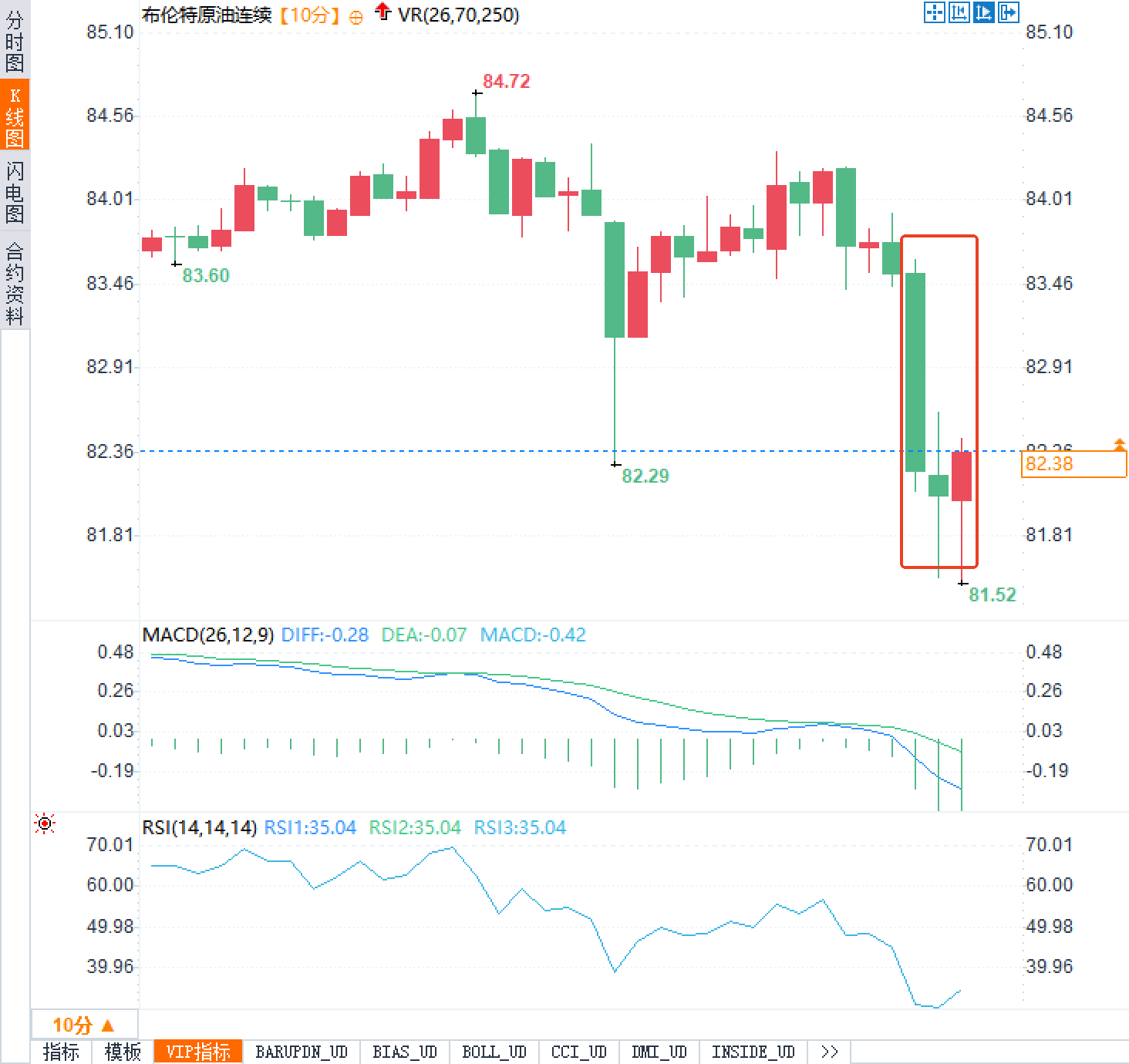
In terms of price movement, after recently reaching a high of $84.72, a continuous correction ensued, with the lowest point reaching around $81.52. The following is a comparison of key technical levels:
These indicators collectively reflect that, stimulated by geopolitical news, market sentiment has shifted from panic to a wait-and-see approach. If prices hold above the $82 level, a short-term technical rebound may occur; conversely, a break below could test lower support levels. Combined with volatility indicators, short-term market uncertainty remains, but signs of easing have significantly reduced the probability of extreme volatility.
On the supply side, according to the latest meeting information, OPEC and its partners suspended their production increase plans in the first quarter of 2026, and the recent meeting maintained this decision, without immediately resuming additional production. This cautious strategy reflects the importance major producers place on avoiding oversupply. High levels of US crude oil production provide an important buffer for global supply. Latest inventory data shows a recent increase in US commercial crude oil inventories, further alleviating market concerns about supply shortages.
On the demand side, global economic growth is steady but shows no signs of overheating. Seasonal factors and energy transition trends also constrain long-term demand. In the current environment, if Iran's supply potential is unleashed, the market balance will tilt towards oversupply. In the long term, the price center may face downward adjustment pressure, but short-term fluctuations will still be dominated by diplomatic news.
In summary, Brent crude oil faces a combination of factors, with geopolitical easing and increased supply forming the upper limit for prices.
Previously, oil prices had been significantly priced in with a geopolitical risk premium due to concerns about regional conflicts, leading to sharp price fluctuations in the short term. However, this new signal quickly changed market sentiment.
Geopolitical factors have consistently been a major driver of crude oil price fluctuations. As a significant oil producer, Iran's progress in nuclear negotiations often directly impacts global supply expectations. Historically, under similar nuclear agreements, Iranian oil exports have seen a marked rebound. If current signals evolve into an actual agreement, the United States may adjust its sanctions policy accordingly, thereby releasing more Iranian crude oil into the international market.
While Iran's oil exports remain at a certain level, sanctions limit its full production and sales potential. Once these restrictions are eased, global crude oil supply will face additional pressure. This, coupled with the production policies of OPEC and its allies, creates a synergistic effect. Traders are watching for further diplomatic developments, as any substantial breakthrough could accelerate the fading of risk premiums. The recent price correction from the high of $84.72 reflects the market's rapid pricing in expectations of easing tensions. Some analysts suggest that the risk premium could fluctuate by more than $10 per barrel, depending on the depth of negotiations. Furthermore, the reduced risk of passage through the Strait of Hormuz, a key shipping route, will further stabilize supply chain expectations. Overall, continued geopolitical easing will inject more supply certainty into the crude oil market, limiting upside potential for prices.
Technical indicators reveal shifts in market sentiment.
The chart shows that Brent crude oil is exhibiting a clear correction trend on the 10-minute chart. In the MACD indicator, the DIFF value is -0.28, the DEA value is -0.07, and the MACD histogram is -0.42, all in negative territory, indicating that short-term momentum remains bearish. The RSI (14) reading is 35.04, relatively low, suggesting the market may be entering oversold territory, but the strength of the rebound needs to be confirmed by trading volume and subsequent candlestick patterns.
In terms of price movement, after recently reaching a high of $84.72, a continuous correction ensued, with the lowest point reaching around $81.52. The following is a comparison of key technical levels:
| technical level | Price (USD) | Potential significance |
|---|---|---|
| recent highs | 84.72 | Upward resistance |
| Current price | 82.50 | Observation position |
| Important support | 81.50 | Short-term bottom |
| Psychological barrier | 82.00 | Trend watershed |
These indicators collectively reflect that, stimulated by geopolitical news, market sentiment has shifted from panic to a wait-and-see approach. If prices hold above the $82 level, a short-term technical rebound may occur; conversely, a break below could test lower support levels. Combined with volatility indicators, short-term market uncertainty remains, but signs of easing have significantly reduced the probability of extreme volatility.
Global oil supply and demand fundamentals outlook
On the supply side, according to the latest meeting information, OPEC and its partners suspended their production increase plans in the first quarter of 2026, and the recent meeting maintained this decision, without immediately resuming additional production. This cautious strategy reflects the importance major producers place on avoiding oversupply. High levels of US crude oil production provide an important buffer for global supply. Latest inventory data shows a recent increase in US commercial crude oil inventories, further alleviating market concerns about supply shortages.
On the demand side, global economic growth is steady but shows no signs of overheating. Seasonal factors and energy transition trends also constrain long-term demand. In the current environment, if Iran's supply potential is unleashed, the market balance will tilt towards oversupply. In the long term, the price center may face downward adjustment pressure, but short-term fluctuations will still be dominated by diplomatic news.
In summary, Brent crude oil faces a combination of factors, with geopolitical easing and increased supply forming the upper limit for prices.
Frequently Asked Questions
Question 1: What is the direct impact of this Iranian statement on oil prices?
A: This statement reduced the geopolitical risk premium, causing oil prices to fall in the short term. Market reactions included rising stock markets and a weaker dollar, reflecting investor optimism about increased supply and easing tensions. Historically, similar developments have led to rapid price adjustments of several percentage points. While this signal did not immediately change the supply structure, it has injected clear expectations into the market, suppressing upward price momentum in the short term.
Question 2: How should current technical indicators guide market interpretation?
A: A negative MACD and low RSI indicate weakening momentum and an oversold condition. Combined with price adjustments, this suggests a possible short-term consolidation or a slight rebound, but confirmation signals are needed. The price action from the high of $84.72 to $82.50 in the chart corresponds to this technical environment.
Question 3: If the nuclear agreement proceeds, what is the long-term outlook for the crude oil market?
A: Increased supply will suppress prices. The combined effects of OPEC+ production policies may lead the market towards balance or even surplus, causing the price center to shift downwards. However, this depends on the actual recovery speed of exports and global demand. Supply growth is projected to exceed demand expansion in 2026, and inventory accumulation will further limit oil price potential. This outlook aligns with the current easing signals.
- Risk Warning and Disclaimer
- The market involves risk, and trading may not be suitable for all investors. This article is for reference only and does not constitute personal investment advice, nor does it take into account certain users’ specific investment objectives, financial situation, or other needs. Any investment decisions made based on this information are at your own risk.