Escalating conflict in the Middle East boosts safe-haven demand, causing gold prices to fluctuate upwards.
2026-03-05 18:19:07
Table of Contents
- The escalating conflict in the Middle East has driven up gold prices.
- Safe-haven demand drives gold price increase
- Escalation of Middle East conflict increases risk
- Federal Reserve Policy and Macroeconomic Data Variables
- Analysts have a long-term bullish outlook.
- Spot Gold 240-minute Technical Analysis
The escalating conflict in the Middle East has driven up gold prices.
Gold prices continued their strong upward trend on Thursday, primarily driven by the escalating conflict in the Middle East . Investors flocked to gold, a traditional safe-haven asset , while a weakening US dollar provided further support. According to real-time market data, spot gold prices recently touched a high above $5,400 per ounce, with a year-to-date gain approaching or exceeding 20%. This upward movement is not an isolated event, but a direct result of the sharp escalation of geopolitical uncertainty. The conflict has spread from localized confrontations to multi-national involvement, threatening energy infrastructure and simultaneously increasing global supply chain risks, leading to a significant decrease in market risk appetite. As a hard currency with no credit risk, gold 's safe-haven properties have been fully activated, accelerating capital inflows. In the short term, the conflict's impulse effect is evident, but if it evolves into a protracted regional war, it will further amplify the dual drivers of inflation and safe-haven demand, pushing gold prices to new highs.

Safe-haven demand drives gold price increase
The core driver of the strong gold price rally is the market's dominance of safe-haven demand . The dollar index has retreated from its three-month high earlier this week, making gold more attractive to non-dollar holders. Senior financial market analyst Kyle Rhoda explicitly pointed out that gold has directly benefited from the escalating geopolitical risks of the past few days. The rise in gold prices is partly a result of the return to normalcy in the financial environment and the dollar's pullback from its highs. As a classic safe-haven asset , gold continues to reach new highs amid heightened global political and economic uncertainty. Data from multiple institutions shows strong central bank gold purchases, providing solid long-term support for gold prices . Spot gold rose 0.32% to $5157.67 per ounce on Thursday, while US gold futures rose 0.66% to $5168.4 per ounce, with a significant acceleration in safe-haven inflows. This phenomenon reflects the market's strong preference for traditional safe-haven assets in an uncertain environment.
Escalation of Middle East conflict increases risk
The escalation of the Middle East conflict has significantly increased geopolitical risks. On Wednesday, the conflict between the US and Iran escalated sharply: a US submarine sank an Iranian warship near Sri Lanka, killing at least 80 people, and NATO air defense systems destroyed an Iranian ballistic missile fired at Turkey. This incident comes as the powerful son of Iran's late Supreme Leader has emerged as a leading candidate for succession, indicating that Tehran will not easily yield. Five days earlier, US-Israeli military action had already resulted in hundreds of deaths, triggering global market turmoil. FXStreet and Investing.com analysts point out that the conflict has entered its sixth day, with multiple rounds of US and Israeli strikes on Iranian territory prompting retaliatory missile and drone attacks from Iran. Coupled with threats to energy infrastructure, market concerns about a protracted regional war have intensified sharply. JPMorgan analysts emphasize that while geopolitical conflicts bring short-term, impulsive volatility, broad geopolitical risks will continue to support gold prices , maintaining a target price of $6,300 by the end of 2026 (potentially as high as $8,500 in the base case scenario). TD Securities analysts add that gold will benefit from geopolitical instability, reduced risk appetite, and inflation concerns stemming from soaring energy costs.
Federal Reserve Policy and Macroeconomic Data Variables
Federal Reserve policy and macroeconomic data have become key variables influencing gold prices . US President Trump's formal nomination of former Federal Reserve Governor Kevin Warsh as the next Fed Chair is seen as a step towards appointing a chairman inclined towards interest rate cuts. However, the oil price surge triggered by the conflict has reignited inflation concerns, leading to adjustments in market expectations for Fed policy. According to the CME FedWatch Tool, the probability of keeping interest rates unchanged at the March 18 meeting is extremely high. Investors are closely watching the US weekly initial jobless claims data to be released later today, as well as Friday's February jobs report. The Middle East conflict has pushed up oil prices, significantly reducing the probability of a Fed rate cut in June, increasing the likelihood of short-term gold price volatility. The US dollar index fell slightly by 0.3%, further supporting gold . The dynamic interplay between macroeconomic data and policy expectations will directly determine the short-term trend.
Analysts have a long-term bullish outlook.
Analysts generally maintain a long-term bullish outlook. Rhoda believes the crisis will support gold prices in the long run. However, the uncertainty surrounding the war's prospects means the market will continue to face significant volatility until signs of the conflict reaching their peak. Zaner Metals strategist Peter Grant points out that as long as the war with Iran continues, the macroeconomic fundamentals for gold remain broadly favorable, maintaining a bullish outlook and predicting new historical highs. Institutions such as BNP Paribas have also raised their 2026 target prices, generally maintaining an optimistic outlook. Despite the risk of a pullback, analysts recommend investors buy gold on dips during periods of volatility as an effective hedge against inflation and geopolitical risks. Future gold price movements will depend on the evolution of the conflict, actual Federal Reserve policies, and global economic data. Overall, the Middle East conflict provides strong safe-haven support for gold prices , while uncertainty surrounding Federal Reserve policies and macroeconomic data will determine the short-term pace.
Spot Gold 240-minute Technical Analysis
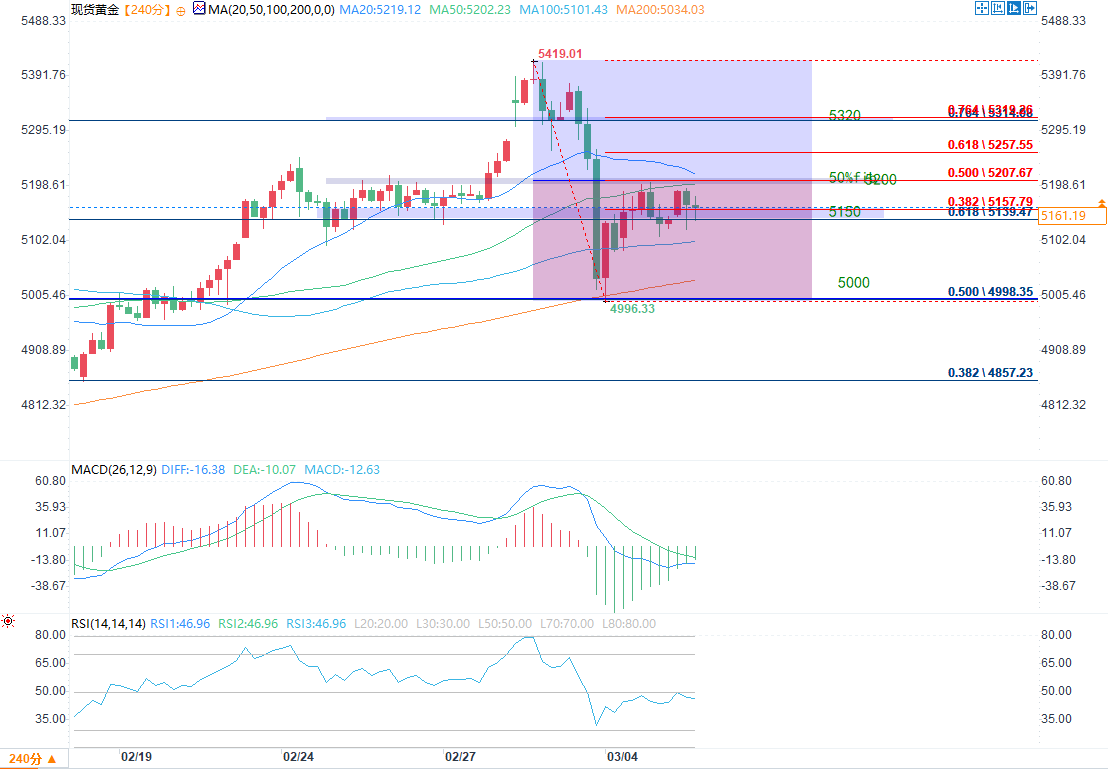
(4-hour chart of spot gold source: EasyForex)
The 240-minute chart for spot gold clearly shows a battle between bulls and bears. Following the escalation of the conflict with Iran, gold prices initially surged to $5419.01 per ounce, but profit-taking and a stronger dollar pushed prices down rapidly, reaching a low of $4996.33 per ounce, briefly breaking below the psychological level of $5000. Looking at the rebound structure, gold prices have consistently traded below the medium-term moving averages, indicating insufficient bullish momentum. Key levels are currently clear: the resistance level around $5200 is a dense area of the 20-period moving average, the 50-period moving average, and the 50% Fibonacci retracement level, forming extremely strong technical resistance; the $5150-$5200 range is the core watershed where bulls and bears repeatedly contend. The MACD indicator's DIFF and DEA lines remain below the zero line, with negative histogram bars, indicating short-term bearish dominance; the RSI reading of 47.30 is at a slightly weak to neutral level. The non-farm payroll data will be key to breaking the deadlock: strong data could see gold prices test support below $5,000; weak data or increased risk aversion could see prices break through $5,200 and challenge previous highs. Currently, gold prices are consolidating within the key $5,150-$5,200 range, and investors should closely monitor the non-farm payroll data and the $5,200 resistance level.
Frequently Asked Questions
Q: How do Middle East conflicts drive up gold prices?
A: The escalating conflict in the Middle East has directly exacerbated geopolitical risks, prompting investors to turn to gold as a traditional safe-haven asset, leading to a surge in demand. Simultaneously, the conflict has pushed up oil prices, triggering inflation concerns and further supporting gold prices. The article indicates that after six days of conflict, spot gold has reached above $5,400, with a year-to-date gain of nearly 20%, and JPMorgan Chase has even given a target price of $6,300 by the end of 2026.
Q: What are the key resistance and support levels in the current technical analysis?
A: On the 240-minute chart, $5200 is the core resistance level (where the 20-period, 50-period moving averages and the 50% Fibonacci retracement level converge), and the $5150-$5200 range is the dividing line between bulls and bears; support lies around $4996, and a strong non-farm payroll data could test even lower levels. The MACD is in a bearish alignment, and the RSI is neutral to weak, indicating short-term consolidation.
Q: What impact do Federal Reserve policies have on gold?
A: Trump's nomination of Walsh, who favors rate cuts, as chairman was initially positive for gold, but the conflict pushing up oil prices and reigniting inflation has made it highly likely that interest rates will remain unchanged in March and less likely that they will be cut in June. The dollar's slight decline of 0.3% provided support; future Fed policies and employment data will determine the short-term pace.
Q: Why has the central bank's demand for gold become a long-term support?
A: Data from multiple institutions shows that central bank gold purchases are robust, providing sustained buying support for gold amid heightened global uncertainty. This, along with geopolitical risks and a weakening dollar, constitutes a long-term positive factor. Even with short-term fluctuations, central bank demand ensures a solid bottom for gold prices.
Q: What should investors do now?
A: The long-term bullish trend remains unchanged. We recommend buying gold on dips during market fluctuations to hedge against inflation and geopolitical risks. In the short term, be wary of sharp fluctuations triggered by non-farm payroll data and developments in conflicts. Pay attention to a breakout signal at the $5200 resistance level and seize opportunities for swing trading.
- Risk Warning and Disclaimer
- The market involves risk, and trading may not be suitable for all investors. This article is for reference only and does not constitute personal investment advice, nor does it take into account certain users’ specific investment objectives, financial situation, or other needs. Any investment decisions made based on this information are at your own risk.