Why did gold prices rise despite the cooling Middle East? What forces are at play behind this?
2026-03-05 19:40:59
On Thursday, March 5th, during the Asian and European sessions, spot gold experienced a slight fluctuation after an initial rise. In the afternoon, there were clear signs of easing tensions in the Middle East conflict, market liquidity tensions quickly subsided, the US dollar index plunged, and gold rebounded rapidly by 40 points before maintaining a range-bound trading pattern, currently trading around 5162.
Israeli Transport Minister Miri Regev announced that Israel will reopen its airspace and resume outbound flights on March 8, with subsequent adjustments made dynamically based on the security situation. This is an important signal of stabilization in the region.
Iran subsequently released significant information regarding reconciliation. The Iranian Deputy Foreign Minister stated that Iran is willing to abandon its nuclear program if the United States provides a satisfactory alternative. The Islamic Republic News Agency of Iran also disclosed that Iran had prepared to clear its uranium stockpile in exchange for corresponding returns during negotiations. These consecutive statements directly cooled market risk aversion.
As the situation eased, crude oil prices plummeted. Brent crude oil retreated from its 15.8% surge this week, falling $2 to $82.30 per barrel, while Dutch TTF natural gas also gave back some of its gains. US stock index futures jumped in response, and market risk appetite recovered significantly.
Silver recovered half of the losses from the previous two days, with the London fixing price falling $3 after hitting a high of $86.80 per ounce.
The pause in the war-driven surge in long-term US Treasury yields led to a slight pullback in the US dollar index, erasing its previous 2.0% gain. The weakening dollar also provided some support for gold prices.
The World Gold Council, based on IMF data, pointed out that geopolitical risks are usually the core support for central banks' gold holdings, but the sharp fluctuations in gold prices in January led to a significant shift in official gold purchases.
Global central bank net gold purchases in January were only 5 tons, a new low since December 2024, and nearly 80% lower than the monthly average of 27 tons in 2025.
Gold prices fluctuated further in February, with prices continuing to fall from their highs at the beginning of the year.
According to calculations by the World Gold Council, central banks' actual gold purchases over the past decade have been nearly twice the amount reported by the IMF, reaching a post-World War II high. Since 2016, unreported gold purchases have accounted for nearly one-fifth of new mine production, indicating that the long-term trend of countries reducing their reliance on dollar reserves has not changed.
Russia and other countries have spoken out, pointing out that the so-called "rules-based international order" of the United States is actually a self-serving jungle law, and that the actions of the United States and Israel against Iran blatantly trample on international law and the norms of international relations.
Russia also condemned the actions of the US and Israel for disrupting the regional situation and issued a strong statement on the related policies of several European countries.
The US claims to have sunk an Iranian naval vessel in the Indian Ocean and that NATO's air defense system intercepted a missile fired at Turkey. However, key US allies Britain and France question the legitimacy of the military action against Iran, and Spain refuses to allow the US military to launch attacks from its bases, refusing to back down even in the face of trade threats. The divisions between the US and European camps have also left the regional situation uncertain.
As mentioned in previous articles, gold prices have risen sharply in this bull market and are highly sensitive to changes in market benchmark interest rates, exhibiting a correlation with technology stocks. Influenced by signals of easing tensions, European stocks, US stock index futures, and gold have all rebounded simultaneously. Going forward, attention will continue to be focused on whether the Iranian conflict and inflation will affect the policy shifts of central banks around the world. At the same time, we should keep an eye on the US dollar and US Treasury yields, as one determines the price of gold and the other determines the market benchmark interest rate.
From a technical perspective, spot gold is slowly climbing along the lower rail of an upward channel. Current resistance levels are at 5200 and the lower rail of the upward channel, while support remains at the key level of 5123. Gold prices are currently holding above this level. The ideal scenario for gold is for energy prices to remain largely unaffected while the war continues. However, the current situation is highly intertwined with the war between Israel, the US, and Iran, as well as energy issues such as the Strait of Hormuz, making this gold price increase a significant challenge. Gold is caught between escalating war and rising interest rates; only if the war escalates but interest rates remain stable can gold prices rise.
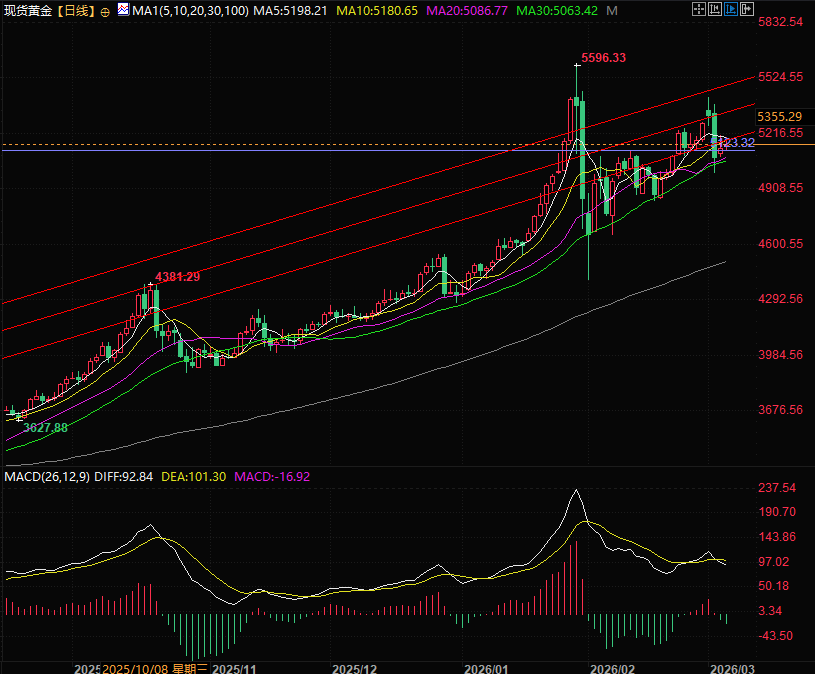
(Spot gold daily chart, source: FX678)
At 19:37 Beijing time, spot gold was trading at $5,161 per ounce.
The situation in the Middle East is showing signs of de-escalation, and risk aversion has quickly subsided.
Israeli Transport Minister Miri Regev announced that Israel will reopen its airspace and resume outbound flights on March 8, with subsequent adjustments made dynamically based on the security situation. This is an important signal of stabilization in the region.
Iran subsequently released significant information regarding reconciliation. The Iranian Deputy Foreign Minister stated that Iran is willing to abandon its nuclear program if the United States provides a satisfactory alternative. The Islamic Republic News Agency of Iran also disclosed that Iran had prepared to clear its uranium stockpile in exchange for corresponding returns during negotiations. These consecutive statements directly cooled market risk aversion.
Global asset correlation: Risk appetite rebounds, but asset performance diverges.
As the situation eased, crude oil prices plummeted. Brent crude oil retreated from its 15.8% surge this week, falling $2 to $82.30 per barrel, while Dutch TTF natural gas also gave back some of its gains. US stock index futures jumped in response, and market risk appetite recovered significantly.
Silver recovered half of the losses from the previous two days, with the London fixing price falling $3 after hitting a high of $86.80 per ounce.
The pause in the war-driven surge in long-term US Treasury yields led to a slight pullback in the US dollar index, erasing its previous 2.0% gain. The weakening dollar also provided some support for gold prices.
Central bank gold purchases have dropped sharply in the short term, but the long-term logic of de-dollarization remains unchanged.
The World Gold Council, based on IMF data, pointed out that geopolitical risks are usually the core support for central banks' gold holdings, but the sharp fluctuations in gold prices in January led to a significant shift in official gold purchases.
Global central bank net gold purchases in January were only 5 tons, a new low since December 2024, and nearly 80% lower than the monthly average of 27 tons in 2025.
Gold prices fluctuated further in February, with prices continuing to fall from their highs at the beginning of the year.
According to calculations by the World Gold Council, central banks' actual gold purchases over the past decade have been nearly twice the amount reported by the IMF, reaching a post-World War II high. Since 2016, unreported gold purchases have accounted for nearly one-fifth of new mine production, indicating that the long-term trend of countries reducing their reliance on dollar reserves has not changed.
The international public opinion divide remains unresolved and there are still potential variables.
Russia and other countries have spoken out, pointing out that the so-called "rules-based international order" of the United States is actually a self-serving jungle law, and that the actions of the United States and Israel against Iran blatantly trample on international law and the norms of international relations.
Russia also condemned the actions of the US and Israel for disrupting the regional situation and issued a strong statement on the related policies of several European countries.
The US claims to have sunk an Iranian naval vessel in the Indian Ocean and that NATO's air defense system intercepted a missile fired at Turkey. However, key US allies Britain and France question the legitimacy of the military action against Iran, and Spain refuses to allow the US military to launch attacks from its bases, refusing to back down even in the face of trade threats. The divisions between the US and European camps have also left the regional situation uncertain.
Summary and Technical Analysis:
As mentioned in previous articles, gold prices have risen sharply in this bull market and are highly sensitive to changes in market benchmark interest rates, exhibiting a correlation with technology stocks. Influenced by signals of easing tensions, European stocks, US stock index futures, and gold have all rebounded simultaneously. Going forward, attention will continue to be focused on whether the Iranian conflict and inflation will affect the policy shifts of central banks around the world. At the same time, we should keep an eye on the US dollar and US Treasury yields, as one determines the price of gold and the other determines the market benchmark interest rate.
From a technical perspective, spot gold is slowly climbing along the lower rail of an upward channel. Current resistance levels are at 5200 and the lower rail of the upward channel, while support remains at the key level of 5123. Gold prices are currently holding above this level. The ideal scenario for gold is for energy prices to remain largely unaffected while the war continues. However, the current situation is highly intertwined with the war between Israel, the US, and Iran, as well as energy issues such as the Strait of Hormuz, making this gold price increase a significant challenge. Gold is caught between escalating war and rising interest rates; only if the war escalates but interest rates remain stable can gold prices rise.
(Spot gold daily chart, source: FX678)
At 19:37 Beijing time, spot gold was trading at $5,161 per ounce.
- Risk Warning and Disclaimer
- The market involves risk, and trading may not be suitable for all investors. This article is for reference only and does not constitute personal investment advice, nor does it take into account certain users’ specific investment objectives, financial situation, or other needs. Any investment decisions made based on this information are at your own risk.