The situation in the Middle East has sparked supply concerns, causing aluminum prices to pull back after hitting a new high. What is the market waiting for?
2026-03-05 21:24:19
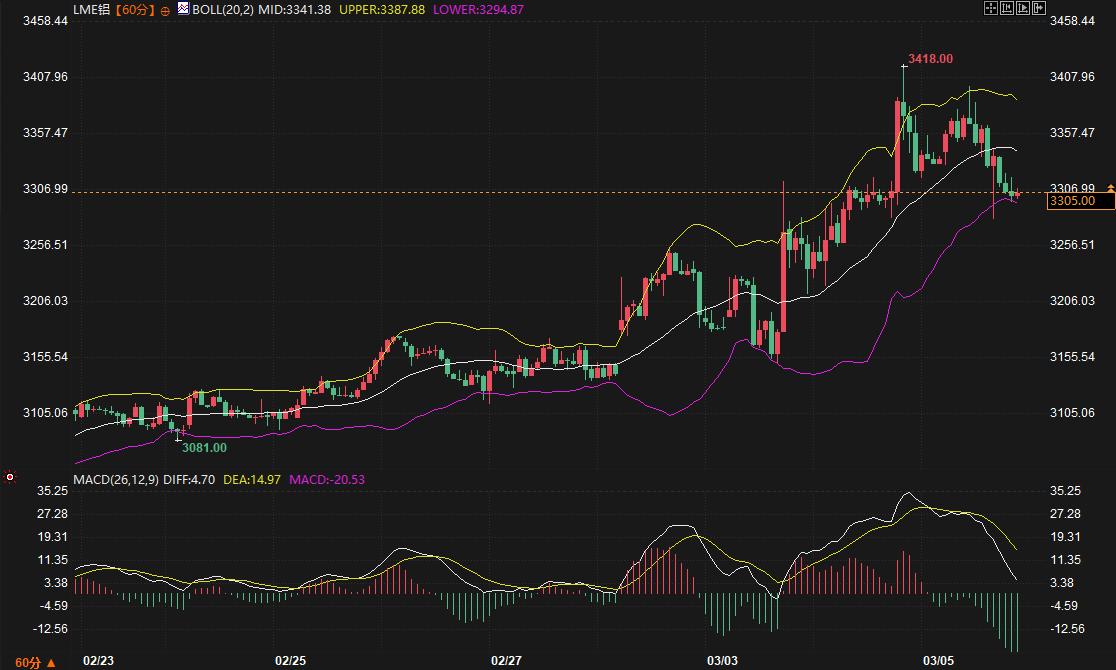
On Thursday (March 5), global metals markets experienced heightened volatility, with aluminum prices retreating after three consecutive days of gains, as focus shifted to the risk of supply disruptions at smelters in the Middle East. The benchmark March aluminum contract on the London Metal Exchange (LME) rose as much as 1.7% in early trading but subsequently fell 0.8% to close at $3,315 per tonne. While this price is lower than Wednesday's near four-year high, it still reflects continued market concerns about tight supply. The Gulf region, a major source of global aluminum supply, contributed approximately 8% of production last year, and force majeure events at its smelters further amplified market uncertainty. Meanwhile, a stronger US dollar put downward pressure on commodities, and the stabilization of the euro-dollar exchange rate and Brent crude oil prices also contributed to the short-term correction in aluminum prices.

The shift in market dynamics stems from a confluence of factors. Firstly, escalating geopolitical tensions in the Middle East, with key smelters like Qatalum and Aluminium Bahrain declaring force majeure, directly fueled supply concerns. These events were not sudden but closely linked to the escalation of regional conflict, leading investors to question the stability of the global aluminum supply chain. Looking back at recent price action, aluminum prices hit a high on Wednesday, reflecting the market's immediate reaction to a potential shortage. However, Thursday's price pullback indicated that investors were beginning to assess broader implications, including a strong US dollar index. As a dollar-denominated commodity, aluminum is highly sensitive to exchange rates; a stronger dollar increases procurement costs for non-dollar holders, naturally dampening demand. Furthermore, LME aluminum inventory data revealed subtle changes: total inventory fell to 459,125 tons, the lowest level since July last year, primarily driven by a net outflow of 2,000 tons from the Port Klang warehouse in Malaysia. Earlier this week, the warehouse had over 45,000 tons of removal orders, suggesting traders are seizing the opportunity of supply shortages to liquidate inventory. While global inventories remain relatively comfortable overall, regional differences are significant, particularly in the US market where inventories are tight. This echoes market concerns sparked by comments about import tariffs, which had already driven up physical aluminum premiums even before major geopolitical events, reflecting the indirect impact of trade policies on the physical market.
Against this backdrop, the views of well-known institutions have provided a reference for the market. An international bank's analyst team recently raised its LME aluminum price target to $3,600, up from $3,400 previously, and even predicts it could climb to $4,000 in an optimistic scenario. This adjustment is based on a quantitative assessment of supply disruptions, emphasizing that events in the Middle East could amplify the global aluminum capacity gap. Another head of commodities research pointed out that the market is currently in a "wait-and-see" mode, awaiting further clarity on the situation in the Middle East. She emphasized that the stabilization of the euro-dollar exchange rate and Brent crude oil has helped calm overall market sentiment, which is consistent with the pullback in aluminum prices. This analysis integrates macroeconomic signals with specific supply dynamics, avoiding the bias of relying solely on a single factor. It is worth noting that although global inventory levels can still buffer short-term shocks, the tight supply in the US market highlights the risk of regional imbalances. If the recovery of Middle Eastern smelters is delayed, the trend of inventory outflows may accelerate, further supporting the price floor.
From a technical perspective, short-term aluminum price fluctuations are closely linked to inventory indicators. LME data shows that continuous inventory declines reinforce the narrative of supply shortages, but the pullback also reminds the market to pay attention to external pressures such as the US dollar. Considering these factors, support levels can be seen in the $3200-$3250 range, based on the recent low retracement and the buffering effect of inventory outflows on the bottom. Resistance levels are seen in the $3400-$3500 range, based on Wednesday's high and institutional targets; a breakout would require a catalyst from Middle Eastern supply news. Key factors to watch during the session include inventory update reports, changes in the US dollar index, and the latest developments at Middle Eastern smelters, all of which will directly impact contract volatility. It is important to emphasize that physical market movements serve only as evidence for market forecasts, not as the sole basis for trading decisions.
Looking ahead, aluminum market trends will depend on the pace of supply recovery in the Middle East and the evolution of the macroeconomic environment. If geopolitical risks ease, prices may consolidate at current high levels, gradually digesting inventory pressure; conversely, prolonged supply disruptions or a continued strong US dollar could push prices closer to optimistic institutional targets. However, uncertainties on the global demand side, such as the pace of recovery in the packaging and transportation industries, should be noted. Overall, the market is likely to maintain a high volatility pattern in the short term, while the long-term outlook depends on supply chain restructuring.
Frequently Asked Questions
The shift in market dynamics stems from a confluence of factors. Firstly, escalating geopolitical tensions in the Middle East, with key smelters like Qatalum and Aluminium Bahrain declaring force majeure, directly fueled supply concerns. These events were not sudden but closely linked to the escalation of regional conflict, leading investors to question the stability of the global aluminum supply chain. Looking back at recent price action, aluminum prices hit a high on Wednesday, reflecting the market's immediate reaction to a potential shortage. However, Thursday's price pullback indicated that investors were beginning to assess broader implications, including a strong US dollar index. As a dollar-denominated commodity, aluminum is highly sensitive to exchange rates; a stronger dollar increases procurement costs for non-dollar holders, naturally dampening demand. Furthermore, LME aluminum inventory data revealed subtle changes: total inventory fell to 459,125 tons, the lowest level since July last year, primarily driven by a net outflow of 2,000 tons from the Port Klang warehouse in Malaysia. Earlier this week, the warehouse had over 45,000 tons of removal orders, suggesting traders are seizing the opportunity of supply shortages to liquidate inventory. While global inventories remain relatively comfortable overall, regional differences are significant, particularly in the US market where inventories are tight. This echoes market concerns sparked by comments about import tariffs, which had already driven up physical aluminum premiums even before major geopolitical events, reflecting the indirect impact of trade policies on the physical market.
Against this backdrop, the views of well-known institutions have provided a reference for the market. An international bank's analyst team recently raised its LME aluminum price target to $3,600, up from $3,400 previously, and even predicts it could climb to $4,000 in an optimistic scenario. This adjustment is based on a quantitative assessment of supply disruptions, emphasizing that events in the Middle East could amplify the global aluminum capacity gap. Another head of commodities research pointed out that the market is currently in a "wait-and-see" mode, awaiting further clarity on the situation in the Middle East. She emphasized that the stabilization of the euro-dollar exchange rate and Brent crude oil has helped calm overall market sentiment, which is consistent with the pullback in aluminum prices. This analysis integrates macroeconomic signals with specific supply dynamics, avoiding the bias of relying solely on a single factor. It is worth noting that although global inventory levels can still buffer short-term shocks, the tight supply in the US market highlights the risk of regional imbalances. If the recovery of Middle Eastern smelters is delayed, the trend of inventory outflows may accelerate, further supporting the price floor.
From a technical perspective, short-term aluminum price fluctuations are closely linked to inventory indicators. LME data shows that continuous inventory declines reinforce the narrative of supply shortages, but the pullback also reminds the market to pay attention to external pressures such as the US dollar. Considering these factors, support levels can be seen in the $3200-$3250 range, based on the recent low retracement and the buffering effect of inventory outflows on the bottom. Resistance levels are seen in the $3400-$3500 range, based on Wednesday's high and institutional targets; a breakout would require a catalyst from Middle Eastern supply news. Key factors to watch during the session include inventory update reports, changes in the US dollar index, and the latest developments at Middle Eastern smelters, all of which will directly impact contract volatility. It is important to emphasize that physical market movements serve only as evidence for market forecasts, not as the sole basis for trading decisions.
Looking ahead, aluminum market trends will depend on the pace of supply recovery in the Middle East and the evolution of the macroeconomic environment. If geopolitical risks ease, prices may consolidate at current high levels, gradually digesting inventory pressure; conversely, prolonged supply disruptions or a continued strong US dollar could push prices closer to optimistic institutional targets. However, uncertainties on the global demand side, such as the pace of recovery in the packaging and transportation industries, should be noted. Overall, the market is likely to maintain a high volatility pattern in the short term, while the long-term outlook depends on supply chain restructuring.
Frequently Asked Questions
Question 1: What specific impact will the force majeure events at Middle Eastern smelters have on the global aluminum supply?
Answer: These events primarily involve key production facilities in the Gulf region, such as Qatalum and Aluminium Bahrain, which contributed approximately 8% of global aluminum production last year. Force majeure means a potential reduction in supply in the short term, fueling market concerns about shortages and leading to increased price volatility. However, global inventories still provide a buffer, partially mitigating the impact. But if recovery is delayed, the effects will ripple down the supply chain to downstream sectors such as packaging and transportation.
Question 2: Why did aluminum prices pull back on Thursday after reaching their high on Wednesday?
Answer: Prices hit a near four-year high on Wednesday, primarily driven by supply concerns. However, they retreated 0.8% to $3,315/ton on Thursday, due to a stronger dollar increasing commodity costs and the market entering a "wait-and-see" mode awaiting developments in the Middle East. Meanwhile, the stability of the euro-dollar exchange rate and Brent crude oil also contributed to the overall metals market correction, with aluminum prices falling in line with this trend.
Question 3: How do changes in LME aluminum inventories affect market trends?
Answer: Inventories fell to 459,125 tons, the lowest level since July last year, mainly driven by outflows from the Port Klang warehouse, including removal orders exceeding 45,000 tons earlier this week. This indicates that traders are taking advantage of the shortage to liquidate, pushing up prices. However, global inventory levels are generally comfortable, while the US market is tight. Premiums had already risen earlier due to comments on import tariffs, reinforcing the impact of regional differences on the market.
Question 4: What are the bases for the predictions of aluminum prices by well-known institutions?
Answer: One institution raised its target to $3,600, with a bullish scenario reaching $4,000, primarily based on the potential amplifying effect of Middle East supply disruptions. Another view emphasizes market stabilization signals, such as calming exchange rates and oil prices, supporting the current pullback, but highlighting the need to monitor evolving geopolitical risks in the long term. These forecasts integrate supply fundamentals and macroeconomic factors, providing a multi-scenario reference.
Question 5: What factors are likely to dominate future trends in the aluminum market?
Answer: In the short term, prices depend on the recovery of Middle Eastern smelters and the dynamics of the US dollar. If risks ease, prices may fluctuate. In the long term, supply chain restructuring and demand recovery (such as in the transportation sector) will be key. Regional inventory imbalances and the impact of trade policies will also continue to play a role, but high market volatility warrants vigilance, and macroeconomic signals should not be ignored.
- Risk Warning and Disclaimer
- The market involves risk, and trading may not be suitable for all investors. This article is for reference only and does not constitute personal investment advice, nor does it take into account certain users’ specific investment objectives, financial situation, or other needs. Any investment decisions made based on this information are at your own risk.