Gold suddenly plummeted by $80; could negotiations ignite a reversal in risk appetite?
2026-03-05 21:48:44
On Thursday, March 5th, Russian Presidential Press Secretary Dmitry Peskov stated that Russia remains open to negotiations on the Ukraine issue and looks forward to the next round of talks, while noting that the current suspension of negotiations stems from objective reasons. This statement quickly ignited market expectations of easing geopolitical risks, causing spot gold prices to plunge by approximately $80, rapidly falling to a low near $5084, before rebounding slightly to around $5127. This sudden event highlights the high sensitivity of gold as a safe-haven asset to geopolitical signals. On the 5-minute candlestick chart, a large bearish candlestick pierced through multiple technical levels, indicating a significant increase in trading activity.
Peskov's statement signals a potential turning point in the Russia-Ukraine situation. Although negotiations had been suspended due to various objective factors, this open stance has prompted investors to reassess the risk premium of continued conflict. While gold prices are primarily driven by monetary policy and inflation expectations in the medium to long term, geopolitical uncertainty often constitutes a significant driver in the short term. When the glimmer of peace appears, safe-haven funds tend to flow out of the precious metals market and into risk assets. This logic has been repeatedly validated in similar historical events: signs of easing conflict are usually accompanied by a period of pullback in gold prices. Specifically, in this instance, the price plunged by approximately $80. Market participants observed that after gold broke below the key level of $5160, selling pressure rapidly intensified until initial buying support appeared around the $5084 area. Traders witnessed a rapid shift in fund flows during this process, highlighting the immediate impact of news events on position adjustments.
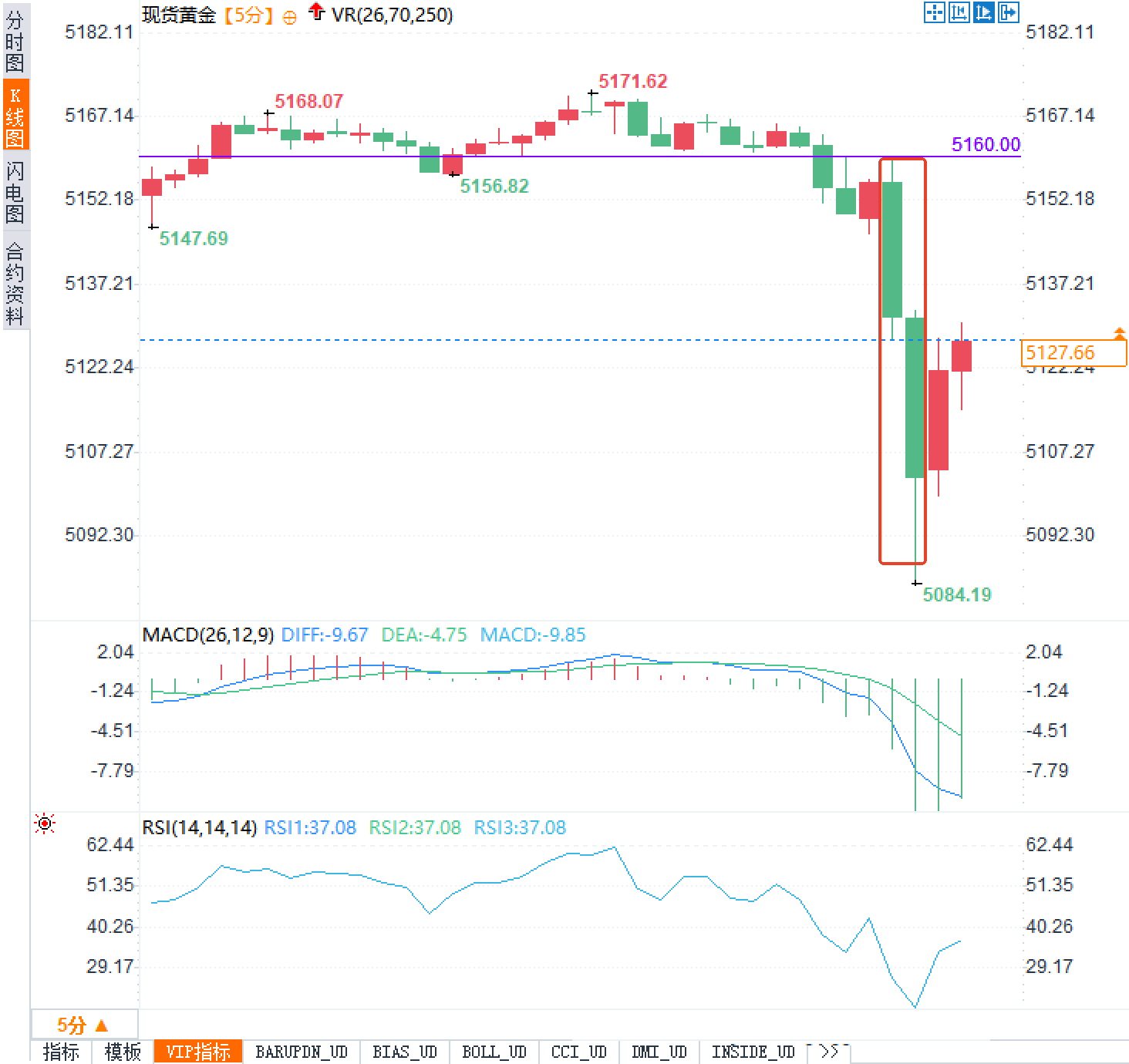
From the 5-minute chart, spot gold experienced a sharp sell-off after fluctuating at high levels. The MACD indicator shows a DIFF value of -9.67, a DEA value of -4.75, and a MACD histogram of -9.85, indicating a clear bearish trend and continued weakening short-term momentum. The RSI (14) reading has fallen back to around 37, placing it in a neutral to weak range. While not yet oversold, the downward momentum is strong. The purple horizontal line at $5160 in the chart has now become resistance, and the trading volume suggests high institutional participation.
Gold pricing is always the result of a multi-factor interplay. Besides geopolitics, the interest rate environment, inflation dynamics, and the dollar's trajectory form the core framework. Despite uncertainty surrounding the Federal Reserve's monetary policy path, changes in real yields continue to impact holding costs. In the current environment, any event that reduces global risk appetite could amplify gold's attractiveness, and vice versa. Peskov's remarks, coupled with market interpretations of the negotiation progress, have led to a short-term supply-demand imbalance within this context. It's worth noting that the continued diversification needs of global central banks provide long-term support for gold, but short-term event-driven volatility remains dominant. The rapid reaction this time reflects the high participation of algorithmic trading and leveraged funds. The Federal Reserve's recent policy of maintaining interest rates in the 3.50% to 3.75% range, coupled with cautious expectations of further easing, has stabilized the opportunity cost assessment of gold. However, the suddenness of geopolitical events often dominates short-term pricing logic.
Negotiation signals weaken gold's safe-haven premium
Peskov's statement signals a potential turning point in the Russia-Ukraine situation. Although negotiations had been suspended due to various objective factors, this open stance has prompted investors to reassess the risk premium of continued conflict. While gold prices are primarily driven by monetary policy and inflation expectations in the medium to long term, geopolitical uncertainty often constitutes a significant driver in the short term. When the glimmer of peace appears, safe-haven funds tend to flow out of the precious metals market and into risk assets. This logic has been repeatedly validated in similar historical events: signs of easing conflict are usually accompanied by a period of pullback in gold prices. Specifically, in this instance, the price plunged by approximately $80. Market participants observed that after gold broke below the key level of $5160, selling pressure rapidly intensified until initial buying support appeared around the $5084 area. Traders witnessed a rapid shift in fund flows during this process, highlighting the immediate impact of news events on position adjustments.
The technical indicators show clear bearish signals.
From the 5-minute chart, spot gold experienced a sharp sell-off after fluctuating at high levels. The MACD indicator shows a DIFF value of -9.67, a DEA value of -4.75, and a MACD histogram of -9.85, indicating a clear bearish trend and continued weakening short-term momentum. The RSI (14) reading has fallen back to around 37, placing it in a neutral to weak range. While not yet oversold, the downward momentum is strong. The purple horizontal line at $5160 in the chart has now become resistance, and the trading volume suggests high institutional participation.
| Key price level | Price (USD/ounce) | significance |
|---|---|---|
| recent highs | 5171.62 | Short-term resistance |
| resistance level | 5160.00 | Key Turning Point |
| low point | 5084.19 | Support Test |
| Current position | 5127.66 | rebound area |
The Interaction Between Macroeconomic Factors and Geopolitics
Gold pricing is always the result of a multi-factor interplay. Besides geopolitics, the interest rate environment, inflation dynamics, and the dollar's trajectory form the core framework. Despite uncertainty surrounding the Federal Reserve's monetary policy path, changes in real yields continue to impact holding costs. In the current environment, any event that reduces global risk appetite could amplify gold's attractiveness, and vice versa. Peskov's remarks, coupled with market interpretations of the negotiation progress, have led to a short-term supply-demand imbalance within this context. It's worth noting that the continued diversification needs of global central banks provide long-term support for gold, but short-term event-driven volatility remains dominant. The rapid reaction this time reflects the high participation of algorithmic trading and leveraged funds. The Federal Reserve's recent policy of maintaining interest rates in the 3.50% to 3.75% range, coupled with cautious expectations of further easing, has stabilized the opportunity cost assessment of gold. However, the suddenness of geopolitical events often dominates short-term pricing logic.
Frequently Asked Questions
Question 1: Why did the statement by the Russian presidential press secretary cause a sharp short-term pullback in spot gold prices?
A: Peskov's statement that Russia is open to negotiations and looks forward to the next round of talks was interpreted by the market as a signal that geopolitical tensions may be easing. As a traditional safe-haven asset, gold's demand often weakens when risk appetite improves, causing the price to fall rapidly by about $80. Traders should note that such events typically bring short-term volatility, but long-term trends are still dominated by macroeconomic factors.
Question 2: From a technical perspective, what do the MACD and RSI indicators for the current gold price indicate?
A: The chart shows that the MACD indicator has formed a death cross and is in negative territory, while the RSI has fallen to around 37, indicating weakening short-term momentum and a more cautious market sentiment. After breaking below a key level, the price may test lower support levels, but if the rebound is weak, further corrections should be anticipated.
Question 3: How is the pricing logic of gold affected by the macroeconomic environment?
A: In the current interest rate environment, the cost of holding gold remains at a certain level. The direction of the Federal Reserve's policies and global economic growth expectations jointly shape its role as a diversified asset.
- Risk Warning and Disclaimer
- The market involves risk, and trading may not be suitable for all investors. This article is for reference only and does not constitute personal investment advice, nor does it take into account certain users’ specific investment objectives, financial situation, or other needs. Any investment decisions made based on this information are at your own risk.