Oil prices continue to rise, exacerbating supply risks in the Gulf, with a medium-term target of $92-95?
2026-03-06 03:33:29
Oil prices surged above $80 due to supply concerns in the Strait of Hormuz. Pipeline alternatives and increased US production capacity could alleviate the pressure, but if oil prices continue to rise, supply risks in the Gulf will intensify, with a medium-term target of $92-95.

Since February 28, crude oil has become one of the best-performing mainstream trading instruments, with the market pricing in a scenario where Gulf region crude oil exports may be subject to prolonged disruptions. Traders are focusing on the sharp decline in shipping volumes in the Strait of Hormuz and whether the situation will continue or ease. This article will review recent events, conduct fundamental analysis, and briefly interpret the price movement of US light crude oil (ticker symbol USOIL).
The Strait of Hormuz is blocked, threatening the world's most critical oil choke point.
Recently, crude oil exports from Gulf countries have declined sharply due to significantly increased difficulty in navigating the narrow Strait of Hormuz, one of the world's most important oil shipping chokepoints. The risk of a direct attack from Iran is extremely high, and the more direct impact is a surge in shipping insurance costs. However, the degree of impact of the situation varies from country to country.
According to data from the U.S. Energy Information Administration (EIA), China is the largest importer of crude oil per day via the Strait of Hormuz, accounting for approximately 45%–50% of the total by the end of 2025, averaging about 5.5 million barrels per day. China is also the world's largest crude oil importer.
However, Iran does not possess the military capability to completely blockade the Strait of Hormuz, and even if it did, blocking the strait might not be in the Iranian government's interest. China has long been Iran's largest buyer of oil and has also been one of Iran's main suppliers of military equipment in recent years.
Currently, the Iranian government is highly likely to maintain its existing stance in response to the geopolitical crisis. Provoking China by attacking oil tankers would not be in its long-term interest. Both China and the United States have a strong strategic motivation to maintain normal passage through the Taiwan Strait, and if necessary, can ensure its operation through emergency insurance or other means.
Not all Gulf oil passes through the Strait of Hormuz.
In light of concerns that Gulf exports may be blocked in the long term, another key fact is that Saudi Arabia has been developing detailed contingency plans for this scenario since the Iran-Iraq War in the 1980s.
The Saudi-led East-West Petroline was opened in 1982, when the new Iranian government was highly likely to close the Strait of Hormuz due to US support for Iraq. The pipeline consists of two lines, totaling approximately 1,200 kilometers in length, running from the Gulf region to the port of Yanbu on the Red Sea coast, with a daily capacity of about 5 million barrels.
In reality, the combined efforts of Saudi Arabia's East-West pipeline and the UAE's Abu Dhabi pipeline (Habu Hill-Fujairah pipeline) mean that simply blocking the Strait of Hormuz cannot cut off all crude oil exports from the Gulf. The fact that the Houthi rebels and Iran have not recently launched large-scale drone or missile attacks on these pipelines also suggests a lack of such capability.
OPEC+ plans to gradually lift production cuts; US crude oil production hits a ten-year high.
Meanwhile, OPEC+ plans to begin phasing out production cuts next month. While the current geopolitical situation may seem to overshadow other factors, the underlying potential supply glut remains significant – many countries outside the Gulf are currently producing below capacity.
US spare capacity and Russian exports may alleviate short-term supply shocks.
In October 2025, US crude oil production reached a more than ten-year high, averaging approximately 14 million barrels per day. With some room for further production increases in the US, coupled with the high probability of Russia significantly increasing its exports to China and India, short-term supply issues could be alleviated relatively easily.
The problem lies in the fact that actual production data from all major oil-producing countries are lagging, with Russian data lagging by as much as six months. Furthermore, the reliability of Russia's publicly released production data during wartime is questionable, making this factor an unreliable signal. Medium- to long-term oil price trends are highly dependent on the duration and outcome of the Gulf conflict; given the current multiple variables, long-term trading in crude oil carries extremely high risk.
Technical Analysis
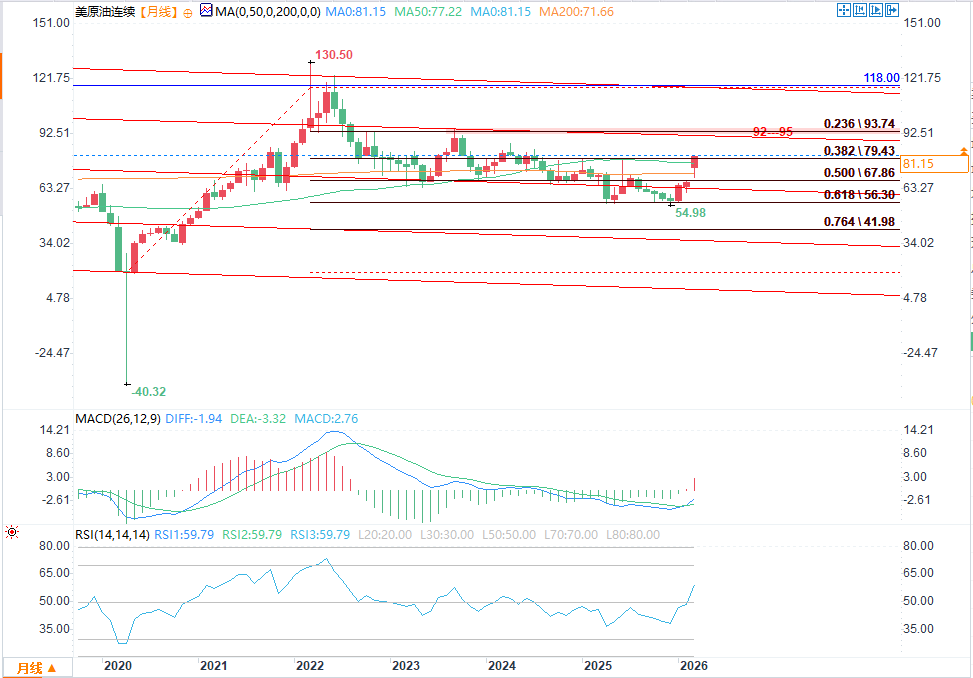
(WTI crude oil monthly chart source: FX678)
WTI crude oil is currently in a strong upward phase driven by geopolitical premiums. As of March 5, 2026, the price has gapped up significantly and continued to rise, breaking through $77 intraday and continuing to climb, with the latest price approaching the $83-$85 range (a significant increase since the end of March 1). The main drivers are the escalation of the US-Iran conflict and the risk of shipping disruptions in the Strait of Hormuz.
Assuming no major reversal in fundamentals and market sentiment, the bulls' medium-term target is likely $92-$95. This range represents a key Fibonacci level for the wave from the 2020 low to the 2022 high, and also corresponds to the upper trendline of the ascending channel and the previous high confluence zone, making it the core target for this round of gains. A decisive break above $95 would target the upper trendline of the channel at $118, entering an extreme upward scenario.
On the downside risk front, the shorts target to fill the previous gap to around $67, but unless the conflict is resolved quickly (such as through a diplomatic breakthrough or a supply recovery), the probability is extremely low in the short term.
The short-term trading strategy is simple and practical: buy on significant pullbacks (about $2 or more down) to capitalize on low geopolitical premiums; after prices reach new highs, use a nearby trailing stop to lock in profits and prevent sudden reversals.
Since February 28, crude oil has become one of the best-performing mainstream trading instruments, with the market pricing in a scenario where Gulf region crude oil exports may be subject to prolonged disruptions. Traders are focusing on the sharp decline in shipping volumes in the Strait of Hormuz and whether the situation will continue or ease. This article will review recent events, conduct fundamental analysis, and briefly interpret the price movement of US light crude oil (ticker symbol USOIL).
The Strait of Hormuz is blocked, threatening the world's most critical oil choke point.
Recently, crude oil exports from Gulf countries have declined sharply due to significantly increased difficulty in navigating the narrow Strait of Hormuz, one of the world's most important oil shipping chokepoints. The risk of a direct attack from Iran is extremely high, and the more direct impact is a surge in shipping insurance costs. However, the degree of impact of the situation varies from country to country.
According to data from the U.S. Energy Information Administration (EIA), China is the largest importer of crude oil per day via the Strait of Hormuz, accounting for approximately 45%–50% of the total by the end of 2025, averaging about 5.5 million barrels per day. China is also the world's largest crude oil importer.
However, Iran does not possess the military capability to completely blockade the Strait of Hormuz, and even if it did, blocking the strait might not be in the Iranian government's interest. China has long been Iran's largest buyer of oil and has also been one of Iran's main suppliers of military equipment in recent years.
Currently, the Iranian government is highly likely to maintain its existing stance in response to the geopolitical crisis. Provoking China by attacking oil tankers would not be in its long-term interest. Both China and the United States have a strong strategic motivation to maintain normal passage through the Taiwan Strait, and if necessary, can ensure its operation through emergency insurance or other means.
Not all Gulf oil passes through the Strait of Hormuz.
In light of concerns that Gulf exports may be blocked in the long term, another key fact is that Saudi Arabia has been developing detailed contingency plans for this scenario since the Iran-Iraq War in the 1980s.
The Saudi-led East-West Petroline was opened in 1982, when the new Iranian government was highly likely to close the Strait of Hormuz due to US support for Iraq. The pipeline consists of two lines, totaling approximately 1,200 kilometers in length, running from the Gulf region to the port of Yanbu on the Red Sea coast, with a daily capacity of about 5 million barrels.
In reality, the combined efforts of Saudi Arabia's East-West pipeline and the UAE's Abu Dhabi pipeline (Habu Hill-Fujairah pipeline) mean that simply blocking the Strait of Hormuz cannot cut off all crude oil exports from the Gulf. The fact that the Houthi rebels and Iran have not recently launched large-scale drone or missile attacks on these pipelines also suggests a lack of such capability.
OPEC+ plans to gradually lift production cuts; US crude oil production hits a ten-year high.
Meanwhile, OPEC+ plans to begin phasing out production cuts next month. While the current geopolitical situation may seem to overshadow other factors, the underlying potential supply glut remains significant – many countries outside the Gulf are currently producing below capacity.
US spare capacity and Russian exports may alleviate short-term supply shocks.
In October 2025, US crude oil production reached a more than ten-year high, averaging approximately 14 million barrels per day. With some room for further production increases in the US, coupled with the high probability of Russia significantly increasing its exports to China and India, short-term supply issues could be alleviated relatively easily.
The problem lies in the fact that actual production data from all major oil-producing countries are lagging, with Russian data lagging by as much as six months. Furthermore, the reliability of Russia's publicly released production data during wartime is questionable, making this factor an unreliable signal. Medium- to long-term oil price trends are highly dependent on the duration and outcome of the Gulf conflict; given the current multiple variables, long-term trading in crude oil carries extremely high risk.
Technical Analysis
(WTI crude oil monthly chart source: FX678)
WTI crude oil is currently in a strong upward phase driven by geopolitical premiums. As of March 5, 2026, the price has gapped up significantly and continued to rise, breaking through $77 intraday and continuing to climb, with the latest price approaching the $83-$85 range (a significant increase since the end of March 1). The main drivers are the escalation of the US-Iran conflict and the risk of shipping disruptions in the Strait of Hormuz.
Assuming no major reversal in fundamentals and market sentiment, the bulls' medium-term target is likely $92-$95. This range represents a key Fibonacci level for the wave from the 2020 low to the 2022 high, and also corresponds to the upper trendline of the ascending channel and the previous high confluence zone, making it the core target for this round of gains. A decisive break above $95 would target the upper trendline of the channel at $118, entering an extreme upward scenario.
On the downside risk front, the shorts target to fill the previous gap to around $67, but unless the conflict is resolved quickly (such as through a diplomatic breakthrough or a supply recovery), the probability is extremely low in the short term.
The short-term trading strategy is simple and practical: buy on significant pullbacks (about $2 or more down) to capitalize on low geopolitical premiums; after prices reach new highs, use a nearby trailing stop to lock in profits and prevent sudden reversals.
- Risk Warning and Disclaimer
- The market involves risk, and trading may not be suitable for all investors. This article is for reference only and does not constitute personal investment advice, nor does it take into account certain users’ specific investment objectives, financial situation, or other needs. Any investment decisions made based on this information are at your own risk.