The US and Israel's surprise attack on Iran caused gold prices to plummet; analysts strongly predict that $6,000 is just around the corner.
2026-03-06 10:41:37
Amid escalating geopolitical risks, gold's performance as a traditional safe-haven asset has once again drawn widespread market attention.
While gold has long been considered an effective tool for hedging against economic uncertainty and inflationary pressures, its safe-haven role has often failed to be fully realized in specific geopolitical conflicts. This week, with the joint military action taken by the United States and Israel against Iran, gold prices experienced significant fluctuations but failed to maintain their strength, ultimately showing a pattern of rising and then falling back.
In their latest commodities report, analysts at Metals Focus, a well-known UK research firm, provided an in-depth analysis of this phenomenon. They pointed out both the current shortcomings in gold's performance and emphasized the potential upside potential, especially given the tail risk of a possible further escalation of the conflict.
At the start of the week, investor reactions to the joint US-Israeli military action propelled gold prices higher, briefly testing resistance near $5,400 per ounce. This brief rise reflected risk aversion in the market at the outset of a sudden geopolitical event; however, this momentum was short-lived. By Thursday afternoon, gold prices had fallen back below $5,100 per ounce, a drop of nearly $400.
This trend shows that although gold still possesses defensive attributes in an environment of economic uncertainty and inflation, its safe-haven role in specific geopolitical risk events has been relatively lackluster, failing to continue to strengthen as some market expectations had.
In their latest commodities report, analysts at Metals Focus stated that while gold's failure to hold onto its recent gains was disappointing, they remain optimistic about the precious metal's performance for the remainder of the year, believing that the upward trend still exists.
Analysts noted in their report that gold's gains from geopolitical tensions or sudden shocks rarely last. They added that this pattern applies to most markets, with the exception of assets whose supply, demand, or trade is directly affected by the event. Even in prolonged conflicts, investor fatigue quickly sets in, and interest in safe-haven assets wanes. The current conflict with Iran is likely to follow a similar pattern.
However, analysts emphasize that due to the specific nature of this conflict, there are considerable tail risks, and the situation could be different.
Analysts further analyze that as the impact of the conflict on shipping in the Strait of Hormuz becomes increasingly apparent, the risks facing the global energy market are constantly increasing. Moreover, the involvement of 12 countries further enhances the real possibility of the war escalating. Analysts say these factors collectively constitute a potential catalyst that cannot be ignored. However, they also point out that there is virtually no widespread willingness in the Middle East to support another protracted conflict.
The analysts added in the report that a protracted and potentially out-of-control war in Iran, coinciding with the upcoming US midterm elections, would pose significant political risks to the Republican Party. Voters are likely to find it difficult to accept the resulting monetary costs, casualties, and the actual and perceived inflationary impact of persistently high oil prices.
Against this backdrop, analysts conducted a scenario analysis of gold price movements. They stated that under the current baseline scenario, gold prices are expected to retest the record high reached in January, but a sustained rise is unlikely due to insufficient momentum. However, analysts added that if there are any signs of further escalation of the conflict, or significant disruption to the oil market, gold prices could easily be pushed up to the $6,000 per ounce level. Beyond event-driven short-term volatility, Metals Focus remains bullish on the medium- to long-term outlook for gold.
They believe this conflict highlights broader economic and geopolitical uncertainty. Analysts say that regardless of whether one agrees with the US decision to strike Iran, this action will have a lasting impact on US foreign policy. Combined with the recent intervention in Venezuela, this clearly demonstrates the US's willingness to use hard power if necessary to achieve its strategic objectives and induce regime or political change. At the same time, the lack of coordination or consultation with most allies marks a clear shift towards unilateralism. This policy shift by the world's largest economy and leading military power will undoubtedly further exacerbate geopolitical uncertainty.
Metals Focus also points out that this military action may be relatively positive for gold's performance against US Treasuries . Although the dollar attracted some inflows this week, the yield on 10-year US Treasuries has risen back above 4%. Analysts say the limited inflows into Treasuries observed this week have exacerbated existing market concerns about their traditional safe-haven role.
They added that this phenomenon is clearly positive for gold: on the one hand, gold directly competes with Treasury bonds for safe-haven inflows; on the other hand, the indirect impact of these concerns on the dollar's performance also provides additional support for gold prices.
In conclusion, while gold prices have experienced a short-term pullback against the backdrop of US and Israeli military action against Iran, analysts at Metals Focus, through detailed scenario analysis, have outlined a clear outlook for investors: despite short-term pressure, long-term upside potential remains, especially in tail-risk scenarios involving escalating conflict or significant energy market volatility, where gold prices could potentially challenge the historical high of $6,000. This assessment is based not only on insights into profound changes in the geopolitical landscape but also reflects the continued important role gold will play in an era of heightened global uncertainty. Investors should closely monitor the development of the conflict and oil market dynamics to seize potential investment opportunities.
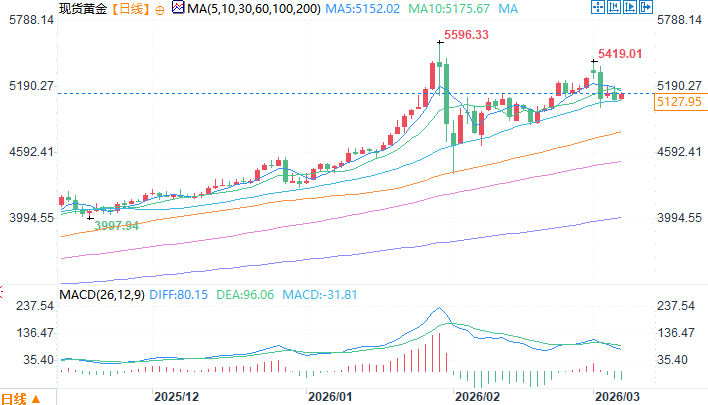
Spot gold daily chart source: EasyForex
At 10:40 AM Beijing time on March 6, spot gold was trading at $5123.95 per ounce.
While gold has long been considered an effective tool for hedging against economic uncertainty and inflationary pressures, its safe-haven role has often failed to be fully realized in specific geopolitical conflicts. This week, with the joint military action taken by the United States and Israel against Iran, gold prices experienced significant fluctuations but failed to maintain their strength, ultimately showing a pattern of rising and then falling back.
In their latest commodities report, analysts at Metals Focus, a well-known UK research firm, provided an in-depth analysis of this phenomenon. They pointed out both the current shortcomings in gold's performance and emphasized the potential upside potential, especially given the tail risk of a possible further escalation of the conflict.
Gold prices fluctuated wildly this week, with its safe-haven appeal briefly appearing.
At the start of the week, investor reactions to the joint US-Israeli military action propelled gold prices higher, briefly testing resistance near $5,400 per ounce. This brief rise reflected risk aversion in the market at the outset of a sudden geopolitical event; however, this momentum was short-lived. By Thursday afternoon, gold prices had fallen back below $5,100 per ounce, a drop of nearly $400.
This trend shows that although gold still possesses defensive attributes in an environment of economic uncertainty and inflation, its safe-haven role in specific geopolitical risk events has been relatively lackluster, failing to continue to strengthen as some market expectations had.
Metals Focus analysts' latest assessment suggests short-term pressure but a bullish long-term outlook.
In their latest commodities report, analysts at Metals Focus stated that while gold's failure to hold onto its recent gains was disappointing, they remain optimistic about the precious metal's performance for the remainder of the year, believing that the upward trend still exists.
Analysts noted in their report that gold's gains from geopolitical tensions or sudden shocks rarely last. They added that this pattern applies to most markets, with the exception of assets whose supply, demand, or trade is directly affected by the event. Even in prolonged conflicts, investor fatigue quickly sets in, and interest in safe-haven assets wanes. The current conflict with Iran is likely to follow a similar pattern.
However, analysts emphasize that due to the specific nature of this conflict, there are considerable tail risks, and the situation could be different.
The risk of escalating conflict is highlighted, with energy markets and the involvement of multiple countries becoming key variables.
Analysts further analyze that as the impact of the conflict on shipping in the Strait of Hormuz becomes increasingly apparent, the risks facing the global energy market are constantly increasing. Moreover, the involvement of 12 countries further enhances the real possibility of the war escalating. Analysts say these factors collectively constitute a potential catalyst that cannot be ignored. However, they also point out that there is virtually no widespread willingness in the Middle East to support another protracted conflict.
The analysts added in the report that a protracted and potentially out-of-control war in Iran, coinciding with the upcoming US midterm elections, would pose significant political risks to the Republican Party. Voters are likely to find it difficult to accept the resulting monetary costs, casualties, and the actual and perceived inflationary impact of persistently high oil prices.
Gold price path to $6,000 under both scenarios is not out of reach
Against this backdrop, analysts conducted a scenario analysis of gold price movements. They stated that under the current baseline scenario, gold prices are expected to retest the record high reached in January, but a sustained rise is unlikely due to insufficient momentum. However, analysts added that if there are any signs of further escalation of the conflict, or significant disruption to the oil market, gold prices could easily be pushed up to the $6,000 per ounce level. Beyond event-driven short-term volatility, Metals Focus remains bullish on the medium- to long-term outlook for gold.
They believe this conflict highlights broader economic and geopolitical uncertainty. Analysts say that regardless of whether one agrees with the US decision to strike Iran, this action will have a lasting impact on US foreign policy. Combined with the recent intervention in Venezuela, this clearly demonstrates the US's willingness to use hard power if necessary to achieve its strategic objectives and induce regime or political change. At the same time, the lack of coordination or consultation with most allies marks a clear shift towards unilateralism. This policy shift by the world's largest economy and leading military power will undoubtedly further exacerbate geopolitical uncertainty.
The relative advantages of US Treasury bonds are becoming apparent, while the safe-haven status of the US dollar and Treasury bonds is being questioned.
Metals Focus also points out that this military action may be relatively positive for gold's performance against US Treasuries . Although the dollar attracted some inflows this week, the yield on 10-year US Treasuries has risen back above 4%. Analysts say the limited inflows into Treasuries observed this week have exacerbated existing market concerns about their traditional safe-haven role.
They added that this phenomenon is clearly positive for gold: on the one hand, gold directly competes with Treasury bonds for safe-haven inflows; on the other hand, the indirect impact of these concerns on the dollar's performance also provides additional support for gold prices.
In conclusion, while gold prices have experienced a short-term pullback against the backdrop of US and Israeli military action against Iran, analysts at Metals Focus, through detailed scenario analysis, have outlined a clear outlook for investors: despite short-term pressure, long-term upside potential remains, especially in tail-risk scenarios involving escalating conflict or significant energy market volatility, where gold prices could potentially challenge the historical high of $6,000. This assessment is based not only on insights into profound changes in the geopolitical landscape but also reflects the continued important role gold will play in an era of heightened global uncertainty. Investors should closely monitor the development of the conflict and oil market dynamics to seize potential investment opportunities.
Spot gold daily chart source: EasyForex
At 10:40 AM Beijing time on March 6, spot gold was trading at $5123.95 per ounce.
- Risk Warning and Disclaimer
- The market involves risk, and trading may not be suitable for all investors. This article is for reference only and does not constitute personal investment advice, nor does it take into account certain users’ specific investment objectives, financial situation, or other needs. Any investment decisions made based on this information are at your own risk.