Despite soaring oil prices, the ECB still calls it a "good position," sending traders' hearts racing.
2026-03-06 16:11:59
On Friday, March 6th, the euro traded in a narrow range against the US dollar between 1.1610 and 1.1615 in early European trading, briefly touching 1.1620 before retreating slightly to around 1.1610. Recent comments from European Central Bank (ECB) Policy Committee member Olaf Sleipen quickly drew market attention. He clearly stated that the central bank can tolerate both slight under-inflation and slight over-inflation, a stance echoing the reality that the Eurozone's inflation rate rose to 1.9% in February. Against the backdrop of fluctuating energy prices due to geopolitical tensions, Sleipen emphasized that the policy outlook has not changed drastically and the Eurozone remains in a good position. This information provides forex traders with a key reference point for examining the interest rate path, especially as the next ECB meeting approaches.

Sleipen's remarks focused on the symmetric management of the inflation target. He pointed out that, just as the central bank has tolerated inflation below target in the past, it can also accept inflation slightly above target. This statement was not made arbitrarily, but rather based on prudent considerations within the current data-dependent framework. He explicitly stated that his view on the policy outlook has not changed dramatically, and the Eurozone economy remains in a good position. Sleipen further mentioned that lessons were learned from the high inflation period of 2021-2022, but the current situation is not entirely the same as that time and cannot be simply compared.
Furthermore, he expressed comfort in holding the Federal Reserve's gold reserves and confidence in the Fed's swap line arrangements. In an environment where energy prices may temporarily push up inflationary pressures, this statement suggests that the ECB will not rush to adjust its existing policy toolbox but will continue to observe data developments. Traders should note that such signals often reinforce market expectations of policy continuity and should avoid overinterpreting short-term fluctuations.
Eurozone inflation rose to 1.9% in February, a slight improvement from 1.7% in January, but still near the European Central Bank's medium-term target. Core inflation was 2.4%, services inflation remained at 3.4%, while energy prices declined. A survey of professional forecasters indicates that overall inflation expectations will remain stable at 1.8% in 2026, rise to 2.0% in 2027, and further to 2.1% in 2028. On the consumer side, inflation expectations for the next 12 months are 2.6%, the three-year expectation is 2.6%, and the five-year expectation has risen to near historical highs.
These data indicate that the inflation path is showing a moderate recovery trend, but the temporary disturbances in the energy component warrant attention. The European Central Bank maintained its deposit facility rate at 2.00%, its main refinancing rate at 2.15%, and its marginal lending facility rate at 2.40%, all unchanged, demonstrating policymakers' acceptance of the current balance.
The above comparison shows that there is a certain divergence between professional forecasts and consumer expectations, with the latter being more susceptible to short-term energy shocks, but overall they have not deviated from the 2% target range.
Current energy price volatility stems primarily from potential supply disruptions caused by geopolitical tensions, but Sleipen explicitly stated that the central bank will not act hastily due to short-term shocks. This contrasts sharply with the misjudgment of "temporary" inflation in 2021-2022, when high inflation persisted longer than expected, leading to a passive tightening of policy. Now, the ECB has learned from that experience, emphasizing data-driven decision-making and phased assessments at each meeting to avoid repeating past mistakes. Sleipen pointed out that the current scenario is not entirely applicable because a tight labor market and the impact of fiscal spending have been taken into account, while the energy shock is expected to be temporary.
The resilience of the Eurozone economy further supports this stance. Stable domestic demand, slower wage growth, and a stronger euro have also dampened import prices. These factors collectively form the basis for policy continuity, ensuring that inflation remains stable at the target level over the medium term, rather than being derailed by a single event. Traders can look to the next ECB meeting (March 19th) for updates to verify whether this continuity will continue.
The euro is currently trading around 1.1610 against the US dollar. The 30-minute chart shows the RSI at approximately 52.8, in neutral territory, while the MACD line is near the zero line, suggesting short-term momentum equilibrium. Key support levels are at 1.1601 and 1.1585, while resistance is around 1.1620. On the fundamental front, Sleipen's remarks strengthened expectations of policy stability in the Eurozone, but rising energy prices may indirectly put downward pressure on the euro.
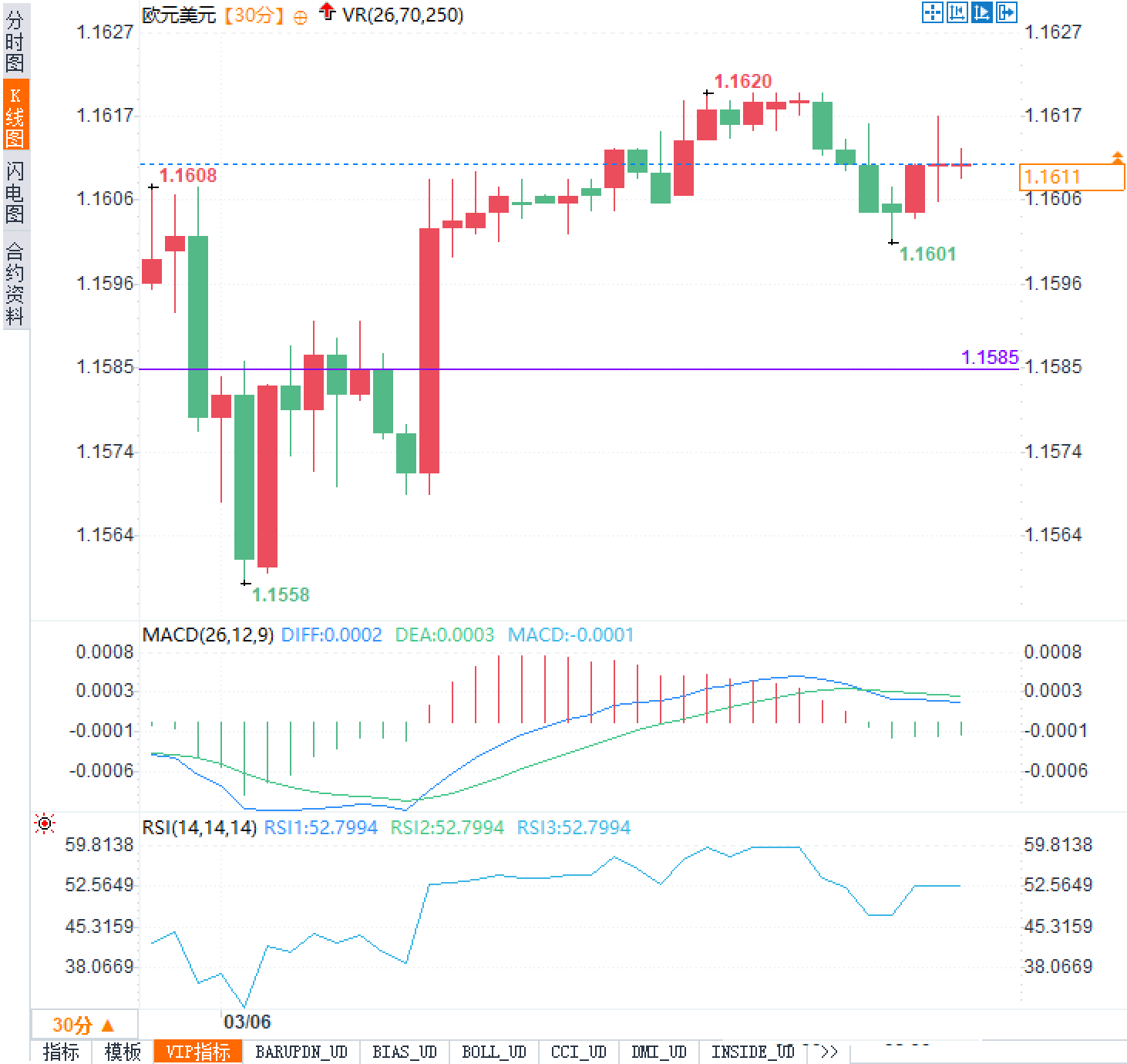
Compared to historical averages, the current exchange rate volatility has narrowed, reflecting the market's digestion of the European Central Bank's (ECB) flexibility. Traders need to pay attention to the pace of US data releases and changes in ECB communication, as these will jointly determine the medium-term direction of the euro. Overall, the current environment emphasizes symmetrical risk management rather than unilateral betting.
The core meaning and policy signals of Sleipen's statement
Sleipen's remarks focused on the symmetric management of the inflation target. He pointed out that, just as the central bank has tolerated inflation below target in the past, it can also accept inflation slightly above target. This statement was not made arbitrarily, but rather based on prudent considerations within the current data-dependent framework. He explicitly stated that his view on the policy outlook has not changed dramatically, and the Eurozone economy remains in a good position. Sleipen further mentioned that lessons were learned from the high inflation period of 2021-2022, but the current situation is not entirely the same as that time and cannot be simply compared.
Furthermore, he expressed comfort in holding the Federal Reserve's gold reserves and confidence in the Fed's swap line arrangements. In an environment where energy prices may temporarily push up inflationary pressures, this statement suggests that the ECB will not rush to adjust its existing policy toolbox but will continue to observe data developments. Traders should note that such signals often reinforce market expectations of policy continuity and should avoid overinterpreting short-term fluctuations.
In-depth assessment of Eurozone inflation data
Eurozone inflation rose to 1.9% in February, a slight improvement from 1.7% in January, but still near the European Central Bank's medium-term target. Core inflation was 2.4%, services inflation remained at 3.4%, while energy prices declined. A survey of professional forecasters indicates that overall inflation expectations will remain stable at 1.8% in 2026, rise to 2.0% in 2027, and further to 2.1% in 2028. On the consumer side, inflation expectations for the next 12 months are 2.6%, the three-year expectation is 2.6%, and the five-year expectation has risen to near historical highs.
These data indicate that the inflation path is showing a moderate recovery trend, but the temporary disturbances in the energy component warrant attention. The European Central Bank maintained its deposit facility rate at 2.00%, its main refinancing rate at 2.15%, and its marginal lending facility rate at 2.40%, all unchanged, demonstrating policymakers' acceptance of the current balance.
| years | Professional forecasters' overall inflation expectations (%) | Consumer 12-month expectations (%) |
|---|---|---|
| 2026 | 1.8 | 2.6 |
| 2027 | 2.0 | 2.6 |
| 2028 | 2.1 | - |
Geopolitical factors, historical lessons and policy continuity
Current energy price volatility stems primarily from potential supply disruptions caused by geopolitical tensions, but Sleipen explicitly stated that the central bank will not act hastily due to short-term shocks. This contrasts sharply with the misjudgment of "temporary" inflation in 2021-2022, when high inflation persisted longer than expected, leading to a passive tightening of policy. Now, the ECB has learned from that experience, emphasizing data-driven decision-making and phased assessments at each meeting to avoid repeating past mistakes. Sleipen pointed out that the current scenario is not entirely applicable because a tight labor market and the impact of fiscal spending have been taken into account, while the energy shock is expected to be temporary.
The resilience of the Eurozone economy further supports this stance. Stable domestic demand, slower wage growth, and a stronger euro have also dampened import prices. These factors collectively form the basis for policy continuity, ensuring that inflation remains stable at the target level over the medium term, rather than being derailed by a single event. Traders can look to the next ECB meeting (March 19th) for updates to verify whether this continuity will continue.
Euro exchange rate market dynamics observation
The euro is currently trading around 1.1610 against the US dollar. The 30-minute chart shows the RSI at approximately 52.8, in neutral territory, while the MACD line is near the zero line, suggesting short-term momentum equilibrium. Key support levels are at 1.1601 and 1.1585, while resistance is around 1.1620. On the fundamental front, Sleipen's remarks strengthened expectations of policy stability in the Eurozone, but rising energy prices may indirectly put downward pressure on the euro.
Compared to historical averages, the current exchange rate volatility has narrowed, reflecting the market's digestion of the European Central Bank's (ECB) flexibility. Traders need to pay attention to the pace of US data releases and changes in ECB communication, as these will jointly determine the medium-term direction of the euro. Overall, the current environment emphasizes symmetrical risk management rather than unilateral betting.
Frequently Asked Questions
Question 1: Why does the European Central Bank emphasize that a small overshoot of inflation is tolerable?
A: This is a direct reflection of the symmetric inflation targeting framework. Since its strategy review in 2021, the ECB has clearly defined the 2% target as a symmetric range. Sleppan's statement is the latest application of this logic, especially in preventing policy overreaction when energy prices are temporarily rising.
Question 2: What exactly did Slepar mean when he said "we are still in a good position"?
A: This indicates that inflation is close to the 2% target range, economic growth is resilient, and the policy toolbox is flexible and available. Combined with the 1.9% inflation data in February and the professional forecaster's medium-term path of 1.8% to 2.1%, the Eurozone has avoided a prolonged period of high inflation in 2021 and 2022. Meanwhile, the stability of the transatlantic swap mechanism further solidifies this position.
Question 3: What are the key differences between the current stance and the historical lessons learned from 2021-2022?
A: Past high inflation stemmed from supply chain disruptions and surging demand, lasting for extended periods and decoupled from expectations; current shocks are primarily temporary fluctuations in energy prices, while wages and core inflation remain under control. Sleipen explicitly stated that the comparison is not entirely accurate, therefore the central bank maintains a data-dependent strategy rather than adjusting to a predetermined path, ensuring policy continuity and expectation anchoring.
- Risk Warning and Disclaimer
- The market involves risk, and trading may not be suitable for all investors. This article is for reference only and does not constitute personal investment advice, nor does it take into account certain users’ specific investment objectives, financial situation, or other needs. Any investment decisions made based on this information are at your own risk.