After the unexpectedly low non-farm payrolls data, which resulted in a sharp drop of 92,000 and a $40 surge in gold prices, is an even bigger "pitfall" yet to come?
2026-03-06 21:49:41
On Friday (March 6th) at 21:30 Beijing time, the unexpectedly weak US February non-farm payroll report triggered a sudden surge in global financial markets. The US dollar index plummeted 25 points, almost erasing all of its intraday gains; spot gold, meanwhile, experienced a dramatic surge, rising approximately $40 in just a few minutes, breaking through the $5100 and $5120 levels. Simultaneously, US Treasury yields fell across the board, and the market's expectation of a June rate cut by the Federal Reserve jumped rapidly from 35% to 50%. This series of dramatic fluctuations reveals investors' panic over a sharp cooling in the job market and a repricing of the dual risks of inflation and economic slowdown against the backdrop of the US-Iran conflict.

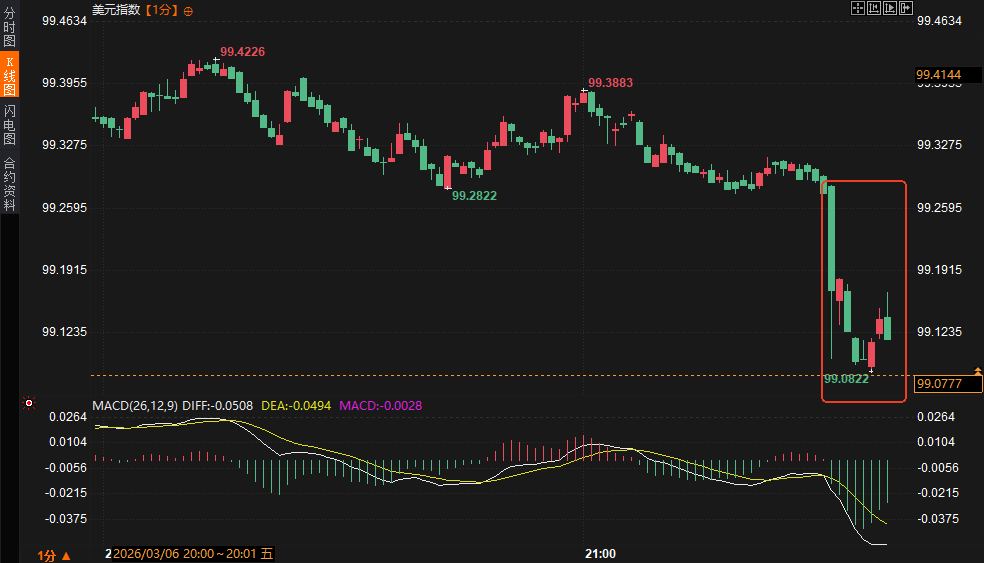
Following the data release, the market reacted swiftly and dramatically. Taking the US dollar index as an example, after the Labor Department report was released at 21:30 Beijing time, it plummeted by approximately 25 points from around 99.36 to 99.09, quickly erasing its intraday gains and turning into a slight decline. This reaction was primarily due to the unexpectedly weak non-farm payroll data: February's non-farm payrolls decreased by 92,000, far below the market expectation of an increase of 50,000, and significantly slower than the revised increase of 126,000 in January. Simultaneously, the unemployment rate rose to 4.4%, higher than the expected 4.3%. In contrast, January retail sales declined by 0.2% month-on-month, slightly better than the expected -0.3%, while core retail sales (excluding automobiles and gasoline) increased by 0.3% month-on-month, better than the expected 0.2%. However, the impact of the retail data was overshadowed by the negative shock of the non-farm payroll report, leading to overall pressure on the US dollar.
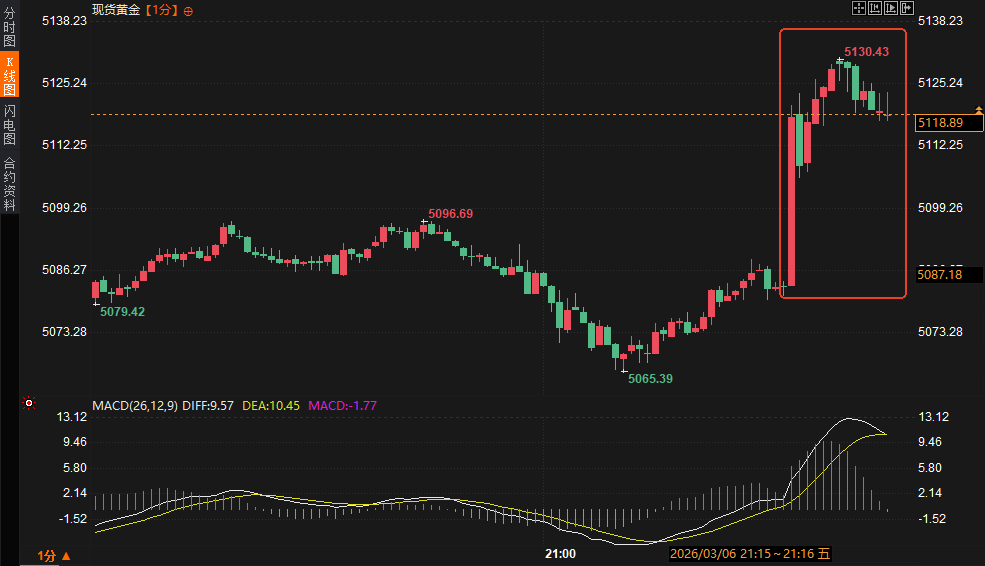
In the realm of safe-haven assets, spot gold prices reacted particularly strongly. Within minutes of the announcement, spot gold rose by approximately $40, breaking through the $5090, $5100, $5110, and $5120 per ounce levels, reaching a high of $5120.81 per ounce, with the daily gain expanding to 0.78%. The COMEX gold futures main contract also rose 0.98%, closing at $5128.30 per ounce. This upward trend continues the recent strong performance of gold. Since the escalation of the US-Iran conflict, gold has gradually climbed from its lower levels at the beginning of the year, benefiting from geopolitical uncertainty and rising inflation expectations. Technically, after breaking through key psychological levels, gold prices have shown strong bullish momentum. The short-term moving average system is in a golden cross formation, and the MACD indicator's red bars are expanding, suggesting increased momentum. However, it should be noted that historical data shows that during periods of weak employment data, gold often faces the risk of a pullback after the initial rebound, especially when inflationary pressures intertwine with expectations of Federal Reserve policy.
Meanwhile, the overall yield curve of US Treasury bonds shifted downward, reflecting growing market concerns about an economic slowdown. The two-year Treasury yield fell 5.7 basis points to 3.542%, and the ten-year yield fell 2.5 basis points to 4.121%. This change was clearly correlated with the European bond market, with the German ten-year bond yield falling 2 basis points to 2.83%. From a fundamental perspective, the decline in US Treasury yields stemmed from warning signs in the job market: the non-farm payroll report showed a decrease of 86,000 jobs in the private sector, 12,000 in manufacturing, 19,000 fewer jobs in the healthcare sector due to strikes, and continued declines in employment in the information technology sector and the federal government. Furthermore, the combined downward revision of the December and January non-farm payroll data by 69,000 jobs further reinforced the narrative of slowing job growth. Historically, similar downward revisions in employment data have often foreshadowed a shift from the peak of the labor market to the early stages of a recession, such as the slowest annual job growth record outside of a recession in 2003.
The impact of these data on the Federal Reserve's policy path warrants in-depth analysis. Before the release, traders estimated a 35% probability of a Fed rate cut in June, but this quickly rose to around 50% after the data was released. This shift stemmed from a sharp cooling in the job market: February job growth was far below expectations, the unemployment rate rose, the labor force participation rate fell to 62.0%, and the U-6 underemployment rate rose to 7.9%, a complete surprise. This contrasts sharply with the views expressed by Fed officials in their speeches since March 2nd—multiple officials emphasized that the labor market was "stabilizing" and warned of lingering inflation risks. However, the weak non-farm payroll data is likely to put pressure on the Fed, forcing it to reconsider its easing path. Analysts point out that the current situation is inconsistent with the stable trend described by officials, which may prompt the Fed to discuss the possibility of resuming rate cuts at its March meeting. On the other hand, the energy price shock from the US-Iran conflict adds complexity: Iran's foreign minister stated his intention to confront the two nuclear-armed states, and frequent incidents in the Strait of Hormuz have led to a surge in US crude oil futures to $86.20 per barrel, Chinese INE crude oil futures exceeding 720 yuan per barrel, and US unleaded gasoline futures exceeding $2.70 per gallon. These factors have pushed up inflation expectations, and soaring gasoline prices may suppress consumer spending, further testing the fragile labor market. Combined with market concerns triggered by Trump's tariff rhetoric, cautious hiring by companies has become the norm, and expectations of artificial intelligence replacing certain jobs have also suppressed labor demand. Although wage data conveys different signals—average hourly earnings rose 0.4% month-on-month, higher than the expected 0.3%—this may exacerbate the Federal Reserve's dilemma: a cooling job market requires a policy response, while strong wages limit the scope for easing.
From a technical and fundamental perspective, the negative surprise in the non-farm payroll data intensified market risk aversion, pushing the US dollar index to test support below the 99 level in the short term. Historically, after similar disappointing employment data, the dollar has often remained weak for several weeks until the Federal Reserve's signals become clearer. Gold's technical movement is highly consistent with its fundamentals: driven by both geopolitical risks and inflation, it broke upwards from its consolidation range at the beginning of the year. Although the RSI indicator is approaching overbought territory, it has not shown significant divergence, suggesting further upside potential in the short term. The decline in US Treasury yields reflects the defensive positioning of the bond market. A flattening yield curve may indicate an increased risk of economic slowdown, but caution is needed regarding the potential for rising oil prices to pull up long-term yields. Overall, these reactions highlight the dominant role of employment data in the current macroeconomic environment. While retail sales were slightly better than expected, they failed to reverse the impact of the non-farm payroll data.
Following the data release, interpretations from both institutional and retail investors emerged rapidly, contrasting sharply with pre-release expectations. Prior to the release, many institutional analysts predicted a 50,000 increase in non-farm payrolls, a rise in the unemployment rate to 4.4%, and a 0.3% decline in retail sales, emphasizing that weather and strikes could contribute to the weakness. Retail traders, however, focused on the consensus expectation of 55,000 new non-farm payrolls, highlighting the data's impact on the Federal Reserve. After the release, institutional views shifted negatively. Analyst Chris Anstey stated that the report would pressure the Fed to consider interest rate cuts, contradicting the description of a "stabilizing" market. Retail investors reacted more directly, pointing to the unexpected decline in non-farm payrolls, a higher-than-expected unemployment rate, and better-than-expected retail sales, but viewing the overall picture as a dangerous signal for the job market. Compared to the earlier expectation of a moderate slowdown, later interpretations emphasized the risk of a surprise, potentially repricing the timing of interest rate cuts. Overall sentiment reflected a heightened concern about stagflation, fueling heated discussions about safe-haven assets. These responses reinforced the market consensus: weak data increased expectations of easing, but inflationary risks constrained the path forward.
Looking ahead, the market trend is likely to continue the current pattern: the US dollar will face short-term pressure, gold will test higher levels supported by safe-haven demand, and US Treasury yields may remain volatile at low levels. Given the ongoing US-Iran conflict and energy price pressures, a slowdown in the labor market could evolve into a broader economic signal, but tax cuts may provide a buffer. If subsequent data confirms a cooling employment trend, market volatility will increase, and the latest statements from Federal Reserve officials will need to be closely watched.
Frequently Asked Questions
Following the data release, the market reacted swiftly and dramatically. Taking the US dollar index as an example, after the Labor Department report was released at 21:30 Beijing time, it plummeted by approximately 25 points from around 99.36 to 99.09, quickly erasing its intraday gains and turning into a slight decline. This reaction was primarily due to the unexpectedly weak non-farm payroll data: February's non-farm payrolls decreased by 92,000, far below the market expectation of an increase of 50,000, and significantly slower than the revised increase of 126,000 in January. Simultaneously, the unemployment rate rose to 4.4%, higher than the expected 4.3%. In contrast, January retail sales declined by 0.2% month-on-month, slightly better than the expected -0.3%, while core retail sales (excluding automobiles and gasoline) increased by 0.3% month-on-month, better than the expected 0.2%. However, the impact of the retail data was overshadowed by the negative shock of the non-farm payroll report, leading to overall pressure on the US dollar.
In the realm of safe-haven assets, spot gold prices reacted particularly strongly. Within minutes of the announcement, spot gold rose by approximately $40, breaking through the $5090, $5100, $5110, and $5120 per ounce levels, reaching a high of $5120.81 per ounce, with the daily gain expanding to 0.78%. The COMEX gold futures main contract also rose 0.98%, closing at $5128.30 per ounce. This upward trend continues the recent strong performance of gold. Since the escalation of the US-Iran conflict, gold has gradually climbed from its lower levels at the beginning of the year, benefiting from geopolitical uncertainty and rising inflation expectations. Technically, after breaking through key psychological levels, gold prices have shown strong bullish momentum. The short-term moving average system is in a golden cross formation, and the MACD indicator's red bars are expanding, suggesting increased momentum. However, it should be noted that historical data shows that during periods of weak employment data, gold often faces the risk of a pullback after the initial rebound, especially when inflationary pressures intertwine with expectations of Federal Reserve policy.
Meanwhile, the overall yield curve of US Treasury bonds shifted downward, reflecting growing market concerns about an economic slowdown. The two-year Treasury yield fell 5.7 basis points to 3.542%, and the ten-year yield fell 2.5 basis points to 4.121%. This change was clearly correlated with the European bond market, with the German ten-year bond yield falling 2 basis points to 2.83%. From a fundamental perspective, the decline in US Treasury yields stemmed from warning signs in the job market: the non-farm payroll report showed a decrease of 86,000 jobs in the private sector, 12,000 in manufacturing, 19,000 fewer jobs in the healthcare sector due to strikes, and continued declines in employment in the information technology sector and the federal government. Furthermore, the combined downward revision of the December and January non-farm payroll data by 69,000 jobs further reinforced the narrative of slowing job growth. Historically, similar downward revisions in employment data have often foreshadowed a shift from the peak of the labor market to the early stages of a recession, such as the slowest annual job growth record outside of a recession in 2003.
The impact of these data on the Federal Reserve's policy path warrants in-depth analysis. Before the release, traders estimated a 35% probability of a Fed rate cut in June, but this quickly rose to around 50% after the data was released. This shift stemmed from a sharp cooling in the job market: February job growth was far below expectations, the unemployment rate rose, the labor force participation rate fell to 62.0%, and the U-6 underemployment rate rose to 7.9%, a complete surprise. This contrasts sharply with the views expressed by Fed officials in their speeches since March 2nd—multiple officials emphasized that the labor market was "stabilizing" and warned of lingering inflation risks. However, the weak non-farm payroll data is likely to put pressure on the Fed, forcing it to reconsider its easing path. Analysts point out that the current situation is inconsistent with the stable trend described by officials, which may prompt the Fed to discuss the possibility of resuming rate cuts at its March meeting. On the other hand, the energy price shock from the US-Iran conflict adds complexity: Iran's foreign minister stated his intention to confront the two nuclear-armed states, and frequent incidents in the Strait of Hormuz have led to a surge in US crude oil futures to $86.20 per barrel, Chinese INE crude oil futures exceeding 720 yuan per barrel, and US unleaded gasoline futures exceeding $2.70 per gallon. These factors have pushed up inflation expectations, and soaring gasoline prices may suppress consumer spending, further testing the fragile labor market. Combined with market concerns triggered by Trump's tariff rhetoric, cautious hiring by companies has become the norm, and expectations of artificial intelligence replacing certain jobs have also suppressed labor demand. Although wage data conveys different signals—average hourly earnings rose 0.4% month-on-month, higher than the expected 0.3%—this may exacerbate the Federal Reserve's dilemma: a cooling job market requires a policy response, while strong wages limit the scope for easing.
From a technical and fundamental perspective, the negative surprise in the non-farm payroll data intensified market risk aversion, pushing the US dollar index to test support below the 99 level in the short term. Historically, after similar disappointing employment data, the dollar has often remained weak for several weeks until the Federal Reserve's signals become clearer. Gold's technical movement is highly consistent with its fundamentals: driven by both geopolitical risks and inflation, it broke upwards from its consolidation range at the beginning of the year. Although the RSI indicator is approaching overbought territory, it has not shown significant divergence, suggesting further upside potential in the short term. The decline in US Treasury yields reflects the defensive positioning of the bond market. A flattening yield curve may indicate an increased risk of economic slowdown, but caution is needed regarding the potential for rising oil prices to pull up long-term yields. Overall, these reactions highlight the dominant role of employment data in the current macroeconomic environment. While retail sales were slightly better than expected, they failed to reverse the impact of the non-farm payroll data.
Following the data release, interpretations from both institutional and retail investors emerged rapidly, contrasting sharply with pre-release expectations. Prior to the release, many institutional analysts predicted a 50,000 increase in non-farm payrolls, a rise in the unemployment rate to 4.4%, and a 0.3% decline in retail sales, emphasizing that weather and strikes could contribute to the weakness. Retail traders, however, focused on the consensus expectation of 55,000 new non-farm payrolls, highlighting the data's impact on the Federal Reserve. After the release, institutional views shifted negatively. Analyst Chris Anstey stated that the report would pressure the Fed to consider interest rate cuts, contradicting the description of a "stabilizing" market. Retail investors reacted more directly, pointing to the unexpected decline in non-farm payrolls, a higher-than-expected unemployment rate, and better-than-expected retail sales, but viewing the overall picture as a dangerous signal for the job market. Compared to the earlier expectation of a moderate slowdown, later interpretations emphasized the risk of a surprise, potentially repricing the timing of interest rate cuts. Overall sentiment reflected a heightened concern about stagflation, fueling heated discussions about safe-haven assets. These responses reinforced the market consensus: weak data increased expectations of easing, but inflationary risks constrained the path forward.
Looking ahead, the market trend is likely to continue the current pattern: the US dollar will face short-term pressure, gold will test higher levels supported by safe-haven demand, and US Treasury yields may remain volatile at low levels. Given the ongoing US-Iran conflict and energy price pressures, a slowdown in the labor market could evolve into a broader economic signal, but tax cuts may provide a buffer. If subsequent data confirms a cooling employment trend, market volatility will increase, and the latest statements from Federal Reserve officials will need to be closely watched.
Frequently Asked Questions
Question 1: Why was the non-farm payroll data so weak in February, and how does it differ from January?
Answer: Nonfarm payrolls fell by 92,000 in February, primarily due to healthcare strikes, job losses in manufacturing and government, with the private sector losing 86,000 jobs. Compared to the revised increase of 126,000 in January, this reflects a sharp slowdown in job growth, driven by factors including business caution regarding policy uncertainty, expectations of AI substitution, and rising energy costs due to the US-Iran conflict. Historical data shows that such uneven growth (e.g., healthcare-led) often foreshadows a turning point in the labor market.
Question 2: Why did retail sales data fail to boost the market, but instead become the main driver of non-farm payrolls?
Answer: January retail sales fell 0.2%, while core sales rose 0.3%, slightly better than expected, but as old news, its impact is limited. The focus is on the surprisingly weak non-farm payrolls data, as employment indicators more directly reflect economic activity. Although retail sales showed resilience, they were dragged down by weather and car sales, unable to reverse the negative sentiment brought about by weak employment, especially under inflationary pressures.
Question 3: How will the US-Iran conflict affect the Federal Reserve's policy path?
Answer: The conflict caused oil prices to surge, with WTI crude oil rising to $86 per barrel, pushing up inflation expectations and limiting the Federal Reserve's room for easing. However, weak non-farm payroll data increased the probability of a June rate cut to 50%, conflicting with officials' "stability" stance. The Fed needs to balance the risks of declining employment and inflation, and in similar historical energy shocks (such as 2022), the timing of rate cuts is often delayed.
Question 4: What implications do the technical trends of gold and the US dollar have?
Answer: Gold broke through multiple levels, with the MACD histogram expanding, indicating strong bullish momentum, benefiting from both safe-haven demand and inflationary pressures. The US dollar fell below the 99.10 support level, continuing its short-term weakness. Looking at the fundamentals together, the unexpectedly weak employment data strengthened safe-haven demand, but caution is needed regarding the amplifying effect of wage growth on inflation. Historically, in similar scenarios, gold has often tested support levels after a rebound.
Question 5: What are the long-term effects of the downward revision of employment data on the overall economy?
Answer: The combined downward revisions of 69,000 jobs in December and January reinforced last year's record for the slowest job growth (non-recessionary since 2003). This erodes consumer confidence, and with 58% expecting rising unemployment, it could dampen consumption and investment. Looking ahead, tax cuts may provide a boost, but the energy shock adds uncertainty, requiring monitoring of the labor force participation rate and the U-6 indicator to determine if we are on the verge of a recession.
- Risk Warning and Disclaimer
- The market involves risk, and trading may not be suitable for all investors. This article is for reference only and does not constitute personal investment advice, nor does it take into account certain users’ specific investment objectives, financial situation, or other needs. Any investment decisions made based on this information are at your own risk.