One chart: Baltic Dry Index falls across the board
2026-03-07 01:26:06
Affected by the overall decline in freight rates for all types of vessels, the Baltic Dry Index published by the London Stock Exchange fell on Friday, marking a significant pullback in the index's recent trend and reflecting the current overall weakness in freight rates in the dry bulk shipping market.
Latest data shows that the Baltic Dry Index (BDI) closed at 2010 points on March 6, 2026, a new low since February 11, 2026, down 5.99% month-on-month, the largest drop since October 1, 2025, and marking the third consecutive day of decline (including zero growth). Looking at the short-term charts, the recent 11 BDI data points show: 6 positive increases, 5 negative increases, and 0 zero increases. Specifically, the Panamax Freight Index (BPI) closed at 1962 points, down 1.75% from the previous value; the Capesize Freight Index (BCI) closed at 2631 points, down 10.84%; and the Supramax Freight Index (BSI) closed at 1386 points, down 0.43%. For detailed 720-day and 10-year trend charts of the Baltic Dry Index and its three main sub-indices, please refer to the specially designed charts.
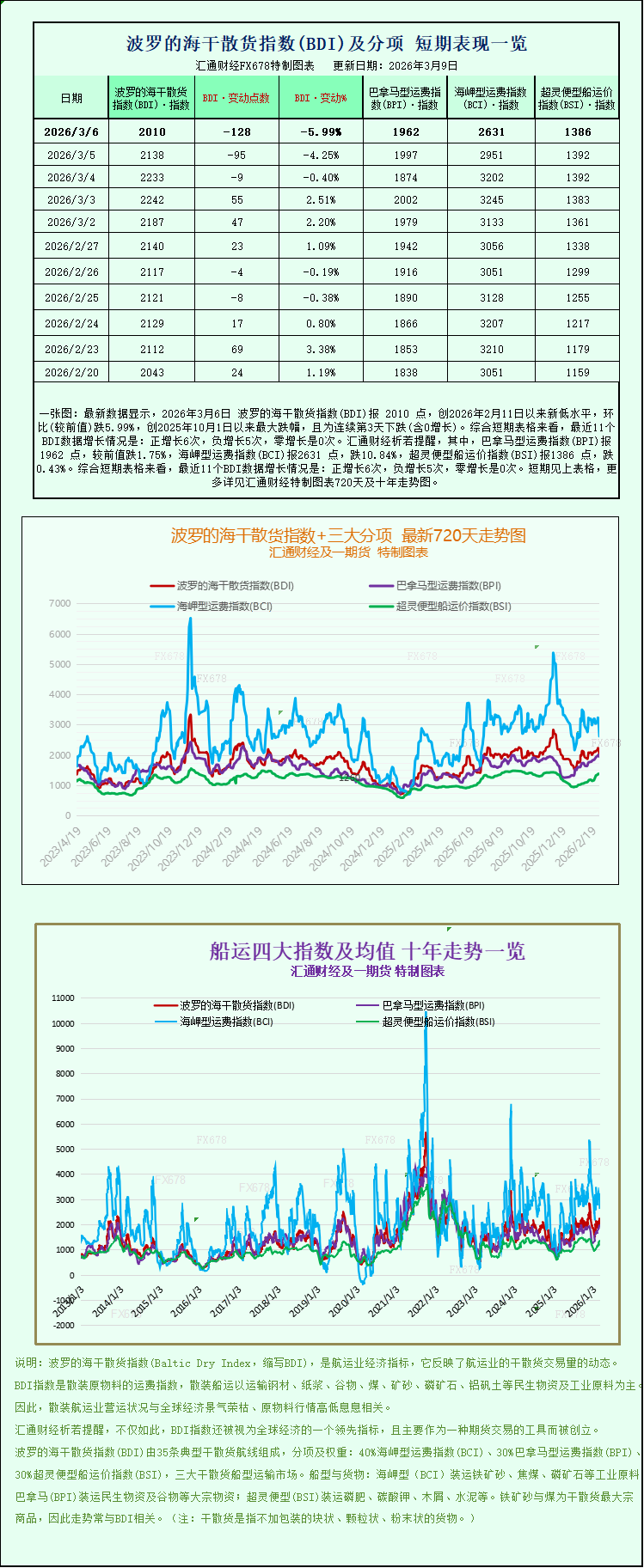
The Baltic Dry Index, which covers freight rates for the three main vessel types—Capesize, Panamax, and Supramax—fell sharply by 128 points, or 6%, to close at 2010 points. This drop was one of the largest single-day declines in recent times, becoming a key signal of market weakness.
Among them, the Capesize freight rate index saw the most significant decline, plunging 320 points in a single day, a drop of 10.8%, closing at 2631 points. Capesize vessels are the mainstay large vessel type in the dry bulk shipping market, primarily undertaking the ocean-going transportation of bulk commodities such as iron ore and coal. A single vessel can carry up to 150,000 tons of cargo, and the sharp decline in its freight rates directly reflects the weak global demand for bulk dry bulk ocean shipping. As a result, the average daily profit of Capesize vessels also decreased by $2907, ultimately falling to $20355, leading to a significant reduction in operating income for shipowners.
It's worth noting that iron ore prices rose against the trend on Friday, in stark contrast to the weakening dry bulk freight rates. Although current demand in the iron ore market has declined, concerns about the supply chain have dominated, ultimately driving up iron ore prices.
The Panamax freight rate index also declined, falling 35 points, or 1.8%, to close at 1962 points. Panamax vessels, with a carrying capacity of 60,000 to 70,000 tons, primarily transport bulk cargo such as coal and grain, and their routes are mainly short to medium distances. The slight decrease in freight rates reflects a cooling demand in the regional dry bulk shipping market. Correspondingly, the average daily profit for Panamax vessels decreased by $314, falling to $17,656.
The Supramax freight rate index saw a relatively mild decline, falling slightly by 6 points, or 0.4%, to close at 1386 points. Supramax vessels, due to their high flexibility and suitability for small and medium-sized ports and multi-route transport, have become a supplementary force in the dry bulk shipping market. Their slight decline indicates that the market weakness has spread to various vessel sub-types, although the magnitude of the drop is relatively limited due to the characteristics of these vessel types.
The shipping market is also facing external impacts from geopolitical conflicts. Since the outbreak of the US-Iran conflict, the Strait of Hormuz, a vital shipping route in the Gulf region, has been largely closed to international shipping. The conflict has resulted in damage to at least nine vessels, and the disruption of shipping through the strait has become a major uncertainty factor in the global shipping market. However, compared to the oil and gas shipping market, the impact of this geopolitical conflict on the dry bulk shipping market is relatively limited. Data shows that only about 4% of global dry bulk trade routes pass through the Strait of Hormuz. This relatively low percentage means that the dry bulk shipping market is less directly impacted by the disruption of shipping through the strait, serving as a significant buffer for the current dry bulk market.
Latest data shows that the Baltic Dry Index (BDI) closed at 2010 points on March 6, 2026, a new low since February 11, 2026, down 5.99% month-on-month, the largest drop since October 1, 2025, and marking the third consecutive day of decline (including zero growth). Looking at the short-term charts, the recent 11 BDI data points show: 6 positive increases, 5 negative increases, and 0 zero increases. Specifically, the Panamax Freight Index (BPI) closed at 1962 points, down 1.75% from the previous value; the Capesize Freight Index (BCI) closed at 2631 points, down 10.84%; and the Supramax Freight Index (BSI) closed at 1386 points, down 0.43%. For detailed 720-day and 10-year trend charts of the Baltic Dry Index and its three main sub-indices, please refer to the specially designed charts.
The Baltic Dry Index, which covers freight rates for the three main vessel types—Capesize, Panamax, and Supramax—fell sharply by 128 points, or 6%, to close at 2010 points. This drop was one of the largest single-day declines in recent times, becoming a key signal of market weakness.
Among them, the Capesize freight rate index saw the most significant decline, plunging 320 points in a single day, a drop of 10.8%, closing at 2631 points. Capesize vessels are the mainstay large vessel type in the dry bulk shipping market, primarily undertaking the ocean-going transportation of bulk commodities such as iron ore and coal. A single vessel can carry up to 150,000 tons of cargo, and the sharp decline in its freight rates directly reflects the weak global demand for bulk dry bulk ocean shipping. As a result, the average daily profit of Capesize vessels also decreased by $2907, ultimately falling to $20355, leading to a significant reduction in operating income for shipowners.
It's worth noting that iron ore prices rose against the trend on Friday, in stark contrast to the weakening dry bulk freight rates. Although current demand in the iron ore market has declined, concerns about the supply chain have dominated, ultimately driving up iron ore prices.
The Panamax freight rate index also declined, falling 35 points, or 1.8%, to close at 1962 points. Panamax vessels, with a carrying capacity of 60,000 to 70,000 tons, primarily transport bulk cargo such as coal and grain, and their routes are mainly short to medium distances. The slight decrease in freight rates reflects a cooling demand in the regional dry bulk shipping market. Correspondingly, the average daily profit for Panamax vessels decreased by $314, falling to $17,656.
The Supramax freight rate index saw a relatively mild decline, falling slightly by 6 points, or 0.4%, to close at 1386 points. Supramax vessels, due to their high flexibility and suitability for small and medium-sized ports and multi-route transport, have become a supplementary force in the dry bulk shipping market. Their slight decline indicates that the market weakness has spread to various vessel sub-types, although the magnitude of the drop is relatively limited due to the characteristics of these vessel types.
The shipping market is also facing external impacts from geopolitical conflicts. Since the outbreak of the US-Iran conflict, the Strait of Hormuz, a vital shipping route in the Gulf region, has been largely closed to international shipping. The conflict has resulted in damage to at least nine vessels, and the disruption of shipping through the strait has become a major uncertainty factor in the global shipping market. However, compared to the oil and gas shipping market, the impact of this geopolitical conflict on the dry bulk shipping market is relatively limited. Data shows that only about 4% of global dry bulk trade routes pass through the Strait of Hormuz. This relatively low percentage means that the dry bulk shipping market is less directly impacted by the disruption of shipping through the strait, serving as a significant buffer for the current dry bulk market.
- Risk Warning and Disclaimer
- The market involves risk, and trading may not be suitable for all investors. This article is for reference only and does not constitute personal investment advice, nor does it take into account certain users’ specific investment objectives, financial situation, or other needs. Any investment decisions made based on this information are at your own risk.